










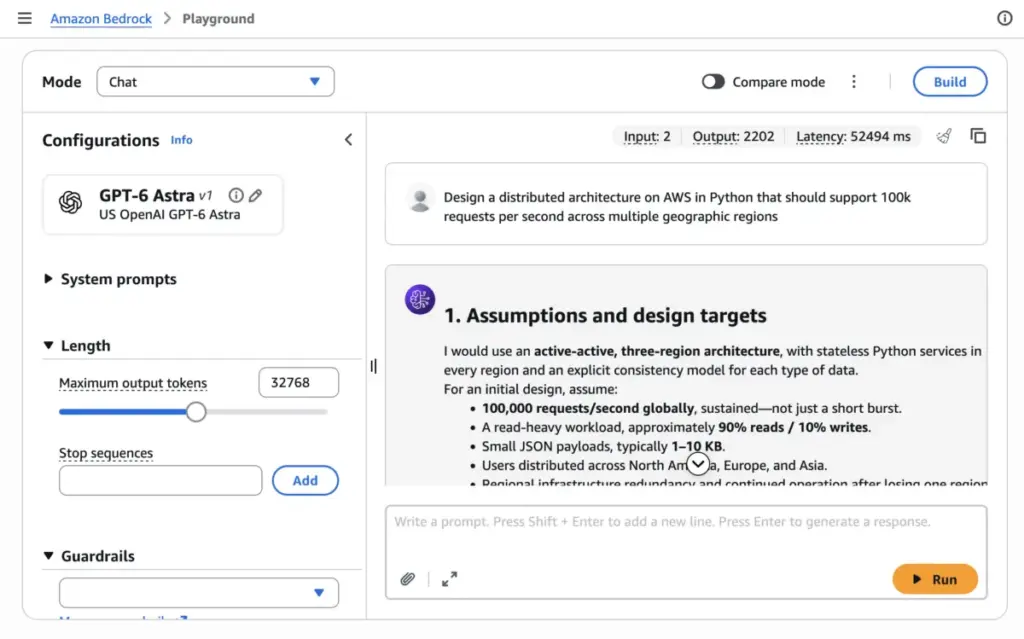
As the crisp air of mid-September settles over New York City, the rhythm of the professional world has shifted into high gear. The seasonal transition, marked by the familiar return of sweater weather and the bustling pace of city life, is mirrored by a surge of activity within the AWS ecosystem. For developers and enterprise architects, this week is defined by a significant expansion in generative AI capabilities, headlined by the integration of OpenAI’s most advanced frontier model, GPT-6 Astra, into Amazon Bedrock. This development serves as a poignant reminder that the true competitive advantage for organizations today lies not merely in the adoption of sophisticated tools, but in the fundamental shift in how developers leverage AI agents to transform complex workflows.
The Arrival of GPT-6 Astra on Amazon Bedrock
The most significant headline to emerge from the AWS launch calendar this week is the general availability of OpenAI’s GPT-6 Astra on Amazon Bedrock. Representing OpenAI’s latest and most capable iteration of its frontier model technology, the integration into Bedrock marks a pivotal moment for businesses looking to scale their AI-driven operations. GPT-6 Astra is engineered to handle a new class of professional demands, offering enhanced reasoning capabilities, sharper judgment, and the ability to produce high-fidelity writing and design outputs.
One of the most transformative features of this release is the model’s expanded context window, which supports up to 1 million input tokens. This massive capacity allows organizations to ingest and process entire codebases, lengthy legal contracts, or vast collections of disparate documents in a single prompt. By doing so, the model enables users to reconcile competing inputs or identify nuances across massive datasets that would be practically impossible for human teams to synthesize manually. Furthermore, the model introduces advanced computer and browser-use capabilities, allowing it to navigate digital interfaces to assist with intricate, multi-step business workflows.
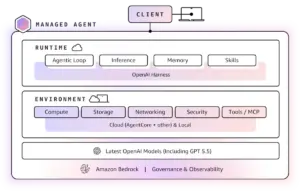
For current AWS customers, accessing this power is designed to be seamless. The model can be invoked via standard Amazon Bedrock APIs, or, for those utilizing the ChatGPT Work and Codex platforms, it can be configured as the underlying engine. To complement the launch, OpenAI is also rolling out new enterprise-grade plugins for ChatGPT Work, specifically designed to extend Astra’s browser-interaction capabilities across common business applications.
Crucially, this integration adheres to the high security and governance standards that AWS customers expect. By leveraging established AWS controls, organizations can secure their workloads, govern granular access to the model, and maintain a clear audit trail of all model invocations. Perhaps most importantly for enterprise security officers, OpenAI and AWS have confirmed that inference data used with GPT-6 Astra on Bedrock is not utilized for the training of future models, ensuring that proprietary business logic and sensitive information remain private and protected within the user’s environment.
Shifting Paradigms in AI Development
The integration of GPT-6 Astra is more than just a performance upgrade; it highlights an evolving philosophy in the software development community. As the industry matures, the focus is shifting away from the novelty of generative AI toward the practical application of AI agents. Developers who are seeing the most significant gains in productivity and innovation are those who have moved beyond using AI for simple text generation. Instead, they are reimagining their entire development lifecycle, treating AI agents as collaborative partners that can reason, plan, and execute tasks across distributed systems.
This "different way of working" involves moving away from rigid, manual scripting and toward dynamic, agentic workflows. By utilizing models that can understand context at the scale of 1 million tokens, developers can offload the "heavy lifting" of documentation reconciliation, bug analysis, and cross-platform automation to the model. The result is a workflow where the human engineer acts more as an architect and editor, guiding the agent through complex challenges rather than performing the rote implementation of every line of code or logic.
Keeping Pace with the AWS Ecosystem
While the launch of GPT-6 Astra dominates the conversation, it is part of a broader, continuous stream of innovation emanating from AWS this week. The rapid cadence of updates can be difficult to track, but it is essential for builders to remain informed about the latest tools and services that can enhance their infrastructure.

For those looking to stay ahead of these developments, the "What’s New with AWS" page serves as the primary source for real-time announcements. Whether it is an incremental update to a storage service, a new regional availability for a database engine, or the introduction of a specialized developer tool, these updates collectively contribute to the robust, scalable nature of the AWS cloud. Similarly, the AWS Blogs platform continues to be a vital resource for deep dives, architectural guidance, and technical insights that bridge the gap between abstract concepts and practical implementations.
Beyond the technical documentation, the human element of building remains a core pillar of the AWS experience. The AWS Builder Center stands out as a critical hub for developers, architects, and data scientists to connect with their peers. It is a space designed not just for learning, but for the exchange of solutions and the cultivation of a community that understands the unique pressures and possibilities of modern cloud-native development. Engaging with these communities—whether through virtual forums, regional meetups, or large-scale conferences—is an increasingly important component of professional growth in an era where the technology stack changes on a weekly basis.
As the industry moves through the remainder of the year, the focus on AI integration will only intensify. The deployment of frontier models like GPT-6 Astra onto managed platforms like Bedrock provides a stable, secure foundation for enterprises to experiment, build, and deploy at scale. It is a time of immense opportunity, provided that teams remain disciplined in their governance and creative in their approach to agentic workflows.
For those looking to stay connected, the weekly rhythm of the AWS ecosystem continues to offer new avenues for exploration. The coming weeks promise further refinements, additional model integrations, and new tools that will inevitably challenge current assumptions about what is possible in the cloud. Staying attuned to these updates is not merely a matter of keeping up with industry trends; it is a fundamental requirement for anyone building the future of enterprise software. As we look ahead to the next cycle of announcements, it is clear that the integration of powerful, agentic AI into the daily toolkit of the modern developer is no longer a distant ambition, but a current, actionable reality.