









Python has long maintained its status as a dominant force in data science, scientific computing, and artificial intelligence, largely due to its expressive syntax, readability, and vast ecosystem of specialized libraries like NumPy. However, that flexibility often comes at a steep cost in runtime efficiency. When developers encounter performance bottlenecks—typically hidden inside heavy numerical loops—they are frequently forced to step outside the ecosystem. Standard workarounds involve dropping down to lower-level languages like C or C++, or painstakingly refactoring code to fit complex vectorization patterns that may resist straightforward transformation.
For data scientists and software engineers seeking a seamless solution, the Numba library offers an alternative that bypasses these traditional hurdles. Rather than abandoning the Python environment, Numba compiles numeric Python loops directly to optimized machine code on the fly. Yet, developers sometimes find that their compiled code fails to deliver the expected performance gains. According to performance diagnostics and recent benchmarks tested against Numba version 0.67.0, the compiler itself is rarely the source of disappointment. Instead, performance bottlenecks usually stem from inefficiencies at the boundary around the compiled code: failing to cross the boundary effectively, keeping the compilation scope too narrow, or crossing that boundary redundantly on every execution iteration.
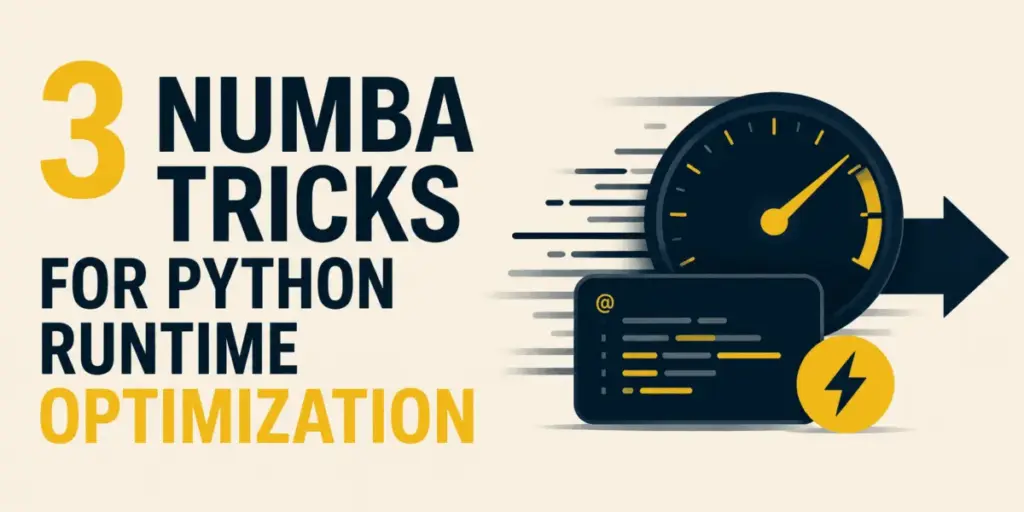
To address these common pitfalls and maximize execution speed, developers can leverage three foundational optimization strategies. These approaches share a common underlying principle focused on managing the compilation boundary, scaling computational workloads across hardware resources, and eliminating redundant overhead.

Compiling the Loop Instead of Interpreting It
The foundational performance issue in standard Python centers on dynamic typing and interpreter overhead. Consider a routine performing a reduction over a large NumPy array, such as calculating the cumulative sum of mathematical operations across ten million elements. In plain Python, the interpreter must dispatch on data types for every single element, resulting in millions of costly type checks that severely degrade execution speed.
To mitigate this without leaving Python, developers can apply the njit decorator—short for "nopython" Just-In-Time compilation. When Numba encounters a decorated function for the first time, it reads the input types, compiles a specialized machine-code version tailored to those types, and executes native code for all subsequent calls.
In comparative benchmarks involving ten million floating-point elements, a plain Python loop struggles significantly, taking over three seconds to complete the calculation. By contrast, applying the @njit decorator transforms the execution profile entirely. While the very first call incurs a minor overhead cost to handle JIT compilation, subsequent executions run at a fraction of the time required by standard interpretation.
Vectorized NumPy operations offer a strong alternative, frequently outperforming interpreted code by leveraging underlying C implementations. However, a Numba-compiled loop can often surpass even native vectorization by avoiding the creation of intermediate temporary arrays and executing the operations within a unified machine-code loop. Nevertheless, nopython mode retains strict constraints. Developers must ensure that the operations inside the hot function remain entirely within the subset of Python and NumPy data types that the compiler can successfully analyze and assign types to.
Spreading the Loop Across Every Core
While compiling a loop to native machine code delivers dramatic speedups, a standard JIT-compiled function still executes within a single processing thread on one CPU core. Modern computing hardware, however, almost universally features multi-core processors capable of handling parallel workloads. Numba bridges this capability gap through native support for multithreading, requiring only minor syntax adjustments to distribute computational tasks across all available processor cores.
By introducing the parallel=True argument to the decorator and swapping the standard Python range() function for Numba’s prange(), the compiler attempts to automatically parallelize the execution loop. The core logic of the function remains completely unchanged. When executed, Numba analyzes the loop structure—specifically identifying patterns like cumulative additions or reductions—and splits the iteration range across multiple threads. Each thread operates on a private accumulator before combining the final results at the end of the execution cycle.
In multi-core performance tests, this parallelized execution yields a massive leap in efficiency. Standard reduction patterns, as well as operations involving subtraction, multiplication, division, and finding maximum or minimum values, are recognized automatically by the compiler. This allows developers to scale their computational throughput dramatically without needing to write complex manual thread-management code or leverage external multiprocessing libraries.
Paying the Compile Cost Only Once
Although JIT compilation provides incredible execution speeds, the compilation process itself consumes computational resources. Because compilation typically occurs dynamically during the first function call, a fresh script process will pay that computation cost repeatedly every time it launches. For scripts executed infrequently, this overhead is entirely negligible. However, for internal tools, automated pipelines, or backend services executed dozens of times an hour, the cumulative compilation time can become a significant performance tax.
To eliminate this redundant overhead, developers can utilize the cache=True parameter alongside parallel execution. This configuration instructs Numba to write the compiled machine code directly to disk, storing it in a cache file alongside the original source code. During subsequent script executions, Numba bypasses the compilation phase entirely, loading the pre-compiled binary straight from disk into memory.
While cached execution provides a seamless startup experience, it requires careful management. Global variables read by a cached function are permanently frozen at their compile-time values and will not dynamically rebind when the cache is loaded later. Furthermore, cache invalidation mechanisms may fail to detect modifications made to helper functions defined in separate external files, potentially leaving a system running outdated compiled code until the cache is manually cleared. Ensuring that cache hits are functioning correctly remains an important verification step for production deployments.
Optimizing Python runtimes with Numba ultimately comes down to strategic boundaries: determining whether computational work resides inside the compiled domain, ensuring the entire execution machine operates within that domain, and eliminating the penalty of crossing compilation boundaries more than once. By compiling the loop, scaling it across multiple hardware cores, and caching the resulting binaries, developers can achieve C-level performance while retaining the readability and agility of the Python ecosystem.