









For organizations operating at scale, the promise of serverless architecture—agility, reduced operational overhead, and simplified infrastructure—can sometimes become obscured by the realities of complex, multi-account deployments. Organizations building event-driven applications on Amazon EventBridge have traditionally relied on a single custom event bus within a single account as their starting point. While this approach is effective for smaller, centralized teams, the model often buckles under the weight of organizational growth. As adoption spreads across different business units, AWS best practices dictate a move toward a multi-account structure, where each team manages its own isolated environment.
To bridge the gap between these accounts, engineers have historically been forced to implement intricate workarounds, such as cross-account rules or complex bus-to-bus configurations. While functional, these workarounds inadvertently reintroduce the very operational complexity that serverless design aims to eliminate. Platform teams often find themselves struggling with fragmented visibility, unable to easily track which teams are subscribing to specific events. Furthermore, the financial overhead of cross-account and bus-to-bus routing charges can compound rapidly, and developers requiring advanced features like strict event ordering are frequently left with no choice but to build custom, fragile solutions or adopt entirely disparate technologies.
In a move to resolve these friction points, AWS has announced a significant evolution in its event-driven toolkit: the new enhanced custom event bus for Amazon EventBridge. This new offering is purpose-built to serve as a unified, centralized backbone for organizations scaling event-driven applications across diverse teams and AWS accounts. By providing a single bus shared across an entire organization, the enhanced custom event bus delivers critical improvements, including native ordering guarantees, a simplified subscriber resource model, and a transparent, modernized pricing structure designed to provide improved economics at scale.
Rethinking Architecture at Scale
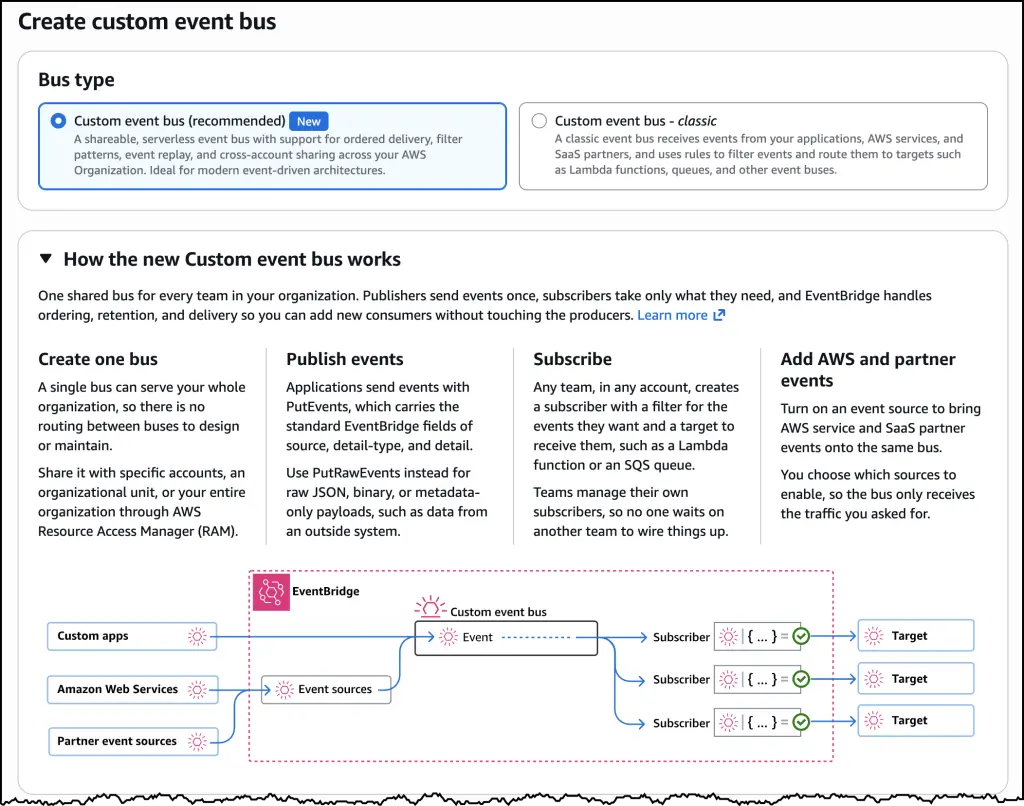
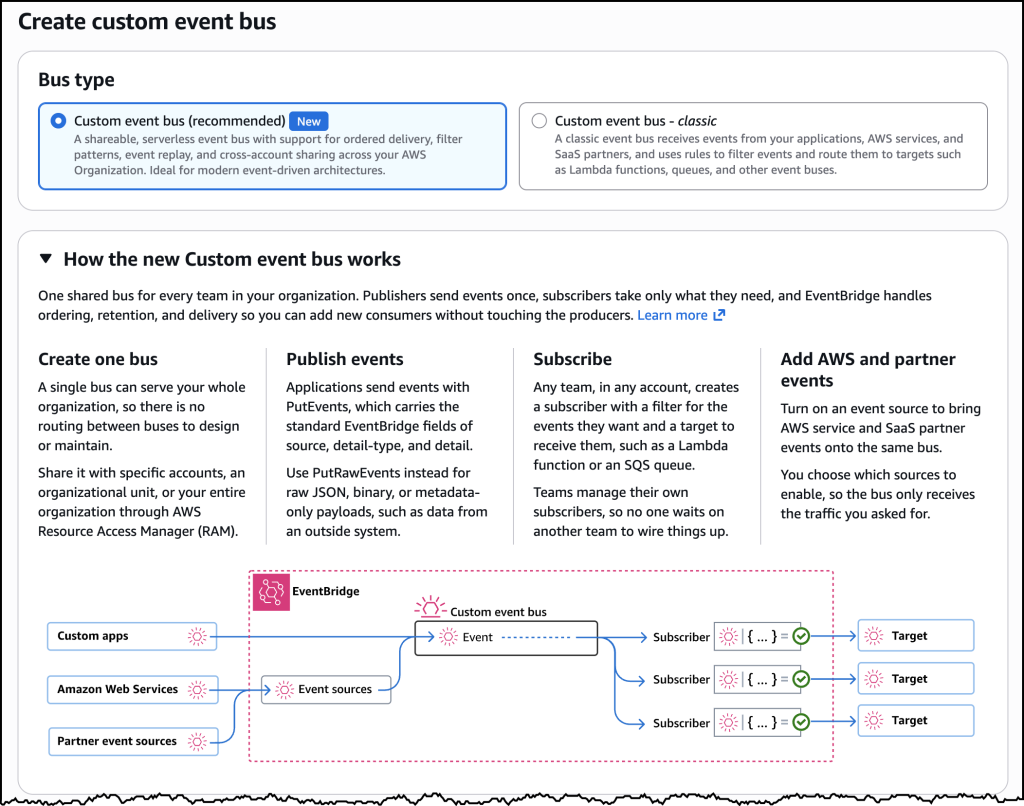
To begin exploring this new capability, administrators can navigate to the EventBridge console, where the "Create custom event bus" workflow has been updated. Users are now presented with two distinct paths: the recommended "Custom event bus" (the new, enhanced version) and the "Custom event bus – classic," which remains fully supported for existing workloads. This dual-path approach ensures that teams can adopt the new technology at their own pace without disrupting legacy event-driven flows.

The core value proposition of the enhanced bus lies in its ability to act as a singular, organization-wide infrastructure. Instead of managing a web of interconnected buses, platform teams can deploy one central hub that serves every team in the organization. Publishers simply send their events to this central point, while subscribers consume only the data they require. Behind the scenes, EventBridge abstracts the heavy lifting of routing, delivery, retention, and—crucially—ordering.
The integration with existing AWS security and governance tools is seamless. By leveraging AWS Resource Access Manager (AWS RAM), organizations can configure sharing settings directly within the console. Administrators can grant access at the level of individual AWS account IDs, entire organizations, or specific organizational units. They can also share access with specific AWS Identity and Access Management (IAM) roles or users. This reliance on established IAM and resource management frameworks means that the days of manually managing complex cross-account permissions or brittle bus-to-bus routing policies are largely over. Once configured, application teams can immediately begin publishing and subscribing without waiting for centralized infrastructure provisioning, significantly increasing the velocity of development.
Solving for Order and Reliability
One of the most frequent challenges in distributed event-driven systems is the assumption of asynchronous, out-of-order processing. While this works for many use cases, specific domains—such as logistics, financial transactions, or state-sensitive updates—require strict sequence. For instance, in a system tracking real-time driver location updates, processing events out of sequence can lead to stale data, triggering incorrect routing decisions.
The enhanced custom event bus addresses this by offering a native solution that handles both ordered and unordered patterns on the same bus. Publishers can assign an EventGroupId to their events. EventBridge then ensures that events sharing the same ID are delivered in the exact sequence in which they were received to subscribers who opt for ordered delivery. Meanwhile, other consumers on the same bus can continue to process those same events asynchronously, without the overhead or latency associated with strict ordering.

Furthermore, to bolster reliability, the enhanced bus introduces synchronous invocation for targets like AWS Lambda. By entering synchronous mode, the system confirms that an event has been successfully processed before acknowledging it. This shift eliminates the common, albeit cumbersome, architectural pattern of placing Amazon Simple Queue Service (SQS) buffers between an event bus and Lambda just to ensure data integrity.
Simplifying Subscriber Management
The introduction of the "Subscriber" resource marks a major shift in how developers interact with EventBridge. Previously, a single consumer’s needs were spread across multiple, disparate configurations—rules, targets, retry policies, and dead-letter queue settings. The new Subscriber resource collapses these into a single, cohesive unit. This simplification makes it significantly easier for teams to define exactly what events they need, where they should be routed, and how the system should handle failures.
In addition to management, the new subscriber model includes variable start time options. This is a powerful feature for onboarding new teams, as it allows developers to "hydrate" new applications with historical events or perform replays to recover from application-level errors. By decoupling the definition of the subscriber from the underlying infrastructure, AWS has made it far simpler to maintain, audit, and troubleshoot event consumption.
Advanced Data Handling and Deduplication
Data quality and consistency are paramount in high-throughput systems. The enhanced bus introduces content-based deduplication, which empowers EventBridge to automatically detect and discard retries of the same event. By hashing key parts of the payload, the service can collapse duplicate events that arrive within a five-minute window. This provides "exactly-once" delivery semantics for sources that might otherwise struggle to identify retries, moving beyond the traditional "at-least-once" model. While developers who already use their own idempotency tokens are encouraged to continue doing so, this new feature provides a robust safety net for scenarios where such tokens are not available.
Data transformation has also been upgraded. Subscribers can now utilize JSONata expressions to reshape event payloads on the fly. This means that if a downstream API requires a specific field structure, the transformation can happen at the bus level, preventing the need for custom mapping logic inside the consumer’s code. Additionally, for teams working with formats like Apache Avro or Protocol Buffers, EventBridge can now deserialize these payloads into JSON. This allows subscribers to perform fine-grained filtering and routing on the full event content without the burden of manually deserializing every message themselves.
Economics and Availability
The financial model of the enhanced custom event bus is as modern as its feature set. AWS has moved to a new throughput-based pricing model for ingress and egress, where publishers pay for events ingested and subscribers pay for events delivered. This replaces the legacy per-event pricing, which often penalized multi-bus architectures with compounding cross-account fees. By simplifying the cost structure, AWS provides more predictable economics for large-scale deployments, allowing teams to better align their infrastructure costs with their actual usage patterns.
The enhanced custom event bus is available immediately across a broad range of AWS Regions, including US East (N. Virginia, Ohio), US West (Oregon), Europe (Ireland, Frankfurt, Stockholm, Spain), and across several Asia Pacific hubs such as Sydney, Tokyo, and Singapore. Organizations can begin migrating to or adopting this new model through the AWS Management Console, the AWS Command Line Interface (CLI), or the EventBridge APIs. As organizations continue to push the boundaries of serverless, this centralized, feature-rich event bus represents a significant step forward in reducing the friction of operating at scale, allowing engineering teams to focus more on building business logic and less on the complexities of cross-account event routing.