The developer ecosystem surrounding the Model Context Protocol (MCP) has undergone a significant architectural transformation following a major update to its core specification. According to recent technical releases, the protocol core has officially shifted to a stateless model, fundamentally altering how modern clients and servers interact across network infrastructures.
Under the updated framework, modern clients are no longer required to establish a formal protocol session before transmitting requests, and servers have dropped their reliance on traditional session identifiers for ordinary interactions. This transition is designed to simplify the deployment of MCP servers behind standard HTTP infrastructure, making it considerably easier for engineering teams to scale their AI integrations using conventional load balancing and multi-worker environments.
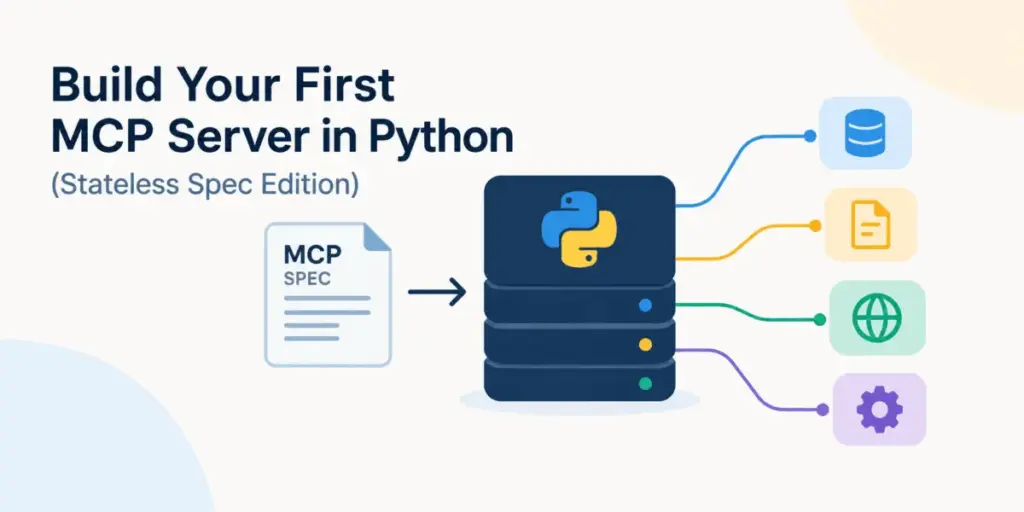
Simultaneously, the official Python Software Development Kit has advanced to version two as its stable production line, introducing a higher-level server programming interface designed to streamline how developers define tools, resources, and prompts. Rather than forcing engineers to write complex boilerplate code or manual JSON schemas, the updated Python interface allows developers to expose application functions directly to language models using standard language features.
To demonstrate the practical implications of this architectural shift, industry engineers have begun testing stateless implementations using developer knowledge-base servers. These applications typically expose a trio of core primitives: tools that allow models to search external information sources, resources that provide static data to host applications, and prompt templates designed to standardize user interactions. Because the updated protocol core is entirely stateless, every incoming request contains all the information required for processing, eliminating the need for sticky routing or shared memory caches across server instances.
The evolution of the Python SDK highlights a growing emphasis on developer experience within the artificial intelligence tooling space. By leveraging native type hints and standard function signatures, the framework automatically generates input schemas and parameter definitions without requiring manual manifest creation. This means that an ordinary function designed to query a database or search a document repository can double as an AI-accessible tool simply by applying a framework decorator.
Furthermore, the distinction between tools, resources, and prompts has been clarified within the updated specification. Tools function similarly to action-oriented operations that models can invoke autonomously to perform specific tasks, whereas resources provide readable data that host applications can load into context, paralleling standard retrieval patterns. Prompt templates, meanwhile, remain available to standardize repetitive user workflows, all managed through a unified server interface.
The operational benefits of the stateless specification become particularly apparent when deploying applications in high-traffic production environments. In older iterations of the protocol, maintaining long-lived sessions required infrastructure to track connection states across multiple round trips, often complicating horizontal scaling. Under the revised specification, individual requests can be routed to any available worker instance in a cluster without breaking the logical flow of conversation or tool execution. This allows development teams to spin up multiple worker processes behind standard web servers without worrying about session affinity.
For developers seeking to maintain application-level state—such as shopping carts or user-specific workflows—the protocol maintainers recommend an explicit-handle pattern. Rather than concealing state within a protocol-level session identifier, applications pass identifiers explicitly through tool arguments and return values. This ensures that the model and the application remain synchronized while keeping the underlying transport layer entirely stateless.
As the artificial intelligence industry continues to mature, updates of this nature reflect a broader industry push toward robust, production-ready infrastructure standards. By removing unnecessary protocol overhead and aligning more closely with standard web architecture, the Model Context Protocol aims to make agentic workflows as straightforward to deploy and scale as traditional web services.