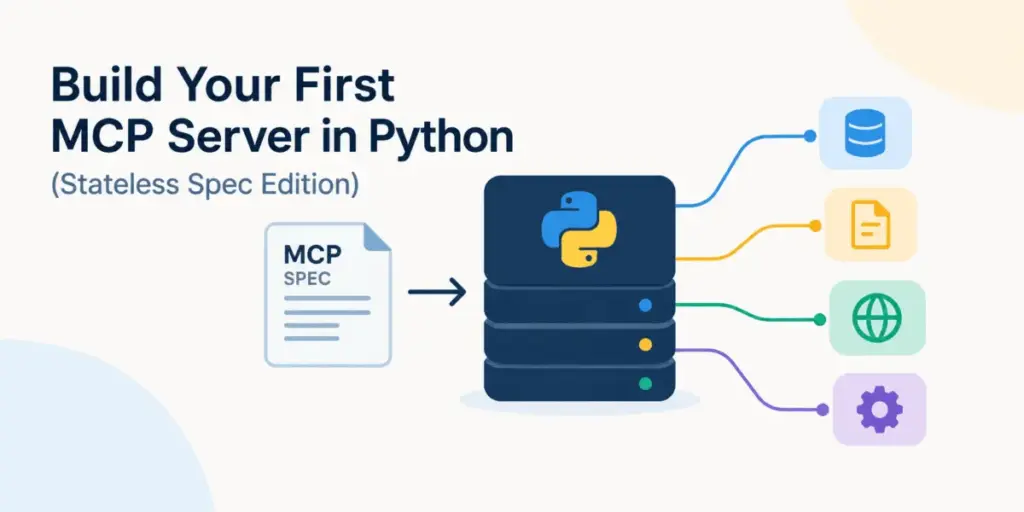
The ecosystem surrounding the Model Context Protocol (MCP) has undergone a significant architectural transformation following a major update to its core specification and the stabilization of its official Python software development kit. The changes, introduced through the July 2026 specification update, fundamentally shift the protocol from a stateful, session-bound model to a streamlined, stateless architecture. This shift makes it dramatically easier for developers to build, scale, and deploy MCP servers behind standard HTTP infrastructure without the operational overhead of managing sticky routing or persistent connection state.
Alongside the protocol update, the official Python SDK has advanced to version 2, introducing a high-level MCPServer application programming interface. This new interface allows engineers to define complex tools, resources, and prompt templates using ordinary Python functions and standard type hints, eliminating the need for manual JSON schema definitions or complex boilerplate code.
Understanding the Stateless Architecture Shift
To appreciate the significance of the recent protocol changes, it helps to examine how the Model Context Protocol previously operated. In earlier iterations of the specification, clients were required to establish a formal protocol session before making requests. This handshake generated a specific session identifier, such as an Mcp-Session-Id, which had to be included in subsequent requests to tie them to the same logical interaction.

While this stateful approach supported bidirectional communication, it introduced substantial complexity in production environments. Multi-instance deployments of MCP servers required sticky routing configuration to ensure that requests from a specific client session always landed on the same server worker. If a container restarted or traffic was rebalanced across a cluster without preserving session affinity, the connection state would break.
The updated specification resolves this friction by removing the requirement for modern clients to establish a protocol session before making requests. Ordinary requests no longer rely on session identifiers, turning the core protocol into a clean, self-contained request and response model. Each incoming request carries everything required for the server to process it independently.
This architectural evolution means that standard HTTP load balancers can distribute traffic freely across any available worker node without worrying about where previous requests were handled. For engineering teams deploying AI-driven infrastructure, this brings MCP services in line with standard cloud-native microservice design patterns, enabling effortless horizontal scaling using conventional tools like Uvicorn workers.
Building Modern Developer Knowledge Bases with SDK v2
The release of Python SDK v2 simplifies how developers implement MCP primitives, translating native Python code directly into protocol-compliant capabilities. Using the high-level MCPServer class, developers can instantiate a server, supply operational instructions, and expose tools, resources, and prompts with simple decorators.
Consider the implementation of a developer support knowledge base server. Rather than manually constructing verbose JSON schemas for tool manifests, developers simply write standard Python functions complete with type annotations and docstrings. The SDK automatically parses these signatures to generate the necessary input schemas for the LLM host. A search function taking a query string and an optional integer limit is automatically translated into a structured tool definition complete with required parameters and default values.
This design philosophy extends beyond executable tools to encompass resources and prompt templates. Resources function similarly to read-only data endpoints, comparable to standard HTTP GET requests, allowing host applications to load contextual information directly into memory without invoking autonomous tool calls. Meanwhile, reusable prompt templates provide structured guidance for generating specific types of responses, such as drafting concise technical support replies based on retrieved knowledge base articles.
Development and Deployment Workflows
The updated Python SDK includes robust tooling designed to streamline the developer feedback loop during local building and testing. By integrating development commands directly into the package ecosystem, developers can launch their servers alongside an interactive inspection interface. This tool provides a dedicated user interface for viewing registered primitives, inspecting generated schemas, and executing test queries against local functions before integrating them into a larger language model application.
When moving from local development to production-grade deployment, the server architecture adapts seamlessly to standard ASGI web servers. By exposing a streamable HTTP application interface, the MCP server can run as an independent network service or integrate directly as a component within larger web frameworks like FastAPI or Starlette. This flexibility allows organizations to embed protocol-compliant AI tooling directly into their existing API backends without introducing isolated, specialized infrastructure.
Managing Application State in a Stateless World
A common point of confusion surrounding the transition to a stateless protocol core is how applications handle persistent data like user shopping carts, active user sessions, or ongoing conversational context. Maintainers of the specification emphasize that a stateless protocol does not mean application logic cannot be stateful. Rather, the distinction lies in where that state lives.
Under the previous model, the protocol layer itself attempted to remember state through session management. Under the modern stateless specification, application state is managed explicitly by the application logic and identifiers travel transparently through the requests themselves. For example, rather than relying on a protocol session to track a user’s shopping basket, an application exposes tools that explicitly accept and return identifiers such as basket numbers or user tokens. The language model views these handles and passes them back and forth during execution, giving developers explicit control over how data persists across multiple steps of interaction.
Verifying Deployments with Modern Clients
To interact with these modern servers, the v2 Python SDK provides an updated client class capable of connecting directly to HTTP endpoints using streamable transport protocols. Developers can write lightweight verification scripts that connect to the server, query the negotiated protocol version, list available tools, and execute remote functions programmatically. This decoupling allows engineering teams to test their MCP servers rigorously without depending on third-party AI chat applications or complex desktop integrations.
Ultimately, the convergence of the stateless specification update and the streamlined v2 Python SDK removes much of the friction that previously accompanied protocol implementation. By allowing developers to rely on standard function signatures, familiar type hints, and conventional HTTP scaling infrastructure, the updated Model Context Protocol brings robust, production-ready AI tool integration well within the reach of standard Python engineering workflows.