Amazon Leo has missed its original target to launch commercial services by mid-2026, but the company insists it remains firmly on track to debut its low-Earth orbit (LEO) broadband network later this year. Leadership points to an aggressive acceleration in its manufacturing pipeline and an expanding fleet of operational satellites as the primary drivers keeping the late-2026 timeline achievable.
To date, Amazon Leo has successfully deployed 396 broadband satellites across 14 separate orbital missions. Out of that total batch, only four spacecraft have been deorbited, according to Zack Brown, a company communications manager who detailed the network’s progress in a recent corporate blog post.
The current size of the deployed fleet is considered large enough by mission planners to support an initial commercial service launch. While Amazon Leo has not yet pinned down a specific calendar date for the grand opening, executives maintain that the service will go live before the end of the year.

"We’re still doing work to raise them into final position, and there’s a lot of work on the ground to do. But the plan is to launch initial service in 2026," Chris Weber, Vice President of business and product at Amazon Leo, explained in an interview with Ars Technica.
Despite closing in on the launch window, Amazon Leo has kept several key commercial details under wraps. The company has yet to reveal its pricing structure or outline its go-to-market strategy. However, Weber hinted that the broadband service could eventually be bundled or cross-marketed with a variety of existing Amazon products and services. Potential integration paths include pairing the satellite internet with Amazon Prime and Prime Video subscriptions, eero mesh routers and extenders, Ring smart home doorbells, and Fire TV streaming devices, creating a tightly woven digital ecosystem for consumers.

1,000th Amazon Leo Satellite Recently Came Off the Line
Behind the scenes, the broader Amazon Leo program has achieved a major manufacturing milestone, crossing the threshold of producing more than 1,000 satellites at its massive 172,000-square-foot production facility located in Kirkland, Washington. Brown noted that fully assembled and tested Amazon Leo satellites are now being shipped down to launch sites in Florida every two or three days to keep pace with upcoming missions.
The Kirkland manufacturing plant is engineered for scale, boasting a peak production capacity of five satellites per day. This high-volume output is designed to maintain a robust and steady supply of spacecraft, ensuring that launch vehicles are never left waiting for payloads.
Rajeev Badyal, Vice President of Amazon Leo, emphasized just how rapidly the enterprise has scaled its engineering and assembly capabilities since inception. "It took us six months to make our first 27 satellites. Now we can easily make 27 a week. That’s how far we’ve come," Badyal told Ars Technica, illustrating the dramatic maturation of Amazon’s aerospace supply chain.
Deployment in the Early Stages
Despite the impressive manufacturing velocity inside the Kirkland plant, the current fleet in orbit represents only a fraction of Amazon Leo’s ultimate ambition. The company is authorized and committed to building and deploying a massive constellation consisting of 3,236 first-generation broadband satellites.
Regulatory timelines have required careful navigation. In June, Amazon Leo secured a 24-month extension from the Federal Communications Commission (FCC) for the first half of its constellation buildout. Even with the regulatory breathing room, the company retains its binding commitment to deploy 100 percent of its planned constellation by July 30, 2029. When Amazon originally applied for that timeline extension back in early February, it projected that it would have approximately 700 satellites in orbit by the end of July 2026. Given its current count of 396 operational spacecraft, it appears the company has fallen short of that specific internal milestone as well.
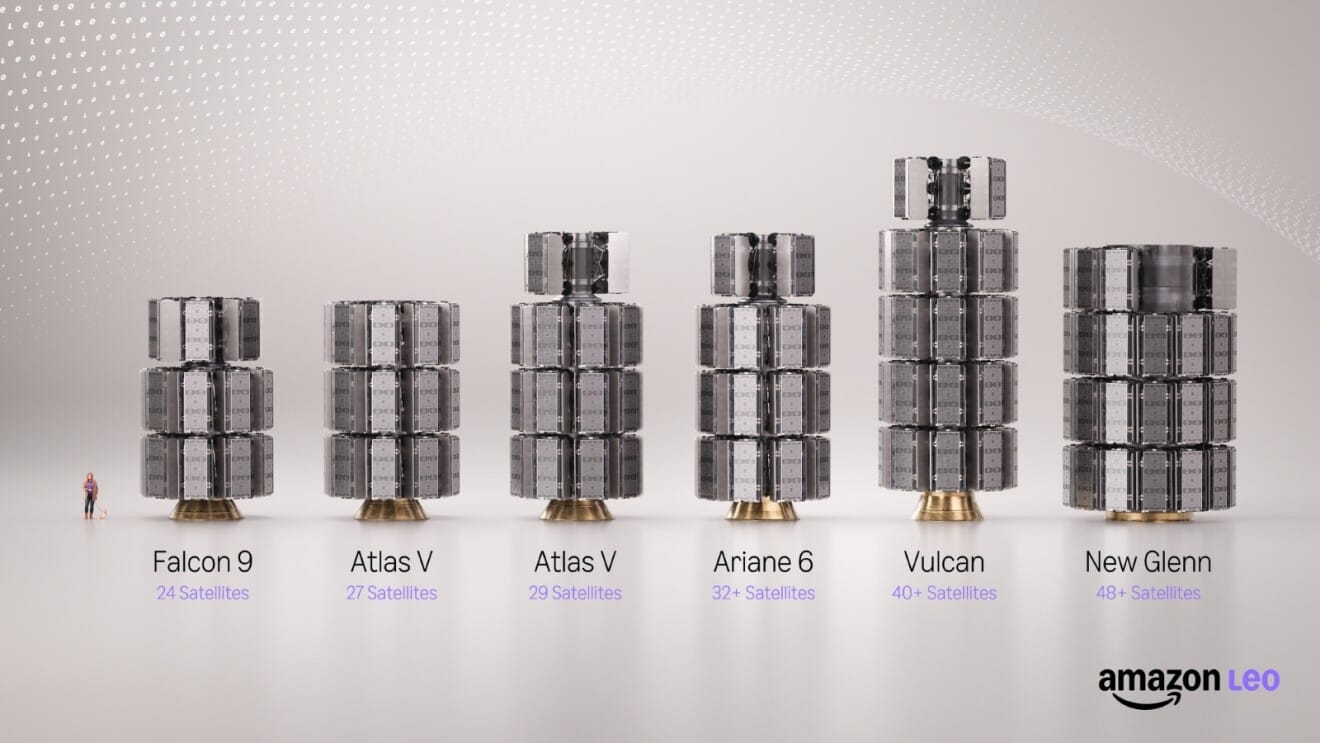
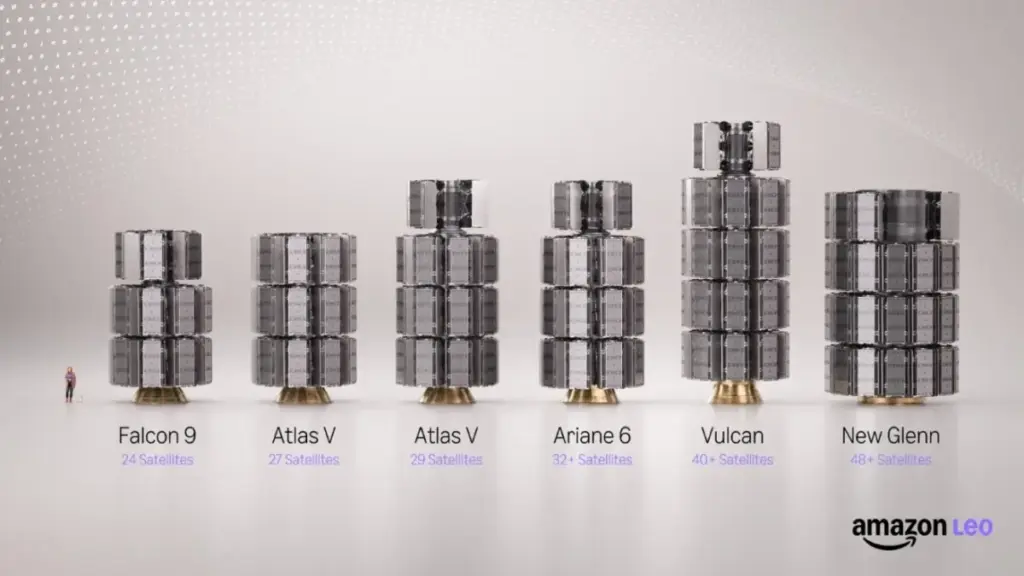
To close the gap, Amazon is actively shoring up its heavy-lift launch capacity. Brown noted that the tech giant has secured more than 100 launches spread across multiple aerospace partners. This multi-vendor strategy relies heavily on established heavy-launch providers like United Launch Alliance (ULA) and Arianespace, alongside Jeff Bezos’ commercial space enterprise, Blue Origin.
Ultimately, Amazon Leo’s rapid deployment schedule hinges on the operational success and readiness of next-generation rockets capable of lofting larger payloads into orbit in a single mission.
Badyal told Ars Technica that Amazon Leo is currently "weeks away" from its inaugural launch aboard ULA’s heavy-duty Vulcan rocket. Brown shared a similarly optimistic timeline regarding Amazon Leo’s upcoming integration with Arianespace’s Ariane 6 vehicle, a heavy-class rocket capable of carrying upwards of 32 Amazon Leo satellites in a single fairing. Meanwhile, Blue Origin’s heavy-lift New Glenn rocket—which suffered an explosion during a pre-launch ground test back in May—is intentionally designed to accommodate even larger satellite payloads once fully cleared for operational service.
As the company works toward its broadband rollout, Amazon Leo is also looking toward the future of mobile connectivity. The organization has formally filed a plan with the FCC seeking approval to deploy an additional constellation of more than 5,000 satellites dedicated to direct-to-device (D2D) services. Amazon aims to jumpstart its broader D2D strategy and accelerate its technical roadmap through its pending $11.5 billion acquisition of Globalstar, a move that recently included a new strategic partnership pact with Apple.