On October 1, 2026, Nigeria officially transitioned its national postcode system from a legacy six-digit format to a granular 11-character alphanumeric code capable of identifying individual buildings, such as EK-01-A03-FK-01. While this modernization represents a significant leap forward for national infrastructure and logistics, it has introduced a major vulnerability for software systems powered by artificial intelligence. Language models trained on data predating the shift continue to rely on the obsolete six-digit structure with complete confidence, creating systemic failures for both coding agents writing validation logic and runtime agents processing customer inputs.
The discrepancy poses a dual threat to modern software development. Coding agents tasked with generating validation rules consistently fall back on obsolete patterns from their training data, ignoring current realities even when provided with web-search capabilities and explicit prompts detailing the correct date. Meanwhile, runtime agents tasked with extracting delivery information from customer messages risk processing hallucinated codes that satisfy outdated assumptions while failing to align with real-world structures. Addressing this challenge requires establishing strict architectural boundaries, leveraging specialized libraries, and implementing robust deterministic checks that treat artificial intelligence models as untrusted data extractors rather than authoritative decision-makers.
The Challenge with Coding Agents and Legacy Training Data
When asked to generate Python, JavaScript, Rust, or Java code for validating Nigerian postcodes, modern coding assistants overwhelmingly default to the historical six-digit format. Even when evaluated in clean environments equipped with web-search tools and given the correct date of October 5, 2026, these models consistently produce legacy regex patterns from memory rather than performing the necessary search or adjusting to the new standard. This phenomenon stems from the fundamental nature of language models, which naturally reproduce the dominant patterns found within their training corpora. Because the 11-character Nigeria Digital Addressing and Postcode System (NDAPS) standard had little to no presence in historical training data, models default to what they know best.
Consequently, the code generated by these agents automatically rejects valid, contemporary postcodes. Developers can mitigate this issue at the source by embedding specific contextual instructions directly into project configuration files, such as editor rules or repository documentation. By explicitly defining the new 11-character standard and pointing the agent toward official technical resources like the open-source ng-postcode library ecosystem, developers can successfully steer coding assistants toward generating accurate validation logic. However, configuration rules can be easily ignored, overlooked, or outdated, leaving runtime environments vulnerable to unverified inputs.
Establishing Trust Boundaries in Runtime Environments
To secure production systems against model hallucinations and outdated assumptions, engineers must establish a clear trust boundary at runtime. Language models operating within live applications should be strictly relegated to a single, limited responsibility: extracting raw strings from unstructured user messages. Every subsequent operation—including structural parsing, registry verification, and geographic routing—must be handled by deterministic code rather than probabilistic model confidence.
The 11-character postcode structure lends itself naturally to this architectural separation. The code is divided into five distinct segments, where each successive component narrows the geographical scope. The initial two letters designate the state, followed by a two-digit local government area code, a three-character district identifier, a two-letter area code, and a final two-digit building unit designation. Because this architecture is rigorously structured, custom validation code can instantly identify structural anomalies offline without requiring external network calls or relying on model heuristics.
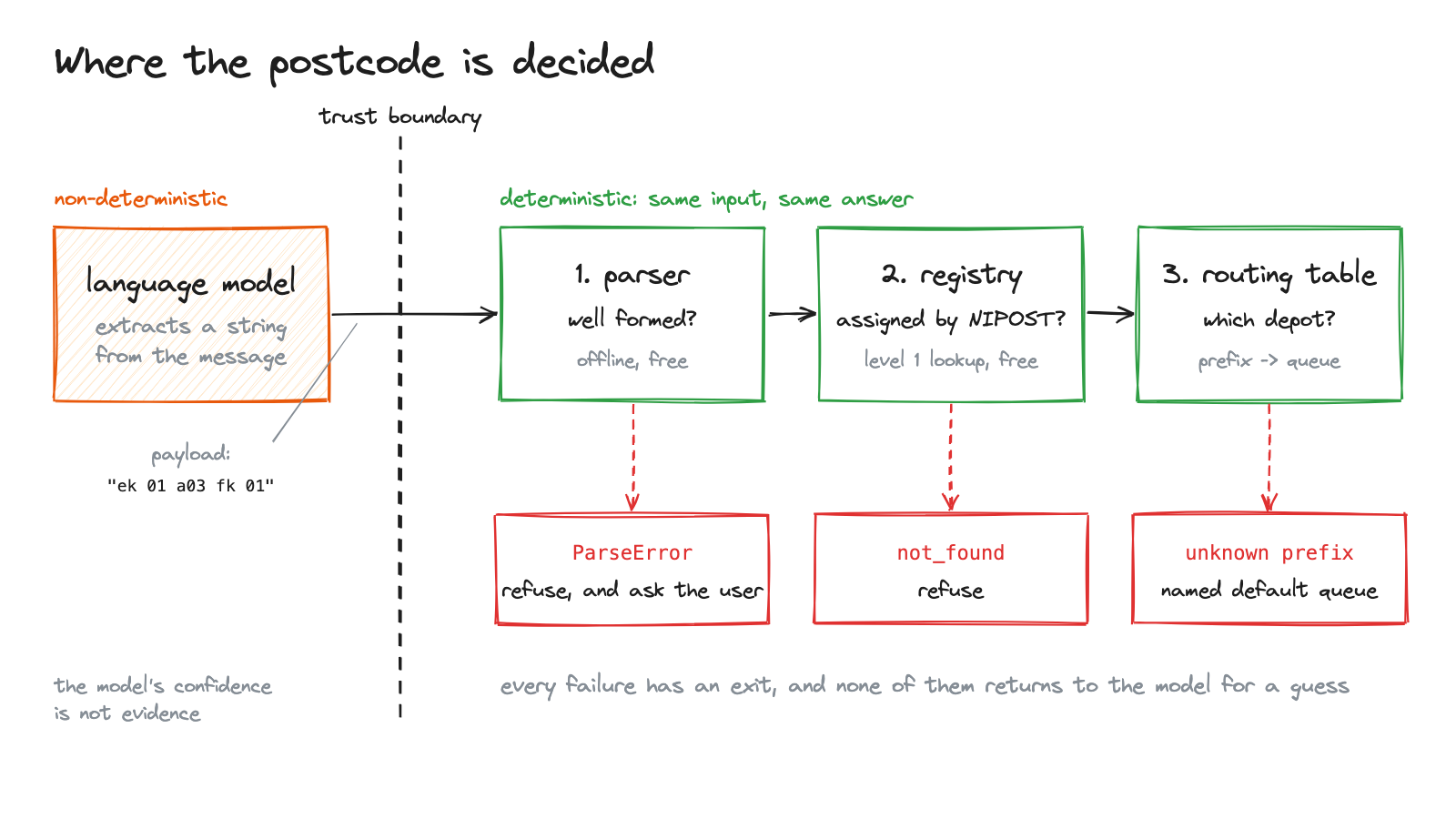
Implementing a strict validation gate ensures that every postcode produced by a model passes through comprehensive structural checks before entering downstream databases or third-party APIs. When a model extracts a mistyped or malformed string, the system can evaluate whether a close correction is possible while refusing to process the unconfirmed value automatically. Rather than allowing a probabilistic guess to trigger downstream actions, the system prompts the user to confirm the intended correction, ensuring that automated workflows never act on unverified assumptions.
Verifying Codes Against Official Registries
While structural parsing confirms that a given string is well-formed according to the rules of the NDAPS format, it cannot independently verify whether the Nigerian Postal Service has actually assigned that specific code to a physical building. A model can easily generate a string that perfectly matches the 11-character syntax while corresponding to a non-existent location. To eliminate this risk, systems must execute registry lookups against official endpoints using lightweight verification requests.
Initial lookups focus on confirming basic validity without incurring unnecessary costs or exposing sensitive location data. When an API key is properly configured, these registry checks distinguish between valid assigned locations, unassigned structural placeholders, and network connectivity failures. Handling these states explicitly prevents temporary network disruptions or invalid credentials from being misinterpreted as proof that a building does not exist.
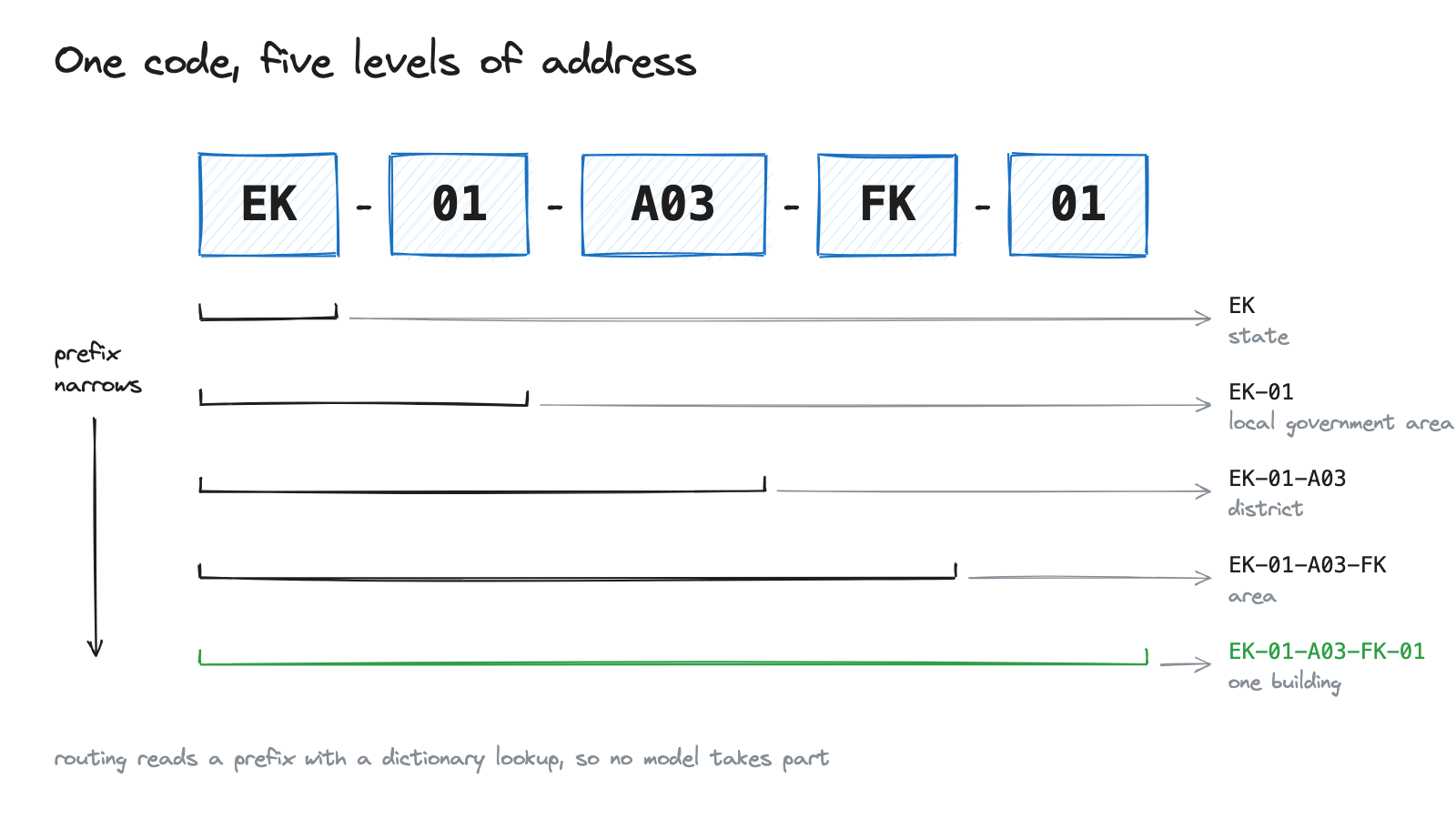
Furthermore, prefix-based routing leverages the hierarchical nature of the postcode to direct logistical workflows efficiently. Because the initial segments of the code correspond directly to administrative regions and local government areas, routing logic can be implemented as a reliable dictionary lookup rather than a free-text interpretation by a model. This guarantees that operational workloads are consistently routed to the appropriate depots or sorting queues based on verifiable data, preventing routing errors caused by ambiguous address descriptions.
Managing Failure States and Model Context Protocols
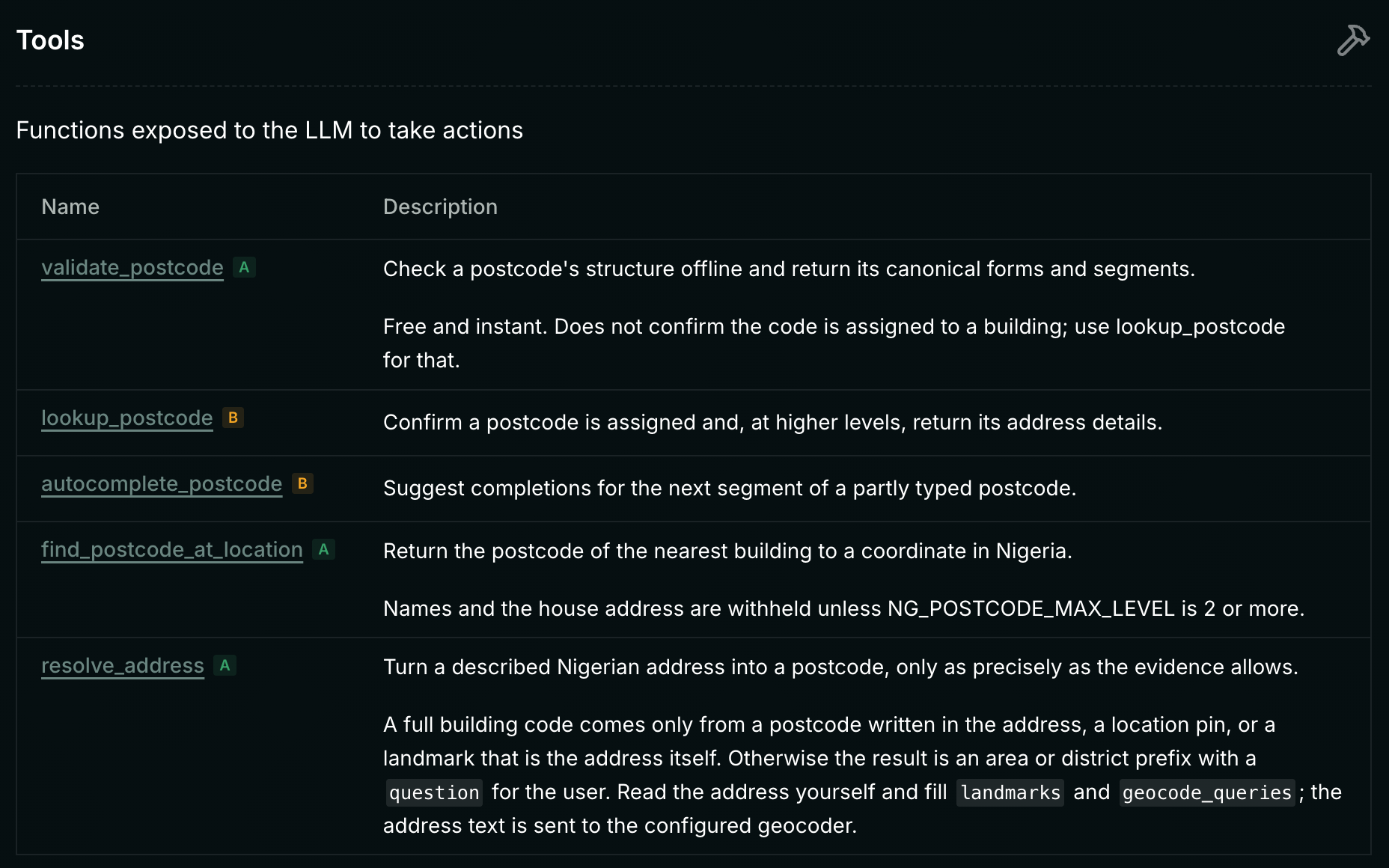
Robust production systems must account for a wide variety of potential failure states, ranging from expired API keys and network timeouts to structural typos and outright hallucinations. When integrating language models with specialized tools through standardized interfaces like the Model Context Protocol, developers can enforce strict operational limits that cannot be bypassed by model prompting.
Configuration parameters can restrict the depth of registry lookups, ensuring that resource-intensive or sensitive queries remain locked behind administrative controls unless explicitly authorized by human operators. By capping the frequency and depth of paid API calls at the server level, organizations protect themselves against runaway agent behaviors and unexpected financial expenses. When errors occur—whether due to an invalid API key, an unreachable endpoint, or an unrecognized postcode format—comprehensive error-handling mechanisms ensure that the system receives precise, actionable feedback rather than ambiguous fallback values.
Ultimately, securing applications against outdated artificial intelligence training data requires treating language models with appropriate skepticism. By restricting models to string extraction, enforcing strict offline parsing rules, verifying codes against official registries, and maintaining human oversight for corrections and sensitive data access, developers can build resilient systems that adapt seamlessly to national infrastructure updates without succumbing to automated fabrications.