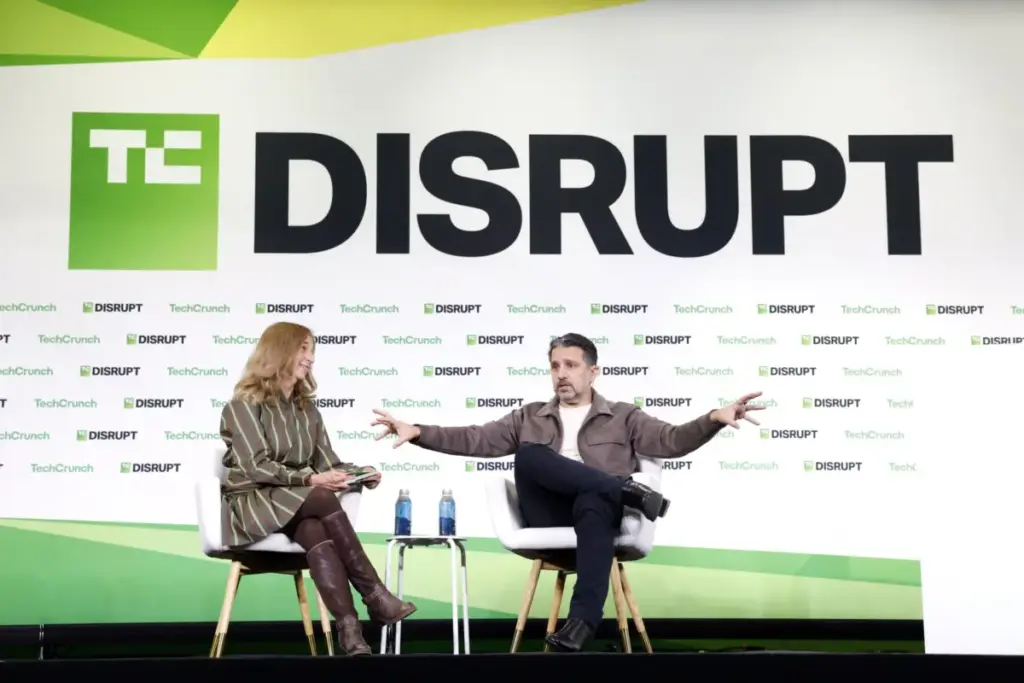
For startup founders navigating the precarious early stages of building a product, the fear of failure is often paralyzing. Yet, according to Amazon executive Panos Panay, that very fear—and the avoidance of the mistakes that trigger it—is perhaps the greatest threat to long-term success. Speaking onstage at TechCrunch Disrupt in San Francisco, Panay, who currently serves as Amazon’s Senior Vice President of Devices, Alexa, and Leo, delivered a candid assessment of what it truly takes to build enduring technology: an uncompromising willingness to fail, to analyze that failure, and to evolve.
Drawing from a career spanning nearly two decades at Microsoft before his transition to Amazon, Panay argued that failure is not merely a possibility in the tech industry; it is a mandatory requirement for any team looking to push the boundaries of what is possible. For Panay, the absence of failure is often a red flag, signaling that a team is playing it too safe, staying well within the boundaries of known territory rather than venturing into the transformative, high-risk spaces where true innovation occurs.
"You have to be willing to fail, and actually, not just willing, you actually have to go fail," Panay told the audience. "If you haven’t failed, you probably haven’t pushed the boundary. It’s literally about harvesting the lessons learned when you fail. You have to be willing to face it, and as you face it, learn from it."

The Anatomy of a High-Stakes Setback
Panay’s perspective is rooted in hard-won experience. During his long tenure at Microsoft, he was a central figure in the company’s hardware division, an era that saw both significant triumphs and notable missteps. He pointed directly to the launch of the Surface RT, Microsoft’s inaugural tablet computer, as a defining moment of failure. The product, which was intended to challenge the dominance of existing tablets, struggled to find its footing, eventually resulting in a nearly $1 billion write-down for the tech giant.
The episode was not just a financial blow; it was a public one. Panay recalled the experience of seeing the word "failure" splashed across newspaper covers, a visceral reminder of the stakes involved in consumer hardware. Yet, he emphasized that the failure itself was not the launch event. Instead, he framed the debacle as the inevitable result of a series of missteps and decisions that had occurred months, or even years, prior.
"I remember being on the front cover of a newspaper, and it just said failure," Panay said. "But, here’s the thing, it was easy to admit failure. The trick was, and always is, did you harvest the learnings and understand what happened? All right. What did you learn? Because the failure wasn’t that moment. It was decisions that led up to it two years before that, whether the software wasn’t complete or the inventory was wrong or how we balanced into retail. There were all these steps along the way."
This distinction—between the singular moment of a failed launch and the systemic, incremental decisions that preceded it—is where Panay believes the real work of leadership lies. Founders often focus on the public perception of a failed product, but the value lies in the granular autopsy of the development process. By avoiding excuses and confronting the reality of the situation, a leader can identify where the chain of execution broke down.
Balancing Resilience with Flexibility
A central theme of Panay’s message was the importance of balancing unwavering vision with the tactical flexibility required to survive. It is a common pitfall for founders to become so wedded to their initial concept that they fail to see when the market or the technology demands a change in direction. However, he cautioned against the opposite extreme: abandoning a vision entirely because of a single setback.

"Here’s the other side of it," Panay noted. "You want to succeed, yeah? You take that failure, but you don’t let go of your vision. That’s it. Surface has done pretty well. You don’t let go of your vision. You don’t break it."
The trajectory of the Surface line serves as his primary case study for this philosophy. While the early iterations faced significant skepticism and financial losses, the team remained committed to the core vision of a hybrid computing experience. By treating the initial failure as a data point rather than a death knell, they were able to iterate, refine, and eventually turn the product line into a significant pillar of Microsoft’s hardware ecosystem.
For those in the startup trenches, this process of iteration is critical. Panay believes that founders who successfully navigate these hurdles are those who can move quickly to adapt their strategy without compromising the soul of their project. He advocates for a "vector change" approach—rarely does a pivot require a full 180-degree turn. More often, he suggests, it is a matter of a 30-degree adjustment based on the lessons learned during the previous phase.
Cultivating a Culture of Learning
The ability to pivot is fundamentally tied to an organization’s culture. If a team is terrified of failure, they will hide their mistakes until they become unmanageable. Conversely, if a team is encouraged to "harvest the learnings," as Panay puts it, they are more likely to identify friction points early, when they are still solvable.
"It goes back to the same fundamental, like, have you learned?" he said. "Were you learning along the way? Because if you were learning, then you just change your vector. Usually, it’s not 180 degrees. Usually, it’s just 30 degrees. Take your lessons learned, change a little bit, adapt your vision where it needs to be, and then go."
Panay’s warning is directed specifically at those who linger in a state of denial. He noted that there are many people who "hang on too long" to a broken strategy, and the root cause is almost always an inability to accept the reality of the failure in the first place. By refusing to admit that a specific feature, marketing strategy, or inventory plan was wrong, leaders lose the ability to correct course.
As Panay continues his work at Amazon, overseeing a vast portfolio of devices and services like Alexa, his philosophy remains a cornerstone of his leadership style. For the founders gathered at TechCrunch Disrupt, the takeaway was clear: the path to a successful product is paved with small, necessary failures. The difference between those who eventually succeed and those who vanish lies entirely in the speed at which they can process those failures, learn from them, and apply that knowledge to the next iteration.
In a fast-moving, high-stakes industry, Panay suggests that the most valuable asset a founder can possess is not just a groundbreaking idea, but the humility to recognize when that idea needs to be reshaped by the hard, unforgiving lessons of reality. The journey is rarely linear, but for those willing to embrace the friction of failure, it is the only way to reach the next frontier of innovation.