The mantra of "HODLing"—the long-term strategy of holding onto digital assets through market turbulence—is often touted as the definitive pathway to wealth in the cryptocurrency sector. For many, this philosophy has yielded life-changing returns as Bitcoin, Ethereum, and other major tokens have shattered previous records, creating a new generation of wealthy investors. However, the experience of XRP holders serves as a sobering reminder that this strategy does not guarantee success for every project, regardless of its historical significance or market capitalization.
As of mid-October 2026, XRP, the payments-focused cryptocurrency native to the XRP Ledger and currently the fifth-largest digital asset by market value, finds itself in a precarious position. While the broader cryptocurrency market has experienced monumental growth over the past nine years, XRP remains notably stuck, trading well below the heights of its 2017 cycle peak. This performance discrepancy highlights a stark divergence between the asset’s historical performance and the current market reality.
The 2017 bull run was a watershed moment for the industry, marking the period when cryptocurrency truly broke into the mainstream consciousness. It drew in a massive wave of retail investors and institutional interest, culminating in a frenzied rally that spilled over into the first weeks of 2018. For many assets, that peak became a springboard for future cycles. For XRP, however, that peak has proven to be a formidable ceiling.
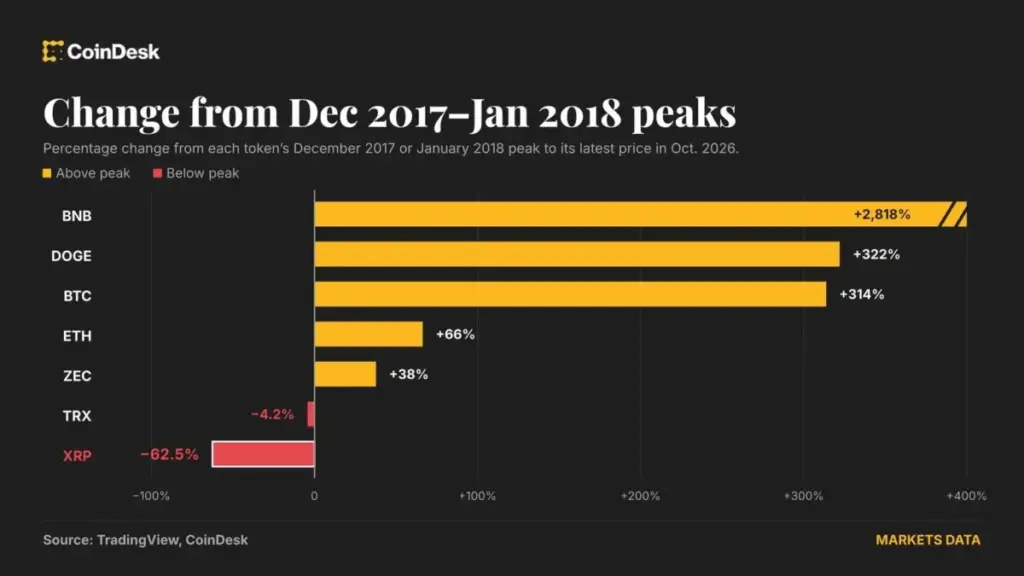
Currently trading around $1.33, the token is down approximately 62.5% from its early January 2018 high of $3.55. This means that an investor who purchased XRP at the height of that 2018 mania has remained underwater for nearly nine years, despite the token’s brief attempt to break that ceiling when it touched $3.66 in July 2025—a peak from which it has since retreated.
The contrast with other major assets is striking. Bitcoin, the industry bellwether, is currently trading at over $80,000, representing a 314% increase from its December 2017 peak of $19,804. Similarly, other major tokens have seen massive appreciation. Dogecoin has climbed 322% from its January 2018 high, while BNB has experienced a staggering 2,800% surge. Even Ethereum, which has also faced its own share of market volatility, remains up 66% from its 2017 peak, and Zcash has seen a 38% increase. While it is true that many of these assets have pulled back significantly from their own 2025 highs, they remain in a different solar system compared to their 2017 benchmarks, leaving XRP as a notable outlier in the laggard category.
The Dilution of Value: Supply and Market Dynamics
Analysts point to several structural reasons for this sustained underperformance, with the primary culprit being the significant expansion of XRP’s circulating supply. According to Nicolai Sondergaard, a senior research analyst at the analytics firm Nansen, the math behind XRP’s price action is inextricably linked to its tokenomics.
"Circulating supply grew 63%, from 38.7 billion in 2017 to 63.1 billion, while XRP’s total market value fell only about 3%," Sondergaard noted. "More XRP in circulation means each token represents a smaller share of roughly the same total value."
This concept of circulating supply is fundamental to understanding asset valuation. As the number of tokens in circulation increases, each individual unit represents a smaller slice of the total market capitalization. Consequently, for the price of a single token to reach its previous highs, the total market value of the project would need to grow disproportionately to compensate for this dilution.
Oliver Carding, head of marketing at Tesseract Group, an institutional digital asset management firm overseeing more than $500 million in assets, suggests that the narrative changes when shifting the focus from price to total value. "On value, XRP recovered," Carding explains. "About 63% more XRP is in circulation than at that peak, so the same circulating market capitalization would mean a price roughly 39% lower."
The ETF Conundrum and Weakening Demand
Beyond supply dynamics, the market environment for XRP has been characterized by noticeably weaker demand compared to its larger peers. The recent rise of U.S.-listed exchange-traded funds (ETFs) has been a significant catalyst for institutional capital inflows into the digital asset space. While Bitcoin and Ethereum ETFs have successfully attracted billions of dollars, XRP-based funds have failed to capture the same level of enthusiasm.
"ETF uptake has also been muted relative to BTC and ETH," observes Paul Howard, senior director at the market-making firm Wincent. Data from the source SoSoValue confirms this, showing that XRP funds have managed to pull in only $1.80 billion in investor money since their debut nearly a year ago. To put this in perspective, Bitcoin ETFs have frequently seen inflows exceeding $1 billion in a single trading day, highlighting the massive disparity in institutional appetite.
Further evidence of this waning interest can be found in on-chain and trading data. Nansen’s research indicates that the broader trading ecosystem for the asset has cooled, with XRP spot volume down 53.5%, perpetual futures volume down 44%, and active addresses declining by 10.7%. These metrics suggest that both speculative interest and utility-based usage are struggling to keep pace with the rest of the market.
Ripple’s Strategic Pivot and the Regulatory Shadow
The focus of Ripple—the payments technology company intrinsically linked to the XRP ecosystem—has also played a role in the token’s market narrative. While other ecosystems have aggressively pivoted toward the explosive growth sectors of decentralized finance (DeFi), artificial intelligence, and memecoins, Ripple has maintained a more traditional, infrastructure-heavy approach.
"Ripple, meanwhile, has been working hard to build payment infrastructure, RLUSD, and trade financing products around the usage of the ledger and coin, and this has taken focus from just core XRP," Howard notes. While these developments are aimed at long-term institutional adoption, they have not generated the same immediate speculative frenzy that fueled the growth of assets like Solana or Ethereum during their recent cycles. Investors, who now have a much broader menu of digital assets to choose from, have frequently gravitated toward narratives that emphasize DeFi integration and high-velocity capital deployment, areas where XRP has historically had less of a footprint.
The most significant weight on XRP’s performance, however, has been the prolonged and arduous legal battle with the U.S. Securities and Exchange Commission (SEC). The conflict began in December 2020, when the SEC sued Ripple and two of its top executives, alleging that the company had conducted an unregistered securities offering worth $1.3 billion. This lawsuit created an atmosphere of profound uncertainty that lasted for years.
While a federal judge provided some clarity in 2023 by ruling that XRP sales on public exchanges did not constitute securities offerings, the legal battle persisted. In 2024, the court ordered Ripple to pay a $125 million penalty, and the matter only truly reached its conclusion in August 2025, when both the SEC and Ripple dropped their respective appeals.
Carding points out that this regulatory cloud is essential to understanding why XRP failed to reclaim its 2018 highs during the 2021 bull market, a period when many other altcoins reached new all-time highs. "The SEC case helps explain why XRP did not revisit its 2018 high in 2021, when Coinbase suspended trading," Carding says. Even after the case ended in August 2025—at a time when the price was above $3—the momentum failed to sustain itself. Since that resolution, XRP has trended downward, losing approximately 59% of its value, compared to a 32% decline for Bitcoin and 44% for Ethereum over the same timeframe.
A Wider Trend of Underperformance
It is important to note that XRP is not alone in its struggle to surpass the benchmarks set during the 2017 mania. Carding notes that six of the other ten assets that occupied the top rankings in January 2018 are currently trading further below their valuations from that time than XRP is. This suggests that the "survivorship bias" often seen in the crypto market—where only the most successful coins are highlighted—can obscure the reality that many legacy projects have found it nearly impossible to regain their former market dominance.
For investors who remain committed to the XRP ecosystem, the path forward remains murky. Carding suggests that the most critical indicators to watch are the performance of XRP relative to Bitcoin, as well as the net monthly distribution of tokens after escrow releases. "Relative weakness that persists as distribution slows would point to weaker demand," he cautions.
In practical terms, this means that even if Ripple manages to slow the rate at which new XRP tokens enter the market, a continued failure to outperform Bitcoin would serve as a clear signal that institutional and retail demand for the asset is fundamentally softening. As the market continues to evolve, the challenge for XRP will be to prove that its utility-focused infrastructure can translate into the kind of market demand that its competitors have successfully tapped into. For now, the asset remains a case study in the complexities of long-term holding in an industry that is often defined by rapid change and shifting narratives.