The way most modern organizations are rolling out artificial intelligence feels less like a calculated business strategy and more like an elaborate farce. If current corporate rollout methods were adapted into a feature-length film, critics would likely dismiss the plot as entirely unbelievable, arguing that no real-world management team could possibly be that short-sighted. Yet, businesses worldwide find themselves trapped in this exact cycle. What makes the current state of AI adoption all the more frustrating is that corporate leaders have walked this exact path before.
Back in 2014, consultant and author Paul Boag published Digital Adaptation through Smashing Magazine, a book designed to diagnose the recurring mistakes organizations made during the chaotic era of digital transformation and to chart a better course forward. A decade later, the similarities between how enterprises approached digital transformation then and how they are approaching artificial intelligence today are striking. Revisiting the lessons of that era reveals that the biggest mistake organizations are making with AI—just as they did with digital tools a decade ago—is approaching it primarily as a technological challenge rather than a human and cultural one.
It’s About People, Not Technology
To be sure, both digital transformation and the integration of artificial intelligence represent major technological advances, and a certain level of technical implementation is required for either to function. However, the software deployment itself is merely the tip of a very large iceberg.

During the height of the digital transformation era, internal IT departments rushed to roll out complex content management systems, customer relationship management platforms, and corporate intranets. Concurrently, customer-facing teams launched new websites, mobile applications, and personalized digital experiences. Yet, organizations invested almost no institutional effort into understanding how actual human beings were going to interact with these systems on a daily basis. Consequently, internal software proved notoriously difficult to use, while customers either remained indifferent to the new digital offerings or actively demanded entirely different solutions.
A remarkably similar phenomenon is playing out with artificial intelligence today. Senior management teams have bought heavily into the overarching market hype, prompting internal IT departments to deploy enterprise-wide licenses for tools like Copilot Studio and consider their job finished. Aside from offering a handful of generic, organization-wide training webinars, leadership largely washes its hands of the transition. Consequently, ordinary staff members are left stranded, staring at powerful new interfaces while wondering what they are actually supposed to do with them, all while feeling immense pressure to immediately deliver measurable productivity gains.
Organizations must ultimately recognize that artificial intelligence represents a profound cultural shift as much as it is a technological upgrade, and that shift carries enormous, stressful implications for their personnel. This time around, the psychological stakes are even higher because employees are acutely aware of the existential threat to their livelihoods. Workers have read the very same headlines about automation and job displacement that corporate executives have, and no amount of casual, reassuring promises from senior leadership will alleviate their underlying anxieties.
Why Would Staff Want To Adopt AI?
Examining the current climate from an ordinary staff member’s perspective reveals why organic adoption is stalling. Artificial intelligence offers virtually tangible benefits to the average worker on a personal level, particularly when employees suspect that executive management ultimately intends to use these technologies to downsize headcount.
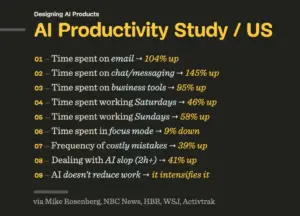
The primary driver behind senior management’s enthusiasm for artificial intelligence is the promise of enhanced productivity—the alluring prospect that individuals can accomplish significantly more work in considerably less time. However, this corporate benefit rarely translates into a personal advantage for the employee. Staff members are still contractually obligated to work their standard hours, but they are now implicitly expected to churn out a much higher volume of output within that exact same timeframe. Workers do not receive extra time back in their personal lives, nor do they see an increase in compensation for their heightened output. Given this dynamic, it is entirely reasonable to ask why any rational employee would willingly embrace the technology.
Before demanding that staff integrate artificial intelligence into their daily routines, organizations must first determine how they intend to genuinely motivate them to do so. One viable strategy involves helping employees identify the most tedious, frustrating aspects of their day-to-day responsibilities and demonstrating precisely how AI can alleviate those specific pain points, thereby making difficult tasks faster and less painful. People are inherently far more receptive to sweeping operational changes when those modifications are presented as genuine opportunities to improve their overall working lives.
Beyond simply streamlining tedious chores, organizations may need to consider offering concrete incentives for AI adoption, ranging from pathways for career progression and financial compensation to experimentation with shorter working hours.
Staff Need Time And Support To Adopt AI
Successfully adopting artificial intelligence is far from a trivial task. It requires employees to fundamentally challenge and often dismantle working practices they have spent years, or even decades, carefully developing. Decades of procedural knowledge must be unlearned and rebuilt from the ground up. Asking this of any workforce is a massive undertaking under ideal circumstances, yet most contemporary employees are far from operating in ideal environments.

Most modern workers are already stretched thin, overworked, and struggling simply to stay afloat amidst relentless to-do lists. They rarely have the luxury of sitting down undisturbed to leisurely learn a complex new software tool and figure out how it organically fits into their existing workflows. True adoption requires much more than a simple operational mandate; it demands dedicated time, careful consideration, and continuous experimentation. Sending an employee on a single formal training course is entirely insufficient for helping them unlock the full potential of artificial intelligence.
At an absolute minimum, staff require role-specific training tailored to their daily professional responsibilities. Forward-thinking organizations need to develop sophisticated internal training programs that help departments across the enterprise understand how to apply AI directly to their unique workflows. Furthermore, employees require ongoing institutional support and uninterrupted time to experiment safely in order to discover the most effective ways to leverage the technology.
However, formal training classes will only take an organization so far. Experience shows that the most effective, enduring support typically comes from peers rather than top-down directives. Rather than focusing initial efforts on converting the most resistant employees, organizations should look to their internal enthusiasts—the handful of people who are already experimenting with artificial intelligence on their own initiative, often without formal permission. By bringing these early adopters together, giving them the time and space to share their successes, and letting their natural enthusiasm spread outward, organizations can leverage powerful social proof.
During the digital transformation era, internal showcases where staff demonstrated successful projects to their peers proved far more effective at driving adoption than any formal memo issued from the executive suite. People are instinctively much more willing to try a new approach when they witness a colleague in a similar role succeeding with it.
Unfortunately, genuine experimentation inherently comes with a significant downside: mistakes will inevitably be made.
It Needs To Be Safe To Fail
Many corporate cultures are hampered by an underlying atmosphere of fear, where professional errors are reflexively viewed as unmistakable signs of incompetence. Yet, the very nature of learning and mastering a disruptive technology like artificial intelligence necessarily involves trial and error, making the fear of failure a massive, invisible barrier to adoption.
This exact dynamic crippled numerous digital transformation initiatives in the past. Senior executives would loudly demand sweeping digital changes across the enterprise and express genuine confusion when transformation failed to materialize. What leadership failed to realize was that they were broadcasting profoundly mixed messages to their teams. On one hand, they demanded innovation and agility; on the other, they continued to enforce rigid key performance indicators and harshly penalized any missteps during annual performance reviews.
Because the institutional pressure to deliver immediate results remained relentless, employees recognized there was zero psychological safety net provided for failure.
In the current artificial intelligence landscape, these cultural hurdles appear even more pronounced. Reports frequently emerge of employees being sharply reprimanded for consuming too many computing tokens just weeks after being formally ordered to incorporate AI into their workflows. In other instances, staff are subjected to such heavy-handed warnings about compliance boundaries that they become too terrified to attempt anything novel at all, concluding that the safest course of action is simply to stick to legacy methods.
If executive management genuinely expects their workforce to embrace artificial intelligence, they must cultivate an environment where staff feel explicitly safe to experiment. This requires leadership to actively adjust performance metrics, modify review processes, and temporarily relax strict governance structures while employees navigate the steep learning curve.
Handle Governance With Care
Naturally, artificial intelligence cannot be rolled out across a modern enterprise entirely without governance. However, governance is historically an area that organizations manage exceptionally poorly.

During the digital transformation era, corporate governance either failed to exist entirely or was enforced with such bureaucratic rigidity that it actively stifled all innovation. Today, that exact same counterproductive pattern is emerging around artificial intelligence. While staff undeniably require a clear governance framework to understand institutional boundaries, compliance expectations, and permissible use cases, organizations frequently err on the side of extreme restrictiveness.
When legal and compliance departments issue voluminous pages of warnings regarding what corporate data can and cannot be shared with artificial intelligence models, they inadvertently foster the very culture of fear that paralyzes adoption. Instead, organizations require a concise set of clear, overarching principles that can be easily understood and referenced, leaving room for common sense and trust in their employees. While mistakes will inevitably occur along the way, they represent the unavoidable cost of organizational evolution and must be factored into the rollout strategy.
Adaptive Technological Rollout
From an IT perspective, organizations must exercise immense caution to avoid locking down their technical infrastructure in a way that inadvertently stifles progress. In 2014, overstretched IT departments frequently selected a rigid suite of enterprise software and deployed it organization-wide with little or no consultation from the end-users. Any software request outside of this pre-approved inventory was forced through a labyrinthine approval process involving bureaucratic steering committees. The resulting glacial pace of technological change contributed heavily to the high failure rate of digital transformation projects.
Today, enterprises are repeating this exact mistake by simply purchasing a standard enterprise license for tools like Copilot, declaring the technology stack complete, and walking away. When specialized teams—such as user experience researchers attempting to build AI-powered research repositories or dynamic user personas—discover that standard corporate software cannot support their actual project requirements, they find themselves immediately bogged down in bureaucratic friction as they attempt to petition internal steering groups for alternative toolsets.
When official internal systems fail to meet operational needs, employees do not simply abandon their goals; instead, they bypass internal controls entirely. Just as the digital transformation era witnessed the rise of unauthorized "shadow IT" when workers signed up for external file-sharing services, the modern workplace is now seeing a massive surge in "shadow AI."
When in-house enterprise tools prove inadequate, staff routinely open personal artificial intelligence accounts on their personal phones or home laptops to get their work done. This behavior creates a far greater security risk than the policies were designed to prevent, as sensitive corporate data ends up entering external platforms completely outside the organization’s control or visibility.
The instinctive corporate reaction to shadow AI is often to clamp down even harder with blocked websites, stricter administrative policies, and threats of disciplinary action. Yet, these heavy-handed tactics rarely succeed; instead, they simply drive employee behavior further underground. Shadow AI should be viewed as a valuable diagnostic symptom, revealing precisely where official corporate toolsets are failing to support the workforce.
Rather than attempting to violently stamp out shadow AI, organizations would benefit from investigating what employees are using these personal accounts for and why official tools are falling short. That operational insight can then be used to shape subsequent technological rollouts. In the early, exploratory days of any major technological shift, organizations must be prepared to tolerate a degree of administrative messiness while their staff explore the boundaries of what is possible and establish practical use cases.
While maintaining centralized control over technology stacks may appeal to risk-averse organizations seeking absolute predictability, change inherently carries exposure to risk. Ultimately, the organizational danger of moving far too slowly in the age of artificial intelligence far outweighs the temporary risks associated with moving too fast.
More dangerous still is the tendency for corporate leadership to view AI adoption merely as a technical procurement exercise while entirely overlooking the human element. Just like the digital transformations of the past, succeeding with artificial intelligence requires a deep, sustained focus on people, workplace culture, and thoughtful change management.