









Naming is hard. The language we use shapes not only the way we think about abstract concepts and concrete items alike, but it also dictates the nature of the conversations we have around them. Across the digital product landscape, this linguistic challenge frequently manifests as widespread confusion regarding colors, icons, user interface components, and core features. It is precisely why designers and developers alike struggle so profoundly when tasked with naming design tokens, HTML classes, and code variables.
Often, the labels chosen during the creative and development processes fall into two problematic extremes. Sometimes, names are far too generic, making it difficult for anyone outside the immediate author to understand what is actually meant or intended. Conversely, names are occasionally far too specific, boxing in future iterations and leaving little room for flexibility, scalability, and code reuse. Navigating this delicate balance requires a closer look at how industry professionals approach naming conventions, structural taxanomies, and cross-functional vocabulary.

How To Name Things
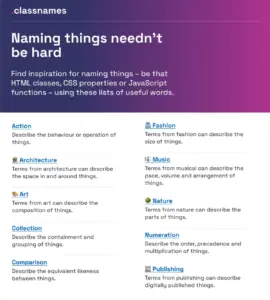
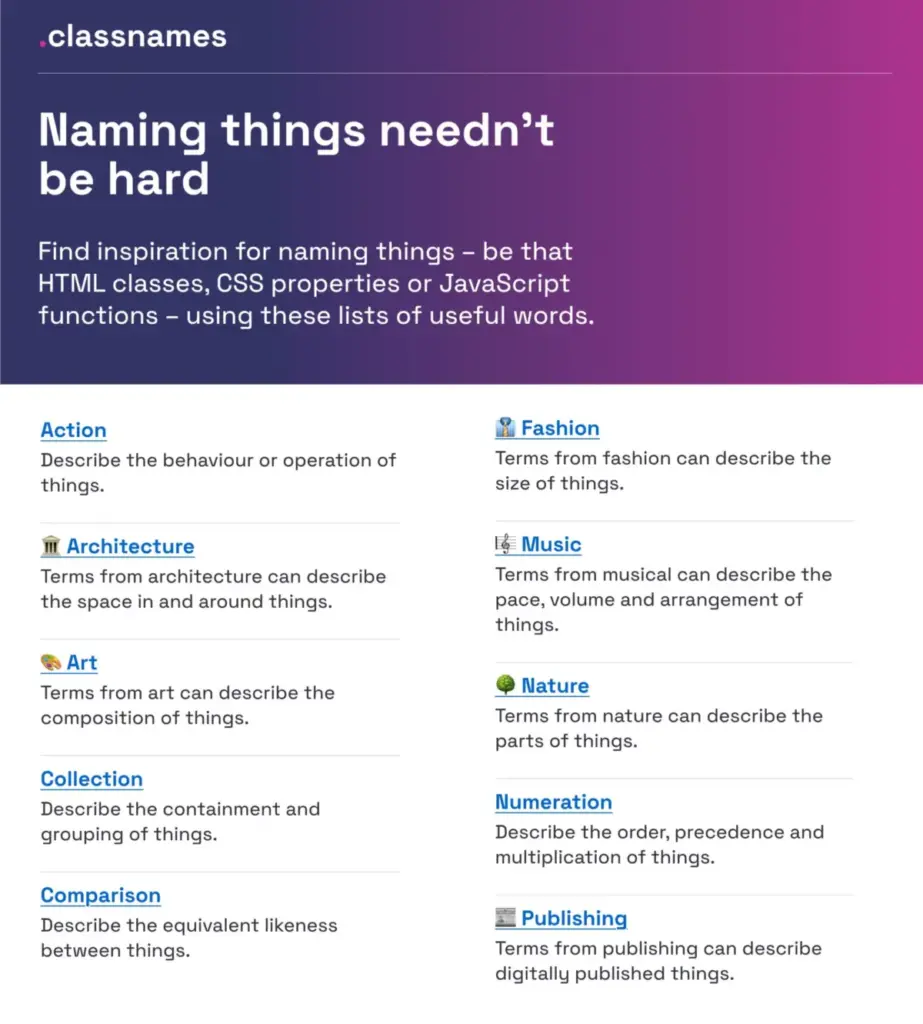
Finding the right inspiration for naming HTML classes, CSS properties, or JavaScript functions has historically been an ad-hoc process. To combat this friction, digital resources like Classnames have emerged as wonderful tools jam-packed with ideas designed to get teams thinking completely outside the box. Rather than relying on tired, repetitive nomenclature, these platforms provide thematically grouped lists of words that fit specific structural and semantic needs.
Users can explore terms designed to describe varying types of behavior, likeness between elements, order, grouping, and direct associations. Beyond standard technical vocabulary, these collections introduce themed sets of words drawn from nature, art, theater, music, architecture, fashion, and publishing—domains that rarely cross paths with code natively, yet offer rich metaphorical value for digital architecture.

How To Name Colors
Establishing a standardized, scalable approach to naming colors presents another historic hurdle for digital teams. Standard hex codes and RGB values lack human context, while generic color names often clash across different branding contexts and themes. To address this, developer David Aerne maintains a massive repository of color names. Currently housing more than thirty thousand unique color names sourced from various historical references and thousands of individual user contributions, the project serves as an invaluable reference.
Accompanied by interactive color pickers and name search utilities, the repository bridges the gap between raw digital values and intuitive human language. Having such a comprehensive reference nearby helps teams avoid the trap of unimaginative color scales, providing a rich vocabulary for custom design systems and stylesheets.

How To Name Layers and Groups
Within design tools like Figma and Sketch, chaotic file structures can severely hinder team collaboration. Recognizing what makes a truly effective label, design expert Javier Cuello summarized a comprehensive set of naming best practices aimed at helping practitioners name their layers, groups, and components in a consistent, scalable manner.
According to Cuello’s guidelines, an effective name must possess a logical structure. It should remain short, deeply meaningful, widely understood by all cross-functional team members, and crucially, completely detached from temporary visual properties. By establishing clear dos and don’ts, these guidelines address the fine details required when managing sizes, colors, groups, layers, and overarching component hierarchies.

How To Name Design Tokens
Building a flexible design token taxonomy that functions seamlessly across multiple products, brands, and themes is one of the most formidable architectural challenges modern enterprises face. This exact hurdle confronted the design systems team at Intuit. As the parent company behind major financial and productivity products such as Mailchimp, QuickBooks, TurboTax, and Mint, the organization needed to develop a flexible token system capable of transcending individual brand themes to serve as a foundational infrastructure for a diverse array of digital products.
In an extensive case study documenting the effort, Nate Baldwin shared valuable insights into the creation of Intuit’s design token taxonomy. The documentation outlines the severe pain points experienced under their legacy taxonomy system, details the strict criteria established for the new architecture, and explains the step-by-step rollout process. The resulting insights offer a blueprint for organizations aiming to build robust and adaptable token taxonomies of their own.

Frequent Names For UI Components
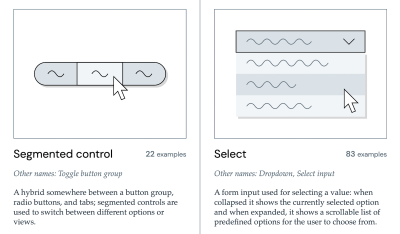
When teams find themselves stuck in a naming loop, examining what other organizations call similar interface patterns is one of the most effective ways to break the deadlock. Rather than getting lost down the rabbit hole of examining hundreds of disparate design systems independently, researcher Iain Bean compiled the Component Gallery to aggregate these naming conventions in one place.
The collection includes diverse examples for more than fifty distinct UI components—ranging from basic structural elements like accordions to accessibility-focused utilities like visually hidden text. Crucially, the gallery also catalogs alternative names that these UI components go by across different enterprise design systems, offering a vital resource for establishing unified team dictionaries. This is further complemented by visual dictionaries like Name That UI, which provide immediate visual context alongside common interface terminology.
How To Name New Features
While technical components require precise internal naming, consumer-facing features demand an entirely different strategy centered around discoverability and adoption. New features frequently suffer from low user adoption simply because they are difficult to discover or understand. Feature adoption is a gradual pipeline: a capability must first be discovered, subsequently understood, actively tried, learned over time, and finally integrated into the user’s existing workflow.
Practical guidelines written by Erin Gannon emphasize that successful feature names must be driven entirely by user needs and underlying problems. Rather than relying on internal corporate jargon or clever internal codenames, feature names should signal the concrete value or outcome of the capability—addressing the user’s core job-to-be-done. The most reliable method is to ask users directly how they describe a specific workflow in their own words, and then incorporate that exact vocabulary into the product interface.

How To Name Variables and Taxonomy Maps
Managing nomenclature across complex, multi-brand ecosystems requires rigorous structural mapping. A prime example of advanced naming architecture comes from the Vodafone UK Design System team. Their published Variables Taxonomy Map breaks down the anatomy and categorization of a design token into a meticulously organized system of collections.
The map illustrates the four core collections necessary to support a multi-theme system, clearly charting the connections between tokens—moving outward from brand foundations and primitive values to semantic tokens and page-level implementations. Building upon foundational industry work by Nathan Curtis regarding design token naming, this taxonomy ensures that any team member can immediately deduce where a token is applied and what it represents simply by reading its identifier. Additional approaches are further supported by community-driven Figma kits and resource collections curated across the design community.

Design Token Naming Guides and Inventories
To simplify the practical application of these concepts, practitioners like Romina Kavcic have developed specialized tools dedicated to design token nomenclature. These interactive guides assist teams in learning the mechanics of token structures while enabling them to configure custom naming conventions incorporating components, categories, states, and roles.
Complementing these builders are structured token inventories, such as four-level spreadsheet frameworks that provide a high-level, bird’s-eye view of an entire design system’s variables. These inventories allow teams to seamlessly integrate new rows, themes, and display modes without losing track of their data, providing robust filtering capabilities that keep large-scale design operations organized.

Naming Products or Services
Moving beyond technical components and variables, naming a standalone product or service introduces high-stakes branding challenges. Open-source repositories like Onym compile an extensive directory of tools, methodologies, and brainstorming prompts tailored for naming new ventures. By aggregating vetting guides, sprint frameworks, etymological resources, and cautionary tales, these repositories provide comprehensive support for teams navigating the murky waters of brand naming.
Ultimately, the right name is consistently defined as the one that is universally understood and actively utilized by both the internal product team and the end users. Far too many hours are wasted across the technology sector when designers, developers, product managers, and users speak about the exact same system components using entirely different dialects. Recognizing that low feature adoption or cross-functional friction can often stem from poor nomenclature allows teams to address naming conflicts proactively, reducing confusion and fostering a more cohesive collaborative environment.