










Developers building modern artificial intelligence applications are increasingly faced with a fragmented ecosystem of proprietary and open-weight models. Whether designing an automated customer support assistant, a content generation pipeline, or a complex analytical tool, engineers often want to evaluate how different systems—such as OpenAI’s GPT, Anthropic’s Claude, and Meta’s Llama—handle identical prompts before committing to a single infrastructure provider.
Historically, this evaluation process has introduced significant overhead. Comparing multiple models typically required developers to establish separate accounts with distinct providers, master unique authentication schemes, and repeatedly rewrite integration code just to execute a preliminary benchmark.
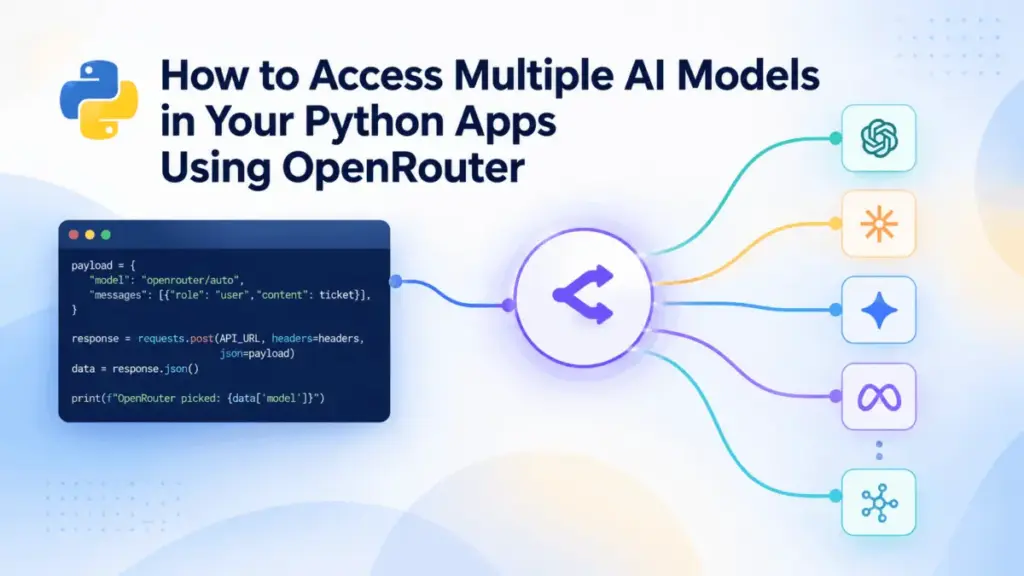
A developer-focused platform called OpenRouter is addressing this fragmentation by sitting in front of dozens of major AI providers and exposing them through a single, unified application programming interface. By normalizing requests, OpenRouter allows engineers to switch between completely different foundational models by altering a single line of configuration code rather than rewriting an entire backend integration. Python applications can maintain a consistent codebase regardless of which underlying provider ultimately fulfills the request.

Streamlining Initial Integration and Setup
Getting started with the platform requires no prior machine learning expertise, lowering the barrier for software developers looking to incorporate generative capabilities into their applications. Basic proficiency in Python, the ability to manage package dependencies via package managers like pip, and familiarity with configuring terminal environment variables are the primary prerequisites. Because OpenRouter manages the complexities of routing requests to various model endpoints, application code simply needs to dispatch standardized text payloads and parse the resulting responses.
Establishing an account on the platform provides access to a management dashboard where users can generate secure authentication tokens. Security best practices dictate storing these keys as environment variables rather than hardcoding them into source files, preventing accidental exposure in public version control repositories.
A notable advantage for developers experimenting with the platform is the availability of free-tier models. Certain models on the service are designated with a specific suffix, indicating that they route to fully functional, zero-cost versions requiring no attached payment method. This architecture enables complete exploratory development, testing, and prototyping without financial risk. If a specific model identifier becomes deprecated or unavailable over time, developers can consult the platform’s active directory or utilize dynamic routing shortcuts that automatically resolve to whichever free model is operational at any given moment.
Crafting Standardized Requests
To interact with the service, developers can rely on standard HTTP requests rather than heavy, proprietary software development kits. Because OpenRouter accepts plain JavaScript Object Notation payloads over a standard endpoint, every request follows a predictable structure. A typical transaction involves dispatching a POST request containing the authentication headers and a request body that specifies the target model alongside a structured list of conversation messages.
The payload design mirrors traditional chat completion architectures. Developers define a model string—typically formatted as a combination of the provider and the model name—alongside an array of messages that can include system-level instructions and user prompts. The platform normalizes the responses from disparate third-party providers into a uniform format, ensuring that parsing logic remains identical regardless of whether a request is answered by a Meta model, a Mistral model, or another supported system.
This uniform structure underpins the core utility of the platform: model interchangeability. Because the designation of the AI model is simply a string parameter within a configuration dictionary, comparative evaluations can be conducted within simple programmatic loops. Developers can iterate through a sequence of different model identifiers, passing the exact same customer service ticket or user prompt to each one, and immediately collect comparative outputs. This capability transforms what was once a multi-week integration effort into a streamlined afternoon experiment.
Advanced Routing and Reliability Features
Beyond basic model swapping, the platform provides sophisticated routing mechanisms designed to optimize cost, performance, and application reliability. For prototyping phases where specific model characteristics are secondary to operational availability, developers can direct traffic to a generalized free router. This configuration instructs the system to automatically select from any currently available complimentary model, ensuring uninterrupted development without incurring charges.
For production environments operating at scale, the platform allows developers to optimize provider selection based on specific criteria such as financial cost or network latency. By passing specific sorting parameters within the request headers, applications can automatically favor the most economical provider or the one delivering the fastest response times for a given model.
Reliability is another critical concern addressed by the architecture. In traditional setups, a sudden provider outage, rate-limiting threshold, or strict content filtering policy can cause an application to fail entirely. OpenRouter mitigates this risk by supporting fallback configurations. Instead of specifying a single model string, developers can submit a prioritized list of models. If the primary choice fails due to an unexpected interruption, the system automatically attempts to fulfill the request using the subsequent models in the list in sequential order. This built-in failover mechanism operates transparently, removing the necessity for complex, custom retry logic within the application code itself.
As the generative artificial intelligence landscape continues to evolve with a proliferation of specialized models, platforms that abstract away infrastructural friction are becoming essential tools for software engineers. By unifying disparate APIs into a single integration point, developers can focus on building resilient, high-performing applications without getting bogged down in the maintenance of multiple third-party SDKs.