









The digital asset landscape remains on high alert following the massive $388 million security breach of the crypto exchange Bitget. As investigators and blockchain forensics teams continue to trace the movement of stolen funds, the perpetrator has ramped up efforts to obfuscate the trail of illicitly obtained assets. According to recent blockchain data, approximately $83 million worth of XRP has been funneled out of three primary holding wallets, leaving the remaining stolen capital in a precarious state of transition.
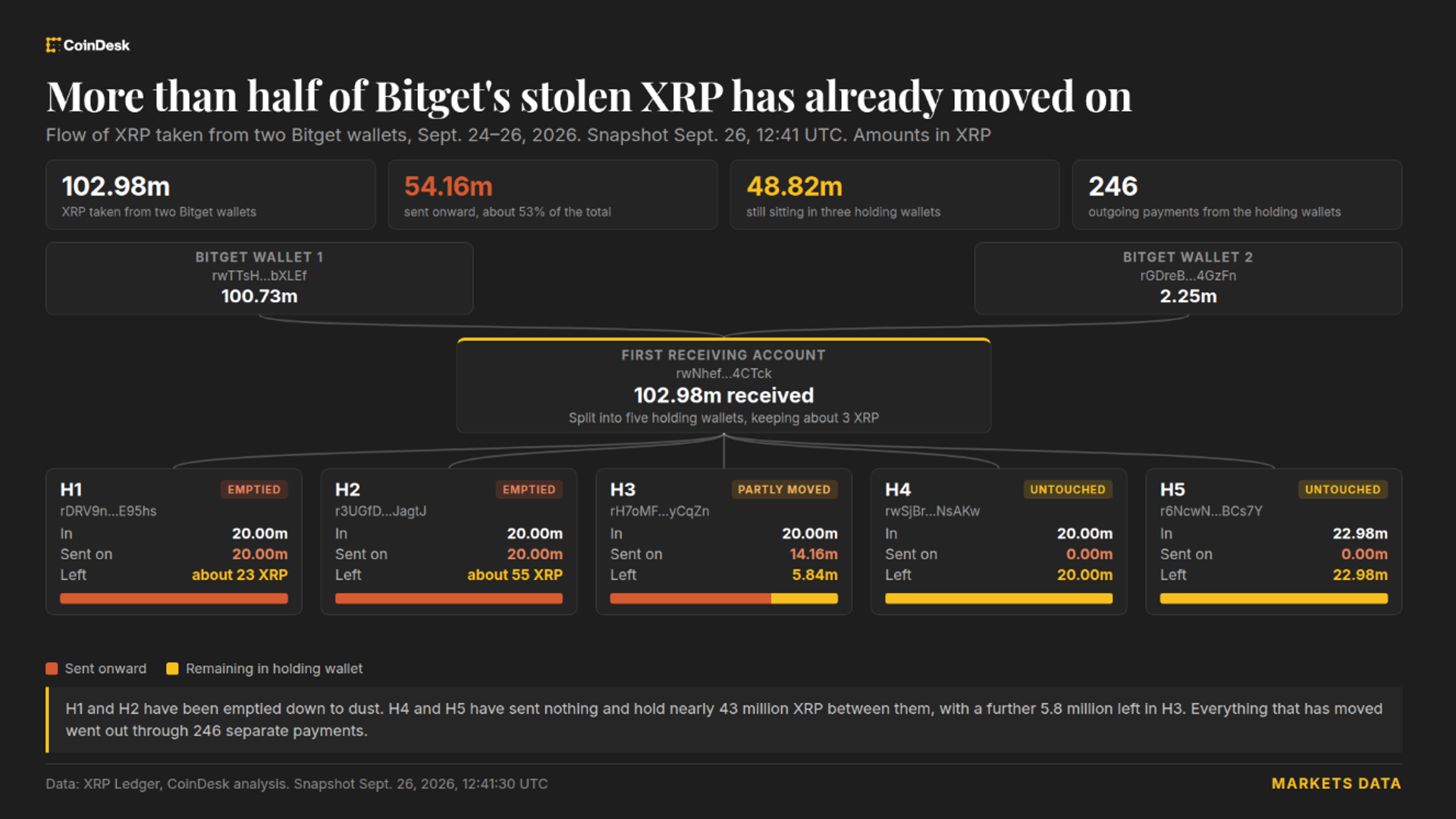
As of Saturday, September 26, 2026, roughly $75 million in XRP remained across the five original accounts used by the attacker immediately following the initial breach. The situation has become a high-stakes game of cat and mouse, complicated by the fundamental architecture of the XRP Ledger, which lacks the native ability to freeze the currency itself, regardless of whether those assets are identified as stolen.
A Rapid Drain of Stolen Assets
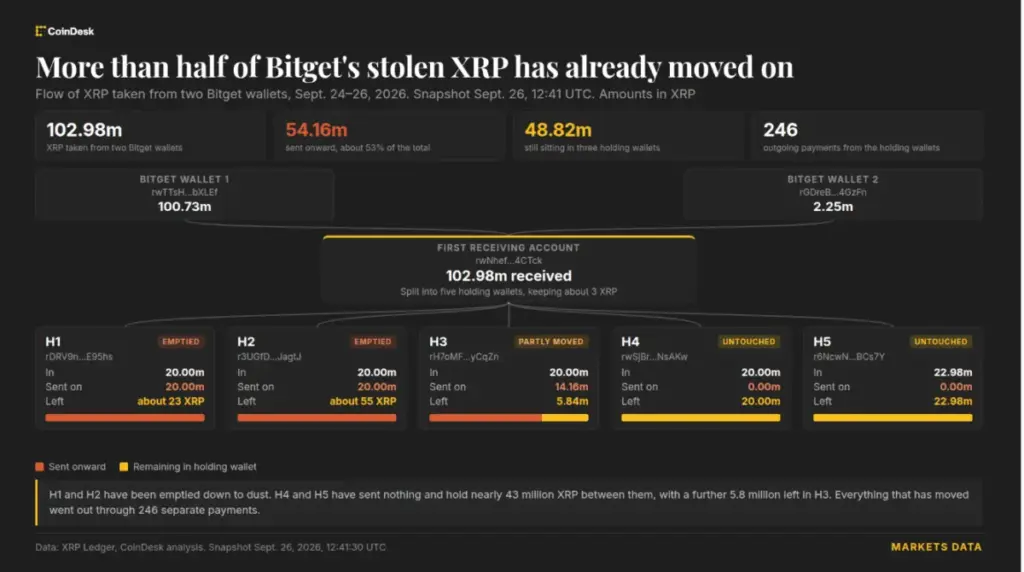
The scope of the theft, which occurred on Thursday, involved approximately 103 million XRP being siphoned from Bitget’s reserves. This total was rapidly partitioned across five distinct wallets. By 12:41 UTC on Saturday, the efficiency of the hacker’s exit strategy became apparent. Two of the accounts, which initially held 20 million XRP each, were effectively drained, with only negligible remnants—approximately 23 and 55 tokens respectively—left behind. A third account was reported to have been depleted to roughly 5.8 million XRP.

The pace of these transfers has accelerated significantly over the last 24 hours. Early Saturday morning, at 04:32 UTC, records indicated that approximately 70 million tokens were still residing in the five original wallets. Within a span of just eight hours, that figure plummeted to 49 million, signaling an aggressive push by the bad actor to move the assets before exchanges and centralized platforms can implement more stringent monitoring or block-list measures.
The nature of these transactions mirrors sophisticated laundering tactics. In several instances, the attacker has attempted to distribute funds across a wider network of intermediary wallets. Forensic analysis of the ledger shows that the hacker is repeating certain behavioral patterns; for example, after a failed transfer of roughly 521,000 XRP occurred because the source wallet lacked sufficient liquidity, the attacker simply adjusted the transaction and repeated it successfully an hour later, suggesting a highly automated or methodical approach to the movement of these coins.
The Limitations of Network Governance
The difficulty in recovering these funds lies in the technical governance of the XRP Ledger. While the ledger allows for the freezing of tokens—such as those issued by third-party companies or stablecoin providers—it does not grant the same authority over XRP itself. Because XRP is the native currency of the ledger, there is no centralized “kill switch” that can be triggered by Ripple or any other entity to prevent the attacker from spending or moving the coins.
This reality places the burden of recovery entirely on the shoulders of the centralized exchanges and decentralized platforms that may eventually receive the stolen funds. Should the attacker attempt to offload the stolen XRP onto a major exchange, that platform could theoretically restrict the recipient’s account and prevent further withdrawals. However, as long as the coins remain within the attacker’s own non-custodial wallets, they remain entirely outside the reach of legal or corporate intervention.
This stands in stark contrast to the handling of stablecoins involved in the same breach. Circle and Tether, the issuers behind USDC and USDT respectively, have already moved to blacklist addresses linked to the hack, successfully freezing approximately $320,000 in assets. Because these tokens are managed via smart contracts that allow for blacklisting, the companies were able to act decisively. However, this recovery represents only a fraction of the total $388 million loss, highlighting the disparity in recovery capabilities across different blockchain assets.
Market Impact and Financial Repercussions
The market has reacted with understandable caution. XRP, which remains one of the most traded assets in the crypto ecosystem, saw its price fluctuate in the wake of the news. By Saturday, the token was trading at approximately $1.54, representing a 4% decline over a 24-hour window, though it maintained a 9% gain over the trailing seven-day period.
Financial analysts are monitoring the situation closely to determine if the stolen funds will create significant sell-side pressure. The original XRP haul, at current valuations, amounts to approximately $160 million. While this figure is substantial, it equates to roughly 4% of the token’s reported daily trading volume of $4.4 billion. Whether the attacker’s liquidation attempts would cause a meaningful dip in price depends heavily on the depth of the order books at the time of any potential sale. If the attacker seeks to offload large amounts in a short period, they risk driving down the price, which would ultimately decrease the total value of their stolen loot.
Bitget’s Response and Recovery Roadmap
The total scale of the incident was updated by Bitget on Friday, with the exchange raising its estimate of the breach to $387.5 million. This adjustment was made after an internal audit uncovered that the initial accounting had failed to include certain Zcash and TRON transfers. The exchange emphasized that this higher figure does not represent a secondary breach, but rather a more accurate tally of the assets compromised during the initial Thursday attack.
In an effort to maintain user confidence, Bitget has moved to assure its customer base that the impact of the hack will not be felt by individual accounts. The exchange confirmed that its internal protection fund is robust enough to cover the entirety of the loss, ensuring that no user balances will be negatively impacted by the incident.
To restore full functionality, the exchange has outlined a structured timeline for the resumption of services. Following the breach, the company implemented a freeze on withdrawals to prevent further outflows and to conduct a forensic sweep of its systems. According to the current plan, Bitcoin withdrawals are scheduled to be the first to resume on September 28, with Ethereum follows on September 29. Users looking to access their USDT holdings can expect services to be restored on September 30, with other remaining tokens slated to follow by October 2.
As the industry looks on, the Bitget incident serves as a stark reminder of the persistent security challenges facing centralized exchanges. While the immediate focus remains on the movement of the stolen XRP and the potential for freezing assets upon entry to secondary platforms, the broader conversation has once again shifted toward the necessity of improved custody solutions and the limitations of blockchain-native recovery mechanisms. For now, the attacker remains in possession of the vast majority of the stolen funds, and the race between the perpetrator’s laundering efforts and the defensive measures of the crypto community continues.