











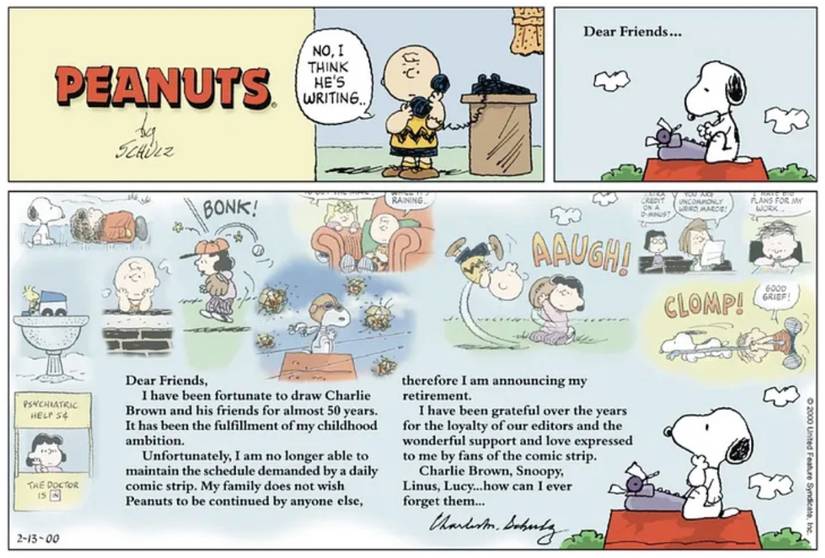
When Charles Schulz passed away on February 12, 2000, at the age of 77, the world lost one of its most influential creative voices. The following morning, the final Peanuts comic strip appeared in newspapers across the globe, bringing a definitive close to a half-century of storytelling. For 50 years, Charlie Brown, Snoopy, and their neighborhood companions had occupied a unique space in the American consciousness, acting as a mirror for the anxieties, triumphs, and quiet existential musings of everyday life. The timing of the final strip’s publication—appearing just one day after the creator’s death—seemed to many fans like a final, poetic gesture of closure.
However, the reality behind that timing is a testament to the mechanics of the comic strip industry rather than a pre-planned farewell. Peanuts strips, particularly the complex Sunday installments, were produced weeks in advance. While Schulz had announced his retirement in December 1999 following a diagnosis of colorectal cancer and a series of strokes, he could not have known the exact date of his passing. The coincidence of the final strip appearing the day after his death serves as a poignant, accidental coda to a legendary career. It was a fitting, if unintended, end for a man whose work was defined by its ability to find profound truth in the mundane.
Over the course of his 50-year career, Schulz produced nearly 18,000 Peanuts strips. These comics ranged from the whimsically comedic to the deeply melancholic, often blurring the lines between the two. Among this vast body of work, one particular sequence from early 1966 stands out, containing what many scholars and fans now consider to be the most profound line of dialogue Schulz ever penned. It is a moment of raw, human realization that, ironically, seems to have been overlooked even by its creator.


Charlie Brown and the Spelling Bee
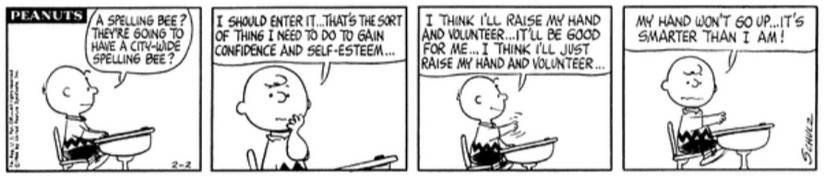
The quote in question emerged from a 16-part storyline centered on Charlie Brown’s ill-fated attempt to compete in a school spelling bee. The arc began on February 2, 1966, and ran through February 20. Because of the lead time required for syndication, the narrative was broken up into daily strips, with the Sunday comics acting as more self-contained vignettes to accommodate the casual reading habits of the weekend audience.
In the narrative, Charlie Brown, ever the underdog, decides to volunteer for the school’s spelling bee. His motivation is simple: he wants to participate, to be involved, and to test his mettle. As is customary for the character, his enthusiasm is met with skepticism by those around him, most notably Lucy. When the moment of truth arrives, Charlie Brown falters under pressure, famously misspelling the word "maze" as "m-a-y-s." The resulting humiliation leads him to retreat into himself, putting his head down at his desk in a moment of dejection. When his teacher demands he lift his head, his frustration boils over, resulting in a brief stint in the principal’s office. Though he eventually returns to class and offers a sincere apology, the narrative arc is less about the spelling competition itself and more about the courage required to participate in a world that often rewards failure.
The true highlight of this storyline occurs in the second strip, shortly after Charlie Brown has made his intention to compete known. Lucy, ever the voice of cynical reality, confronts him, unable to comprehend why he would subject himself to the inevitable embarrassment of failing in a public forum. In a rare moment of defiance, Charlie Brown pushes back against her skepticism. He shouts, "Well, what’s wrong? What’s wrong with trying?! I can try, can’t I?"

It is here that the dialogue shifts from a simple disagreement into a moment of pure philosophical clarity. Charlie Brown follows his outburst with a statement that resonates as much today as it did decades ago: "What’s the good of living if you don’t try a few things?"
The simplicity of the sentence is its greatest strength. It is a fundamental question about the human condition, stripped of pretension. It speaks to the necessity of action over the safety of inaction—the idea that the value of life is found in the attempt, regardless of the outcome. It is a sentiment that cuts through the typical cynicism of the Peanuts world and offers a genuine, optimistic mandate for living.
The Disconnect Between Creator and Creation
Despite the brilliance of the line, it is clear that the profound nature of the sentiment was somewhat lost on the characters themselves. They are children, after all, and their dialogue is often defined by a lack of self-awareness. Yet, there is evidence that even Charles Schulz, the man who carefully crafted these characters, may have underestimated the weight of those specific words.
This suspicion is supported by the trajectory of that 1966 storyline. When the narrative was adapted for the first feature-length Peanuts film, A Boy Named Charlie Brown, released in 1969, Schulz himself wrote the screenplay. The film expanded upon the spelling bee arc, stretching the narrative to fill an 85-minute runtime. It is a significant piece of Peanuts history, capturing the spirit of the comic strip during its mid-career peak. However, in the process of translating the story to the big screen, several elements of the original newspaper strips were altered or excised. Remarkably, the line—"What’s the good of living if you don’t try a few things?"—was absent from the final cut of the film.
Whether this omission was a matter of pacing, narrative focus, or simply a failure on the part of the author to recognize that he had captured lightning in a bottle, the result is the same: one of the most poignant statements in 20th-century literature was relegated to a single, easily missed strip in a forgotten 1966 newspaper run.
To look back at that line now is to appreciate the quiet genius of Schulz. He did not write for the sake of grand philosophical declarations; he wrote to capture the small, authentic struggles of a boy who was constantly trying, failing, and trying again. The fact that the line was potentially "lost" to the creator only underscores the humble nature of his craft. He wasn’t trying to change the world; he was simply reporting on the experience of living within it.
Ultimately, the power of the Peanuts legacy lies in these quiet moments of insight. Charles Schulz spent five decades asking us to consider the value of effort. Through Charlie Brown, he taught generations that the point of existence is not the victory, nor the spelling bee trophy, nor the avoidance of failure. The point is the act of trying. It is a message that remains as relevant today as when it was first inked, a gentle reminder that we must continue to reach for things, to test our limits, and to participate in the act of living, even when we are certain we might misspell our way to a "mays." Schulz certainly lived by that standard, and the nearly 18,000 strips he left behind stand as a testament to what happens when someone decides that trying is, in fact, the entire point.