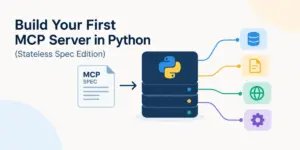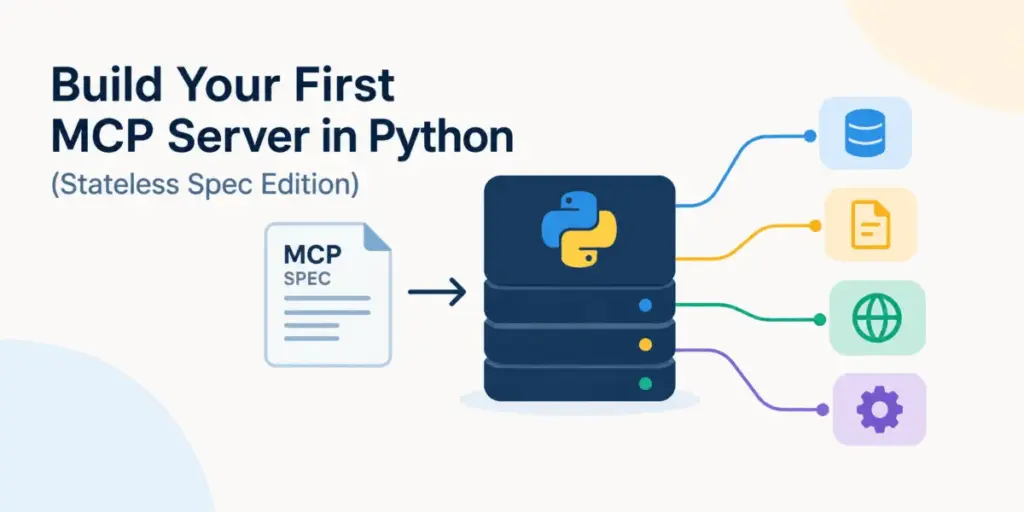
The Model Context Protocol (MCP) has undergone a fundamental architectural evolution, shifting toward a stateless core designed to simplify deployment and infrastructure scaling. Following the implementation of the updated MCP specification released this summer, modern clients no longer need to establish a persistent protocol session prior to dispatching requests. Furthermore, servers are relieved of the requirement to track ordinary requests via session identifiers. This structural update aims to make MCP servers significantly easier to deploy and scale behind standard HTTP infrastructure and conventional load balancers.
Simultaneously, the official Python SDK has advanced to version 2 as its primary stable line. This update introduces a higher-level application programming interface known as MCPServer, allowing developers to define tools, resources, and prompts using regular Python functions without manual JSON schema generation or boilerplate protocol management. The combination of a stateless protocol core and an intuitive Python SDK addresses long-standing challenges in enterprise AI architectures, particularly regarding multi-instance deployments and sticky routing requirements.
Understanding the Shift to a Stateless Protocol Core
Under previous iterations of the Model Context Protocol, establishing communication between an AI client and a server required a formal initialization handshake. This process generated a specific session identifier that had to be maintained across subsequent interactions. In production environments, this stateful design meant that multi-instance deployments often relied on sticky routing or shared session infrastructure to ensure that related requests reached the same server worker.
The updated specification re-architects this model into a self-contained request-and-response framework. Every incoming request now carries all the necessary context required for processing, decoupling individual interactions from persistent protocol sessions. Consequently, requests can be distributed freely across any available server worker in a cluster without risking state synchronization failures. For engineering teams managing high-volume AI applications, this architectural change removes the friction typically associated with scaling real-time model tooling.
Simplifying Developer Workflows with the Python SDK v2
The release of Python SDK v2 aligns with this protocol update by offering a streamlined approach to building MCP-compliant servers. Rather than forcing developers to manually construct tool manifests, handle custom argument parsers, or write explicit JSON schemas, the SDK leverages native Python type hints and docstrings. Functions decorated with the high-level application interface automatically translate Python signatures into valid MCP input schemas, allowing development teams to focus on business logic rather than protocol plumbing.
This design philosophy is evident in how developers expose capabilities such as tools, resources, and prompts. Tools function as executable actions that an automated language model can invoke based on contextual need. Resources provide static or dynamic data sources that host applications can read directly into context without executing functional code. Prompts offer reusable text templates initialized by users or host applications. By standardizing these primitives under a unified decorator pattern, the SDK maintains clear separation between actions, data retrieval, and prompt generation while preserving standard Python syntax.
Developing and Inspecting Servers Locally
To support local testing and rapid development cycles, the updated Python SDK incorporates a dedicated development workflow centered around the MCP Inspector tool. Developers initialize projects using modern Python package managers and install the CLI-enabled package distribution. By launching the development command within the local environment, engineers can spin up an interactive web interface that automatically discovers exposed tools, validates input schemas, and allows manual test invocations before deployment.
This local verification phase bridges the gap between writing standard Python functions and deploying production-ready AI infrastructure. Engineers can inspect tool execution outputs in real-time, ensuring that search queries, data retrieval functions, and prompt templates behave as expected when exposed to external language models. Once verified locally, the application can transition seamlessly from a development utility to a production-grade web service.
Deploying Over Streamable HTTP and ASGI Frameworks
When moving beyond local development, the updated SDK supports serving applications over Streamable HTTP. By default, the server exposes an endpoint designed to handle incoming model requests efficiently. For organizations integrating MCP servers into broader web architectures, the framework provides utilities to export the server as a standard ASGI application compatible with asynchronous web servers such as Uvicorn.
This compatibility allows engineering teams to embed MCP capabilities directly into existing FastAPI or Starlette deployments alongside other microservices. Because the underlying protocol is stateless, deploying these applications across multiple worker processes requires no specialized session storage. Load balancers can distribute traffic evenly across all available workers, enabling linear scaling as demand from client applications increases.
Managing Application-Level State in a Stateless Architecture
The transition to a stateless protocol core does not preclude applications from managing state; rather, it shifts the responsibility of state management from the protocol layer to the application layer. In scenarios where a client application requires persistent state—such as managing a shopping cart or tracking multi-step workflows—developers implement explicit application identifiers rather than relying on hidden protocol sessions.
Under this pattern, functions explicitly generate and return identifiers, such as unique basket or session keys, which are then passed back to the server by the model in subsequent requests. This explicit-handle approach ensures that state remains transparent and traceable within the application logic, aligning with the stateless nature of the underlying transport layer while fully supporting complex user workflows.
As engineering teams adopt the updated specification and the Python SDK v2, the barrier to building robust, scalable AI tool integrations continues to drop. By eliminating the need for protocol handshakes, session warming, and sticky routing, the latest iterations of the Model Context Protocol allow developers to build and scale AI-connected services using standard web engineering practices.