










The landscape of content creation and artificial intelligence text modification shifted notably in early October 2026, as an open-source project named Humanizer captured widespread attention across the developer community. Designed to bypass the need for costly monthly subscriptions, third-party API fees, or sending private writing to external cloud services, Humanizer allows users to rewrite AI-generated content completely locally. By early October, the project had amassed significant interest on Hugging Face, recording more than 143,000 downloads and over 2,100 likes. Its developer also reported that in internal evaluations, 95 percent of 210 rewritten English drafts successfully passed as human-written when tested against the popular detection tool Originality.ai, though those specific metrics remain unverified by independent parties.
The release arrives at a time when writers, marketers, and researchers frequently grapple with the limitations and inconsistencies of automated text detectors. Rather than relying on traditional cloud-based rewriting platforms that charge recurring fees, local execution offers a compelling alternative for individuals looking to maintain privacy and control over their data workflows.
Understanding the Humanizer Model
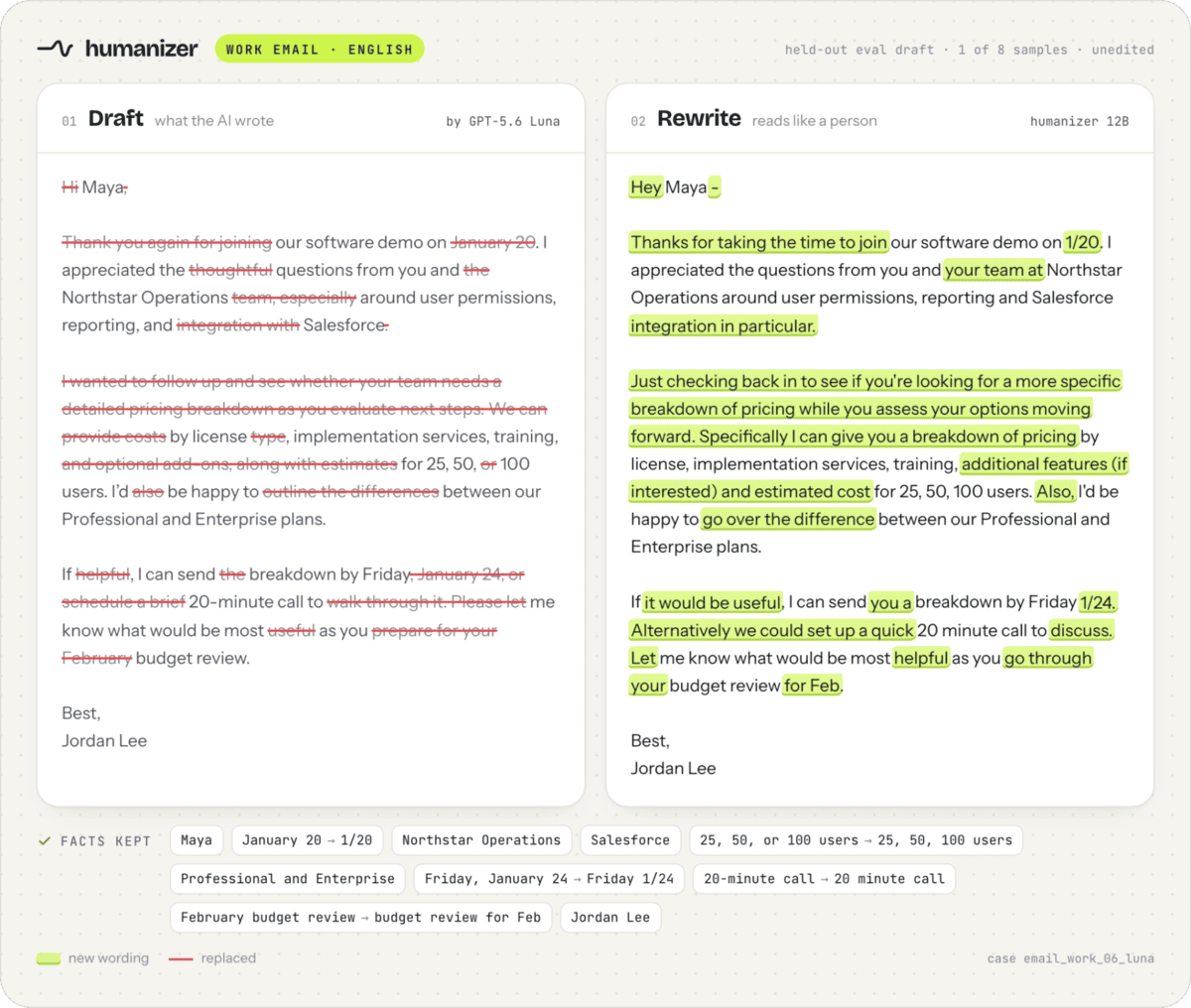
At its technical core, Humanizer is a 12-billion-parameter open-source model constructed upon Google’s Gemma 4 12B architecture. Unlike general-purpose large language models that are trained to perform a broad spectrum of tasks, Humanizer is specifically fine-tuned for a singular purpose: transforming robotic, AI-generated drafts into natural, fluid prose while carefully preserving the underlying facts, context, and core meaning of the original text.

The model’s training methodology involved a curated dataset comprising 28,598 distinct pairs of AI-generated drafts and corresponding human-written text. These samples spanned diverse genres and sources, including academic research papers, formal government reports, professional correspondence, and online community discussions from platforms like Reddit and Hacker News. The development team first employed supervised fine-tuning to teach the architecture how to bridge the stylistic gap between machine output and human expression. Following this foundational training, they utilized Direct Preference Optimization with nearly 4,000 preference pairs, culminating in Group Relative Policy Optimization. During this final phase, an automated large language model judge evaluated potential rewrites specifically for factual accuracy, minimization of redundant phrasing, and protection against unintended shifts in meaning.
An interesting characteristic of the model’s development cycle is that the creators did not incorporate AI detectors into the training loop. Instead, the optimization process concentrated strictly on improving linguistic quality, stylistic variability, and factual consistency. When processing a draft, Humanizer systematically restructures sentences, alters lexical choices, eliminates repetitive conversational patterns typical of generative models, and introduces natural variations in sentence length.
According to evaluations published by the developer, the full-precision model achieved a 95 percent success rate across 210 English test samples when evaluated by Originality.ai, while a quantized version designated as Q8_0 maintained approximately a 93 percent success rate. However, industry experts note that these performance figures are self-reported and that generative models can occasionally introduce subtle factual drift or display varying efficacy across competing detection platforms.
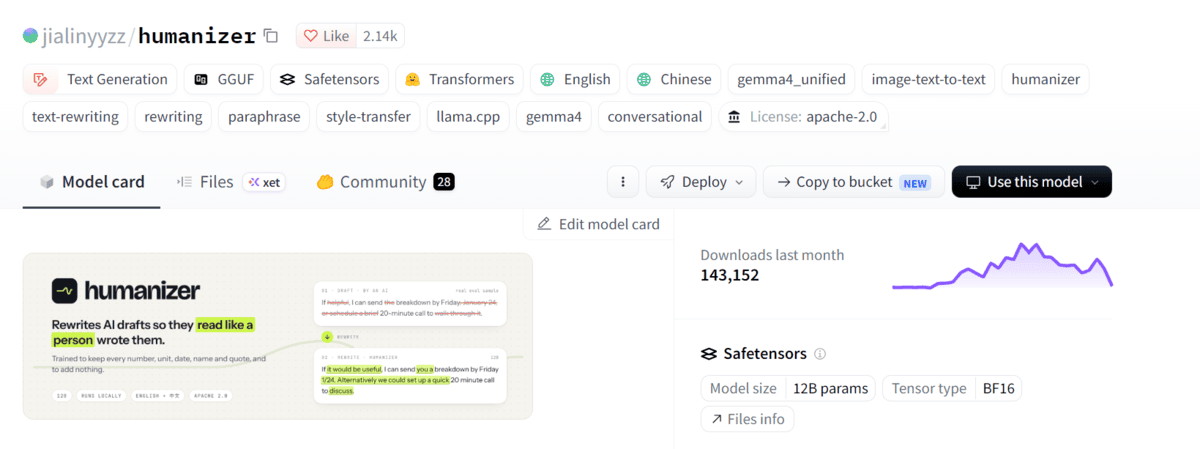
For users seeking accessibility, the software is not restricted to advanced technical implementations. A dedicated desktop application tailored for Windows and macOS environments has been made available, enabling offline execution without requiring the user to write code or interact with command-line interfaces. For more advanced workflows, Humanizer provides compatibility with popular inference engines and frameworks, including llama.cpp, Ollama, Hugging Face Transformers, MLX, and vLLM.
Technical Deployment and Local Inference
For practitioners and technical users operating within Linux environments, setting up the model locally involves utilizing inference engines optimized for consumer hardware. One common approach utilizes llama.cpp, an open-source inference framework designed to run large language models on local hardware without depending on external cloud infrastructure. By integrating NVIDIA CUDA support during the compilation of the server component, administrators can leverage graphics card acceleration to significantly expedite the text generation process.
The deployment process begins by cloning the core repository and compiling the server binary with GPU acceleration enabled. Once the compilation concludes, the environment is prepared for model weights acquisition. To balance memory footprint and generation quality without loading full-precision weights, developers frequently turn to quantized iterations. The 8-bit quantized version, known as Q8_0, provides a practical compromise between resource utilization and output fidelity, though systems with constrained video RAM can alternative smaller quantized variants.
Using the Hugging Face command-line interface, administrators download the requisite model weights and associated prompt configuration files directly into a designated local directory. Once acquired, the inference server is initiated with specific parameters tailored to maximize hardware efficiency. Configuration flags allow operators to offload model layers directly to the graphics processing unit, establish context windows, enable advanced attention mechanisms, and allocate processing threads.
Once the local server instance is active and responsive to local HTTP requests, users can interact with the model programmatically. By loading the official prompt configuration file—which contains the precise instructional framing recommended by the developers—the system ensures that incoming drafts are processed using the intended stylistic guidelines. Standard generation parameters, such as a temperature setting of 1.0 and a top-p threshold of 0.95, align with the creators’ recommendations for achieving optimal stylistic variation.
Practical Performance and Real-World Testing
Evaluating the real-world utility of Humanizer reveals a nuanced picture that often diverges from idealized benchmark claims. When practical tests are conducted on AI-generated articles using popular detection suites such as GPTZero and Copyleaks, the outcomes frequently exhibit significant variability.

In controlled experiments using standard 200-word articles initially flagged by detectors as entirely machine-generated, passing the text through the locally hosted Humanizer model frequently altered the detection metrics, but rarely resulted in a uniform classification. For instance, subsequent scans on rewritten text occasionally demonstrated a sharp reduction in AI probability scores, shifting the classification into an ambiguous zone where detectors expressed uncertainty or estimated a near-even split between human and machine origins. Rather than providing a definitive shield against automated detection, the practical experience often resembles a coin toss, with success rates fluctuating depending on the nature of the source material and the specific algorithms employed by the detection software.
This inconsistency highlights a broader challenge within the modern publishing and academic ecosystems: the inherent unreliability of AI detectors themselves. These detection systems are notoriously susceptible to false positives, occasionally flagging thoroughly human-written prose as machine-generated based on stylistic quirks or formal phrasing. Consequently, relying exclusively on detector scores to gauge the effectiveness of a rewriting model provides an incomplete assessment of text quality.
Despite these variable outcomes, the growing popularity of Humanizer underscores a significant shift in the open-source AI community. The ability to download, configure, and execute sophisticated rewriting models locally—free from monthly subscriptions, usage caps, or privacy concerns associated with third-party web services—offers distinct advantages for technical users and privacy-conscious writers. While the output still requires careful editorial review to ensure factual precision and stylistic coherence, tools like Humanizer represent an accessible step forward in local generative text modification. As open-source architectures continue to evolve, the gap between cloud-hosted proprietary utilities and local consumer hardware solutions is expected to narrow further, providing developers with greater autonomy over their text processing pipelines.