








The data science interview has undergone a more profound transformation over the past two years than it did across the preceding five. For professionals who prepared for technical evaluations in 2023 or 2024 and are now re-entering the job market, the traditional formats and expected competencies may no longer align with what hiring managers actually test in live loops.
Industry analysts note that these shifts are driven by a combination of structural market changes, tighter hiring budgets, and the pervasive integration of artificial intelligence into daily technical workflows. While core competencies such as database querying and statistical inference remain vital, the overall evaluation framework has shifted decisively away from pure implementation toward critical judgment, operational efficiency, and deep architectural comprehension.
The Modern Data Science Interview Loop
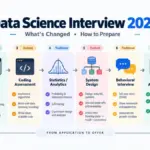
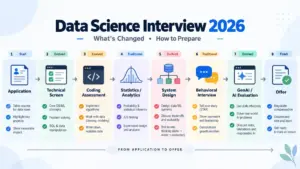
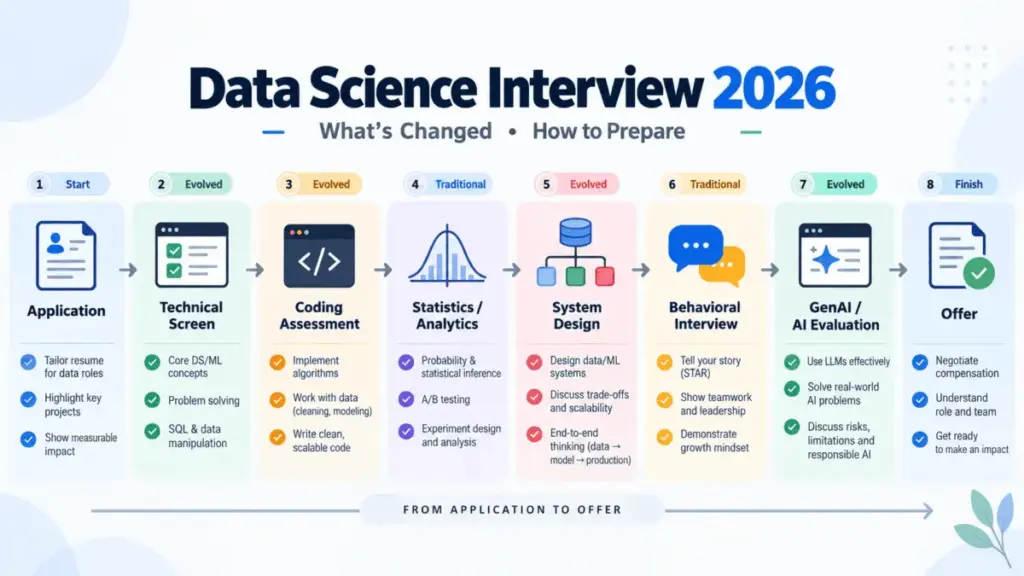
At mid-size to large technology companies, a standard data science interview loop typically spans four to six distinct rounds conducted over a period of two to four weeks. While the exact combination varies depending on the specific focus of the role, most recruitment processes now feature a predictable set of evaluations designed to test both foundational knowledge and modern adaptation.

The process usually begins with a recruiter screen lasting thirty to forty-five minutes, focusing on professional background, career motivation, compensation expectations, and timelines. Industry observers note that the bar for narrative clarity has risen significantly during this initial gatekeeping phase. Candidates who struggle to deliver a crisp, ninety-second summary of their career progression and precise motivations for applying often fail to advance.
Following the recruiter screen, candidates typically face a technical coding round lasting between forty-five and ninety minutes, usually conducted in a live shared environment using SQL and Python. This is frequently followed by a dedicated statistics and machine learning fundamentals round lasting up to ninety minutes, which measures conceptual depth, model selection judgment, and evaluation metric reasoning.
Furthermore, machine learning system design rounds—once reserved almost exclusively for senior or staff-level engineering loops—now routinely appear in mid-level evaluations. These sessions challenge candidates to architect end-to-end production systems from vague business prompts. Business case and product sense rounds similarly test a candidate’s ability to translate abstract commercial problems into measurable data tasks, while behavioral rounds increasingly probe how applicants handle unexpected model behaviors and AI-generated outputs.
Structural and Topical Shifts in Technical Evaluations
The most visible structural change in contemporary technical loops involves the integration of artificial intelligence tools. For over a decade, technical interviews operated under a strict no-tools policy. Today, that monolithic approach has fragmented into three distinct testing environments. Proctored no-tools rounds still exist at many large organizations to evaluate independent logical reasoning, placing less emphasis on raw syntax recall and more on architectural decisions such as when to apply window functions versus self-joins.
Conversely, a growing number of employers explicitly permit AI tools during live coding rounds. In these assisted environments, the evaluation philosophy flips entirely. Interviewers assume that candidates can generate working code, choosing instead to observe how they inspect, validate, troubleshoot, and explain that code in real time. Candidates who blindly accept AI-generated snippets without checking for edge cases or hidden logic errors generally fail these evaluations just as quickly as those who struggle with raw syntax.
Take-home assessments have also evolved in response to generative technologies. Because automated coding assistants can quickly generate polished baseline analyses, traditional take-home assignments have lost some of their standalone diagnostic value. Consequently, companies have responded by coupling take-home submissions with mandatory live defense sessions, requiring candidates to explain their design choices, modify their code on the spot, and defend every underlying assumption against sudden requirement changes.
Alongside these structural shifts, coding questions themselves have become AI-resistant. Pure implementation challenges have largely given way to debugging exercises where candidates receive intentionally flawed code generated by artificial intelligence and must identify, explain, and correct the underlying errors. Comprehension questions that require candidates to walk through an existing complex query and explain its underlying logic have become standard practice.
The Expansion of System Design and Generative AI Competencies
Machine learning system design has steadily moved downstream into mid-level loops, reflecting an industry expectation that modern data scientists own the entire model lifecycle rather than handing off prototypes to separate engineering teams. A typical design prompt might ask a candidate to build a real-time recommendation engine or design an evaluation framework for an artificial intelligence assistant handling tens of thousands of requests per second.
Within these system design evaluations, two new subject areas have emerged as critical benchmarks. First, LLM evaluation system design requires familiarity with automated evaluation methods, human-in-the-loop pipelines, golden test sets, and regression testing prior to deploying model updates. Second, candidates are increasingly expected to reason about vector databases, embedding pipelines, and retrieval-augmented generation architectures as standard components of infrastructure design.
Simultaneously, generative AI and large language model questions have coalesced into a distinct, highly rigorous interview category. Industry data suggests that a significant percentage of generative AI interview questions are rated at a high level of difficulty, rivaling advanced statistical theory. Hiring managers report that the candidates who excel in these technical discussions routinely volunteer insights regarding operational costs and systemic measurement metrics without needing prompting, demonstrating practical experience beyond theoretical experimentation.
The Enduring Foundations of Data Science
Despite the influx of advanced machine learning topics and generative tool evaluations, foundational competencies remain strictly non-negotiable. SQL fluency is tested as rigorously as ever, with many modern loops requiring candidates to work comfortably across multiple cloud database variants rather than generic SQL environments. Statistical reasoning, experimental design, hypothesis testing, and the ability to differentiate between various types of statistical errors remain central pillars of the evaluation process.
Furthermore, business case assessments continue to reward candidates who can translate ambiguous commercial challenges into structured, measurable data problems and communicate their findings clearly to non-technical stakeholders. As automated tools increasingly handle the mechanical generation of code and initial analyses, human communication, strategic clarity, and the ability to narrate one’s analytical reasoning process have become the primary differentiators between successful candidates and those who fail to receive offers.
The modern data science interview ultimately reflects a maturing industry where technical output can be accelerated by automation, placing a higher premium on critical judgment, operational awareness, and the ability to validate and explain complex computational systems.