










Every website shares a singular, fleeting moment of perfection. It is at its absolute best on the exact day it ships. The final code branch is successfully merged, the design is implemented precisely as envisioned, and the site goes live. For a brief, shining moment, everything is aligned. Yet, web professionals know an unspoken truth: the website will never be this good again.
This decline is rarely caused by catastrophic crashes or broken code. The site keeps functioning, servers remain online, and links resolve. Instead, the market shifts beneath it, messaging strategies evolve, competitors introduce new features, and the once-carefully crafted digital presence slowly stops matching the reality of the company it represents. A year later, a website can easily feel like a period piece—not strictly broken, but quietly falling behind. Every development and marketing team is intimately familiar with this digital decay, and historically, almost everyone has treated it as an inevitable law of nature.
However, industry perspectives are beginning to shift as web developers explore a different possibility. Proponents argue that a website could actively improve after launch instead of slowly drifting away from its peak, quietly optimizing itself in the background while the original creators turn their attention to other pressing projects.

Envisioning this workflow reveals a compelling proposition: while a team sleeps, an automated agent might notice that a recent design-system update failed to propagate properly to the pricing page and automatically correct it. Another agent might flag a batch of high-resolution images that were shipped uncompressed during a rushed release and optimize them for performance. A third system could catch an accessibility regression introduced by a newly deployed component, resolving it independently or flagging it for human review. In theory, a team would wake up to a site that is measurably superior to the one they left behind the previous evening, accompanied by a concise checklist of the few nuanced decisions that genuinely required human intervention.
Yet, as developers attempt to turn this vision into reality, they immediately encounter a fundamental paradox that has very little to do with technological limitations: almost nobody actually wants a website that changes entirely on its own.
Why Full Autonomy Misses the Mark
When organizations first gain access to capable artificial intelligence agents, the most obvious impulse is to hand over the entire website. The idea is to let agents write, edit, optimize, and publish content autonomously, allowing human teams to step completely out of the way. It sounds like the natural endpoint of automation, and it is almost universally the first picture people paint when they hear the phrase "autonomous website."
In practice, however, it is also the exact scenario that makes stakeholders deeply uncomfortable once they see it implemented in front of them.
This hesitation became starkly apparent to developers building Fimo, an autonomous website platform. Setting out with the initial assumption that full autonomy was the ultimate goal, the creators watched how users actually interacted with the technology. Instead of enthusiastically handing the reins over to the system, users hesitated. This reluctance did not stem from a fundamental distrust of the agents themselves, but rather from a core organizational truth: a corporate website has no single owner. Different sections, pages, and components belong to different stakeholders across an enterprise, and each individual wants a vastly different degree of control and autonomy.

Consequently, the core engineering and design challenge was never about whether people trusted the technology. It was about figuring out where to draw the line, and determining who gets to draw it. Once framed in this manner, the maintenance of a modern website splits cleanly into distinct categories of labor.
Separating Routine Maintenance from Core Value
The largest category of website maintenance is surprisingly vast, encompassing tasks that are entirely rule-bound, repetitive, and devoid of subjective creative joy. This includes maintaining accessibility compliance as page layouts shift, propagating design-system updates across dozens of templates whenever a foundational token changes, catching broken meta tags, compressing forgotten assets, and fixing links that rotted when a URL structure changed several sprints ago.
None of this is where human talent truly resides. Organizations rarely hire brilliant designers or engineers for their exceptional ability to spot a missing alternative text attribute on an image. Consequently, this administrative overhead represents the exact type of labor that teams are relieved to delegate. Furthermore, it is precisely the kind of work that automated agents handle best, because the tasks are defined by explicit rules rather than subjective taste. An agent that quietly maintains this foundational layer across an entire digital property without requiring human supervision does not threaten anyone’s job; rather, it absorbs the tedious eighty percent of website upkeep that usually falls through the cracks.
Recognizing how much of the day-to-day maintenance load fits into this category transforms the perception of autonomous tools. Teams are not handing over creative judgment or brand direction; they are simply offloading operational chores.
At the opposite end of the spectrum, however, lies a much smaller category of work that teams would refuse to delegate at any price. This is the intellectual core that justifies a team’s existence. While an agent can check a newly generated page against a comprehensive rulebook, verify color contrast ratios, ensure proper heading hierarchies, and confirm that copy aligns with an established style guide, it cannot decide what a page should emotionally feel like. It cannot evaluate whether a newly shipped feature is genuinely compelling in terms of artistic taste or strategic brand alignment. That higher-level judgment is precisely why creative professionals are hired, and no amount of technological capability will remove those responsibilities from a human desk.
The Personal Nature of Control
Between routine digital chores and untouchable creative judgment lies a vast middle ground. Products cannot easily solve this territory automatically because the boundary line falls in drastically different places depending on who is being asked.
Consider a concrete example: changing the default theme of a website to dark mode when a visitor first arrives. An autonomous agent is capable of executing this change across the codebase in a matter of seconds. The real dilemma centers on who has the authority to decide that the change should happen in the first place.
For the brand designer who fiercely guards the organization’s identity, the default theme is far from a trivial setting; it represents a deliberate statement regarding how the brand wishes to be perceived initially, and they insist on making that call themselves. For the software developer tasked with shipping updates, on the other hand, it is simply a one-line configuration change backed by clear functional rationale—precisely the kind of mundane adjustment they would gladly allow an agent to apply so they can move on to more complex engineering challenges.
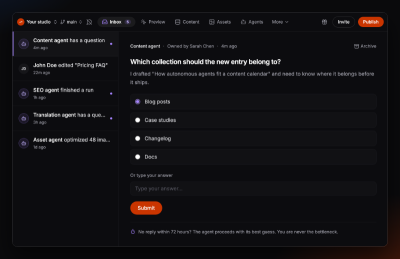
This scenario highlights a fundamental reality: the exact same task carries entirely different weights of judgment depending on the stakeholder. For one person, it represents a strategic brand decision; for another, it is merely a minor technical chore. Because "right" is ultimately a function of where an individual professional derives their personal value rather than an inherent property of the task itself, rigid, one-size-fits-all automation products inevitably fail. Control must be granular, operating on a per-task and per-person basis, providing tools that allow professionals to draw their own boundaries with precision.
Building and Shaping Individual Agents
Recognizing that the threshold of autonomy is deeply personal means that simple binary toggles—such as choosing rigidly between manual approval and full delegation—are ultimately insufficient. Because the appropriate boundary depends entirely on the specific capabilities and actions of the agent, the true unit of control must be the agent itself.
This realization fundamentally shaped platforms like Fimo, steering them away from fixed menus of rigid behaviors toward composable systems. Instead of choosing from preset automation modes, users construct and configure individual agents, explicitly defining what each entity is permitted to touch. Organizations can build specialized workers from scratch or adapt existing templates to fit their specific comfort levels. For instance, a team might deploy an accessibility agent with full autonomy to run completely unattended, while keeping a content generation agent on a tight leash whenever brand-facing messaging is involved.
These systems are designed to evolve over time rather than remain static. By learning from completed tasks and direct human feedback, the operational boundaries established last month naturally shift. Tasks that initially required cautious manual approval can eventually be delegated as the underlying agent consistently proves its reliability. Trust accumulates organically not through abstract reassurance, but through transparent, verifiable performance.
Overcoming the Risk of Digital Stagnation
Ultimately, the initial anxiety that an autonomous system might alter a website without explicit permission obscures a much larger and more insidious danger: the frozen website.
A digital property that remains entirely untouched does not stay secure or pristine; it simply falls behind the curve in a slow, imperceptible drift until it no longer accurately represents the active organization behind it. The ultimate purpose of introducing autonomy into web development was never to completely remove humans from their digital creations, but rather to eliminate the relentless accumulation of digital decay. By allowing automated agents to handle the overwhelming volume of routine maintenance, teams can reclaim their time and focus their human judgment on the handful of critical initiatives that genuinely deserve their attention, ensuring that a website’s launch day remains merely its starting point rather than its absolute peak.