The concept of agentic artificial intelligence has rapidly transitioned from exploratory academic research papers into mission-critical production infrastructure faster than most technology leaders anticipated. Across industries of every size, autonomous systems capable of dynamic planning, utilizing external software tools, and iteratively executing tasks toward defined objectives are now embedded within code review pipelines, automated research assistants, customer operations platforms, and internal enterprise automation workflows.
However, industry experts note that building agents that function reliably in a live production environment is substantially more challenging than developing a convincing prototype or a single-turn chatbot. The architectural gap between a standard conversational model and a multi-step autonomous system involves a completely different class of engineering hurdles. These include complex state management, robust failure recovery mechanisms, secure sandboxed execution environments, and sophisticated evaluation methodologies that assess entire multi-step trajectories rather than isolated model outputs.
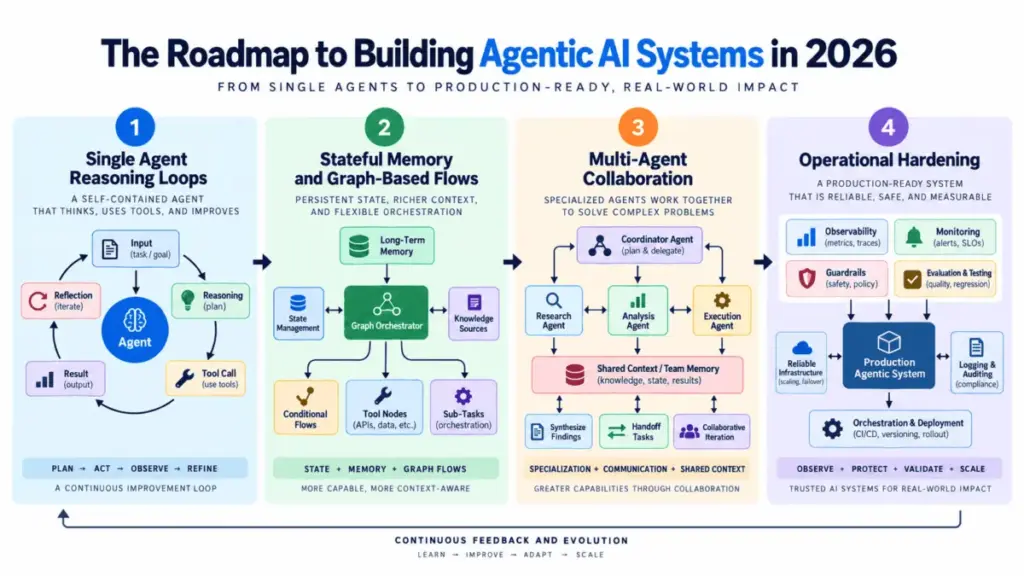
To address these architectural challenges, AI educator and technical mentor Vinod Chugani has outlined a comprehensive developmental roadmap that progresses through four distinct tiers of increasing system complexity. This framework guides engineering teams from understanding individual cognitive architectures to designing, hardening, and observing full multi-scale agentic systems.
Understanding the Anatomy of an Agent and Cognitive Architectures
Before engineering complex systems involving multiple interacting agents, developers must first cultivate a precise understanding of how an individual agent operates internally. Within the modern artificial intelligence landscape, an "agent" refers to a computational system designed to perceive its operating environment, select appropriate actions, execute those actions via external tools, and ingest the resulting feedback to inform its next decision cycle. This continuous execution loop separates true agents from standard, stateless language model invocations.
Several prominent reasoning paradigms currently govern how these agents structure their operational loops. Structured tool interaction serves as a cornerstone of this architecture. Modern systems communicate with external utilities through strict function-calling protocols, where the underlying model outputs a structured instruction targeting a specific API, search engine, database, or code interpreter. It then receives the execution results and incorporates them directly into its subsequent reasoning phase.
Engineers frequently rely on validation libraries such as Pydantic or TypeChat to enforce strict output schemas, thereby preventing malformed tool calls from cascading into severe downstream system failures. Furthermore, managing dynamic context assembly remains a primary operational challenge. Long-running autonomous loops continuously consume tokens. Effectively determining what information remains inside the context window at any given stage, what data requires summarization, and what historical facts should be offloaded to external memory banks represents a vital systems challenge that directly impacts both operational expenditure and logical coherence.
Stateful Memory and Graph-Based Control Flows
A single-loop agent that routinely discards its operational context between consecutive tool invocations is inherently brittle and prone to failure. Consequently, the next evolutionary tier of agent design involves outfitting these systems with persistence layers capable of retaining memory across multiple steps, while simultaneously replacing rigid, linear execution chains with flexible, graph-based control flows.
Memory within advanced agentic architectures typically manifests in distinct functional forms, preserving historical context, episodic experiences, and semantic knowledge bases. Simultaneously, the architectural shift from linear execution chains to graph-structured control frameworks is critical. Traditional linear paths—progressing strictly from step one to step two and onward—are straightforward but lack adaptability. Real-world tasks naturally branch into alternate paths depending on interim findings; for instance, a research agent might pursue one direction if a verified source is found and pivot entirely if it is not.
Advanced orchestration frameworks model these intricate execution pathways as directed acyclic graphs or cyclical state machines to handle iterative refinement. Furthermore, state persistence is the critical juncture where production-grade agentic platforms diverge fundamentally from experimental prototypes. Checkpointing the state of an agent at every individual operational step unlocks three essential capabilities: the ability to roll back to a prior state when an error occurs, the capacity to pause and resume long-running tasks—which is particularly vital when integrating human-in-the-loop approval gates—and the forensic debugging of complex branching execution paths after a run has concluded.
Multi-Agent Collaboration and Protocol Design
When a single autonomous agent proves insufficient for managing large-scale tasks, the subsequent architectural phase involves designing collaborative teams of specialized agents. This team-based approach allows organizations to tackle multifaceted objectives that would otherwise overwhelm a singular system.
Establishing the correct team topology represents the primary design decision in this phase, determining how specialized entities divide labor and share responsibility. However, the design of inter-agent communication protocols is frequently underappreciated yet remains absolutely essential for operational stability. Agents that communicate exclusively through unstructured natural language tend to accumulate compounding errors across successive handoffs. Establishing strict, structured message schemas for task assignments, status updates, and result reporting—alongside explicit task handoff contracts—dramatically reduces coordination failures across the network.
Additionally, formal conflict resolution mechanisms become vital when specialized agents generate divergent outputs. A critic agent might reject a tentative software solution proposed by a coder agent, or a research agent might uncover empirical evidence that directly contradicts the foundational assumptions of a planner agent. Robust multi-agent systems require clearly defined programmatic rules for resolving these divergences, whether through automated voting protocols, iterative re-querying incorporating the conflicting context, or direct escalation to a human reviewer. Furthermore, standardized interfaces such as Anthropic’s Model Context Protocol are increasingly being adopted across the industry to seamlessly connect disparate agents to external tools and enterprise data repositories.
Operational Hardening, Sandboxing, and Observability
A multi-agent deployment that operates successfully in a controlled development environment but fails unpredictably in production cannot be considered a finished product. This final operational stage encompasses the critical engineering practices required to render agentic systems reliable, secure, and fully debuggable at scale.
Runaway loop mitigation stands as a primary operational priority. Agents that lose sight of their primary objective, encounter unexpected tool outputs, or become trapped in self-reinforcing reasoning loops can rapidly consume unbounded computational tokens and time. Production environments require first-class infrastructure controls, including circuit breakers that halt execution after a predetermined threshold of failed steps, strict recursion depth limitations, and dynamic token expenditure ceilings.
Simultaneously, sandboxed code execution is non-negotiable for any agentic system equipped with dynamic programming capabilities. Permitting an autonomous agent to execute arbitrary code directly on a shared server introduces catastrophic security vulnerabilities. Isolated execution environments—ranging from secure containerization tools and cloud-based sandboxes to specialized WebAssembly runtimes—provide the necessary physical confinement to allow agents to write and test code safely.
Observability remains the area where early agentic deployments most frequently encounter failure. Evaluating the true quality of a multi-step agent trajectory requires far more than merely validating the final terminal output. Modern tracing platforms provide execution graph visualization that records every individual agent reasoning step, tool call, and intermediate state. This deep visibility allows engineers to isolate precisely where along an execution trajectory an agent deviated from its intended path. Conducting trajectory-level evaluations—scoring both the operational efficiency and factual correctness of the entire execution path rather than just the final answer—is rapidly becoming the definitive standard for assessing production-grade agent reliability.