









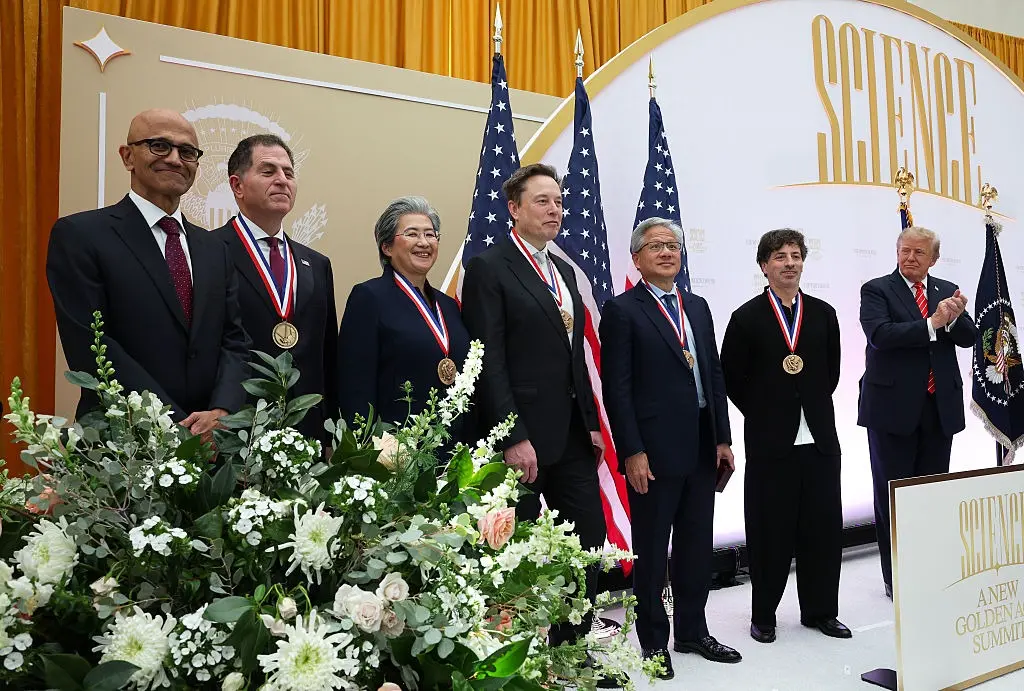
WASHINGTON, D.C. — In a ceremony held Thursday at the Golden Age of American Innovation Summit, President Trump bestowed the nation’s highest scientific and technological honors upon a cohort of the country’s most prominent technology executives. The event, which underscored the administration’s focus on domestic industrial dominance and technological superiority, saw leaders from across the Silicon Valley and computing sectors recognized for their contributions to the American landscape.
The National Medal of Science, widely regarded as the pinnacle of scientific achievement in the United States, was awarded to Tesla and SpaceX CEO Elon Musk, Nvidia CEO Jensen Huang, Alphabet co-founder Sergey Brin, and AMD Chair and CEO Lisa Su. Simultaneously, the National Medal of Technology and Innovation—an honor recognizing those who have made lasting contributions to the nation’s economic and technological well-being—was presented to Microsoft CEO Satya Nadella and Dell Technologies founder and CEO Michael Dell.
The summit, designed to highlight the intersection of government policy and private-sector ingenuity, served as a platform for the administration to frame these executives as the architects of a new era of American exceptionalism. During his remarks, President Trump praised the honorees, crediting them with helping to "pioneer an incredible future for America." He asserted that the combined efforts of these individuals ensured that the United States would maintain a competitive edge on the global stage, declaring to the audience, "Because of them, we will always be on top. No one else can compete with us."

A Convergence of Philanthropy and Policy
While the ceremony served as a celebration of scientific and technological progress, it has simultaneously ignited a broader conversation regarding the relationship between the nation’s tech elite and the current administration. Reports surfacing in the wake of the event have highlighted that the collective group of awardees has been responsible for nearly $6 billion in donations and financial support directed toward projects and initiatives linked to President Trump and his administration.
The scale of these financial ties has drawn scrutiny from transparency advocates and political analysts alike. For instance, companies like Alphabet and Microsoft have previously contributed to the president’s inauguration fund and were instrumental in the funding of the White House ballroom renovation. Other organizations, such as AMD, have directed capital toward pro-Trump political action committees.
Among the most significant financial engagements noted in recent reporting is that of Michael and Susan Dell. Their commitment of $6.25 billion to the "Trump Accounts"—a federal initiative designed as a savings and investment program for American children—represents one of the largest philanthropic efforts by a private sector leader in recent memory. This immense injection of private capital into a government-backed program has become a focal point for those analyzing the depth of the partnership between the White House and the technology sector.
The Paradox of H-1B Restrictions
The presentation of the National Medal of Technology and Innovation to Satya Nadella occurred under a cloud of regulatory friction. The award ceremony followed closely on the heels of an administration decision to indefinitely suspend Microsoft from the H-1B visa program. The program has long been a cornerstone of the American technology industry, allowing companies to recruit and retain highly skilled foreign workers for specialized roles that are often difficult to fill with the domestic labor pool.

The timing of the suspension, juxtaposed with the recognition of Nadella’s achievements, presents a complex picture of the administration’s current tech policy. By restricting access to foreign talent, the White House has signaled a move toward a more protectionist stance on labor, even as it seeks to cultivate a close relationship with the executives who argue that such access is vital for innovation. For industry analysts, this contradiction underscores the challenge of balancing the administration’s "America First" rhetoric with the realities of the globalized tech ecosystem that leaders like Nadella are forced to navigate.
The Broader Implications for Silicon Valley
The recognition of these six individuals—Musk, Huang, Brin, Su, Nadella, and Dell—serves as a high-profile endorsement of the administration’s economic agenda. By aligning the prestige of the National Medal of Science and the National Medal of Technology and Innovation with leaders who have invested heavily in the current administration’s priorities, the White House is effectively signaling its preferred model for the future of American industry: a public-private partnership characterized by deep financial cooperation and a singular focus on national competitiveness.
For the recipients, the medals represent a significant honor, yet the backdrop of the summit suggests that the award carries with it an implicit expectation of continued support for the administration’s vision. As the tech industry continues to grapple with shifting regulatory environments, trade tensions, and the rapid advancement of artificial intelligence and hardware, the role of these specific leaders remains critical.
The Golden Age of American Innovation Summit was framed by the administration as a roadmap for the coming years, with the President emphasizing that the recipients’ work is the engine behind the nation’s resurgence. Whether this focus on domestic champions can offset the challenges posed by restrictive labor policies and geopolitical competition remains an open question for the tech sector.
As the dust settles on the ceremony, the focus of the industry will likely shift back to the practical realities of the marketplace. The administration has made its stance clear: it views these specific leaders as the primary drivers of American success. However, the intersection of political giving, regulatory policy, and scientific achievement continues to be a subject of intense debate. For now, the administration has doubled down on its commitment to these specific figures, placing them at the center of its economic narrative and cementing their status as the key architects of its long-term technological strategy.
The event concluded with a clear message from the White House: the future of American industry is intrinsically tied to the success of its largest corporate entities, and the administration intends to continue fostering that relationship, despite the complexities and public scrutiny that such an alignment inevitably attracts. Whether this strategy will lead to the sustained technological dominance the President envisioned remains to be seen, but for this week, the spotlight remained firmly on the intersection of corporate wealth, political influence, and the prestigious medals bestowed upon those who sit at that crossroads.