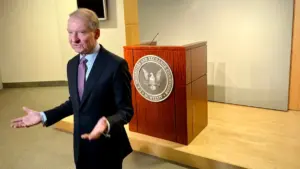











The U.S. Securities and Exchange Commission (SEC) is preparing for a significant transition in its leadership. Commissioner Hester Peirce, a long-serving official widely regarded as the most prominent ally of the digital assets industry within the agency, has officially announced her departure. Her final day at the commission will be October 2, bringing an end to a tenure defined by her persistent, often solitary, push for regulatory clarity in a sector that spent years operating in a legal gray area.
Peirce’s resignation was confirmed in a letter shared on the social media platform X this past Friday. Her exit comes at a pivotal moment for the agency, which continues to issue updated guidance and policy frameworks regarding the crypto industry even as it undergoes internal leadership shifts. The timing of her departure underscores the evolving nature of the SEC’s approach to digital assets, moving from a period of almost exclusive focus on enforcement to one characterized by an emerging attempt at codified rule-making.
A Legacy Defined by Regulatory Advocacy
For years, Hester Peirce served as a steady, often dissenting voice within the SEC. During the chairmanships of both Jay Clayton and Gary Gensler, she frequently stood apart from the majority of the commission, questioning the agency’s reliance on "regulation by enforcement." While her colleagues often opted to pursue legal action against crypto firms to establish precedents, Peirce consistently argued that the lack of clear, tailored rules hindered legitimate innovation and forced projects to either operate in the shadows or flee to more welcoming jurisdictions abroad.

Her moniker, "Crypto Mom," was earned through her unwavering advocacy for a regulatory environment that would allow digital asset businesses to thrive without sacrificing investor protection. She often noted that the agency’s failure to provide guidance created a "parade of enforcement actions" that provided little practical clarity for developers and entrepreneurs.
Her patience for a more constructive regulatory approach finally found a foothold during the administration of President Donald Trump. With the transition in executive leadership and the arrival of SEC Chairman Paul Atkins, the agency’s internal dynamics shifted. Peirce was eventually appointed to lead the newly established SEC Crypto Task Force, a role that allowed her to move beyond critique and toward the active development of policy. This transition marked a significant milestone, shifting the agency’s posture toward creating a more structured, predictable environment for digital asset issuers.
From Enforcement to Frameworks
Peirce’s contributions to the agency have spanned a wide array of technical and philosophical domains. Her work helped clarify the SEC’s stance on contentious issues such as crypto-asset mining, staking protocols, and the rise of meme coins. Perhaps most significantly, she spearheaded efforts to create concrete definitions for various types of crypto assets, aiming to provide industry participants with a roadmap for compliance.
Under her influence, the agency began moving toward more formal rule-making, most notably with the introduction of "Regulation Crypto Assets." This framework was designed to establish a pathway for digital assets to be offered to the public without immediately triggering the cumbersome requirements of traditional securities law, which critics have long argued are ill-suited for the decentralized nature of many blockchain-based projects.
One of the most consequential initiatives during her later tenure has been the introduction of the "innovation exemption." This effort, which focuses on the tokenization of securities, represents a major departure from the agency’s historically rigid stance. By implementing a five-year pilot program, the SEC aims to allow for controlled experimentation, gathering data that will eventually inform permanent regulations. This approach reflects Peirce’s core philosophy: that regulators should prioritize creating "sensible regulatory parameters" that empower individuals to make their own choices while maintaining enough oversight to ensure market integrity.

In her resignation letter, Peirce reflected on this delicate balance, stating, "Maximizing people’s freedom to choose what is best for themselves and their families within sensible regulatory parameters designed to give them the confidence to transact with others is a delicate and vitally important task for the regulator." Following her departure from public service, Peirce is set to join the faculty of the Regent University School of Law as an associate professor, where she will likely continue to influence the legal discourse surrounding financial technology.
The SEC’s Shifting Landscape
The departure of Commissioner Peirce leaves the SEC in a state of flux. With her exit, the commission will be left with only two active members: Chairman Paul Atkins and Commissioner Mark Uyeda. While SEC rules do permit the agency to continue its operations with only two members—a quorum is established when a majority of the current sitting commissioners are present—the vacancy leaves the agency significantly shorthanded during a period of intense policy development.
To date, the Trump administration has not yet put forward nominees to fill the vacant Democratic seats on the commission, nor have there been new appointments to the Commodity Futures Trading Commission (CFTC), which often works in tandem with the SEC on crypto-related issues. Whether the administration intends to fill these vacancies in the coming months remains an open question, leaving the future composition of the agency uncertain.
Final Efforts and Continued Guidance
The SEC’s commitment to refining its crypto policy did not pause in the shadow of Peirce’s departure announcement. On the same day her resignation was made public, the agency released a new set of frequently asked questions (FAQs) designed to address lingering industry concerns.
This latest document aims to provide clarity on the "essential managerial efforts" test, which has been a primary point of friction for many crypto projects. The industry has long sought to understand at what point a project’s adjustments to its software, marketing strategies, or operational decisions cross the threshold into becoming "managerial efforts" that trigger securities law requirements. The agency’s new guidance attempts to navigate these highly technical distinctions, offering a more granular look at how developers can interact with their communities and protocols without inadvertently classifying their tokens as investment contracts.
Additionally, the FAQ addresses the complexities surrounding "staking receipt tokens" and the evolving role of secondary markets. By providing these answers, the SEC is attempting to address the practical, day-to-day uncertainties that have plagued the industry for years. As Commissioner Peirce prepares to leave, these documents serve as a testament to her final push to institutionalize a more predictable, transparent, and innovation-friendly regulatory environment.
Her exit marks the end of a long, often difficult chapter at the SEC, one characterized by intense ideological debate over the role of government in the burgeoning digital economy. Whether the path she helped forge toward a more nuanced regulatory framework will persist remains to be seen, but her influence on the conversation has been undeniable. As the commission moves forward with a reduced headcount, the industry will be watching closely to see if the momentum toward clear rules—a goal Peirce championed throughout her tenure—continues to gain traction or if the agency reverts to its more contentious, enforcement-heavy roots.