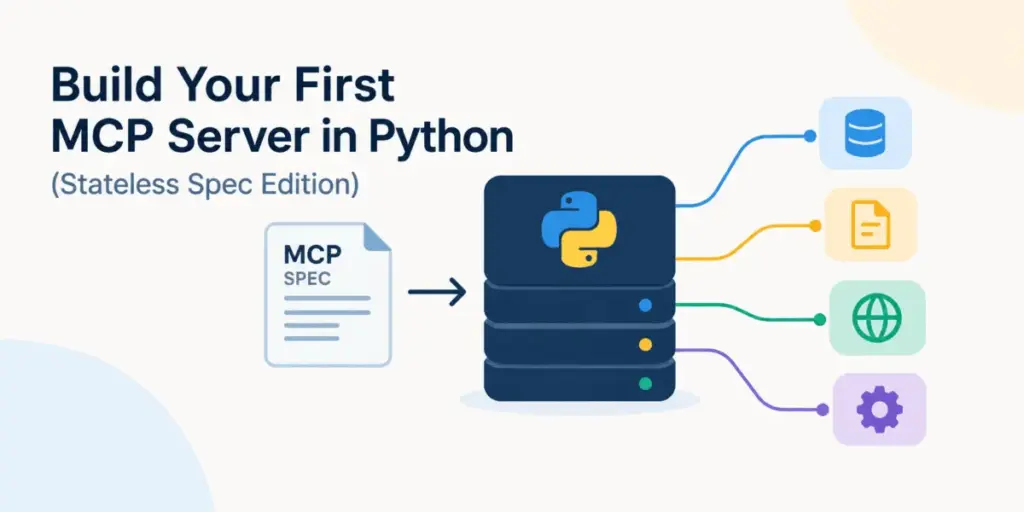
The ecosystem surrounding the Model Context Protocol (MCP) has undergone a fundamental architectural shift following a critical update to its core specifications. Under the updated protocol standards, the architecture of MCP has transitioned to a fully stateless model. This evolution eliminates the traditional requirement for modern clients to establish complex protocol sessions prior to executing requests, while simultaneously liberating servers from relying on specific session identifiers for standard operations. Consequently, deploying and scaling MCP servers behind conventional HTTP infrastructure has become significantly more streamlined for development teams.
Alongside this protocol-level evolution, the official Python software development kit has advanced to its second major stable iteration. This updated SDK introduces a high-level server interface designed to let developers define core protocol primitives—such as tools, resources, and prompt templates—using standard Python functions decorated with intuitive markers. Rather than manually writing intricate JSON schemas or handling cumbersome argument parsers, developers can now rely on the SDK to automatically derive necessary input schemas directly from function signatures and type hints.
To understand the practical impact of these changes, consider the development of a typical developer knowledge-base server. Such an application exposes several core capabilities to a language model host. These include search tools that allow the model to query internal documentation, static resources that present available articles via uniform resource identifiers, and reusable prompt templates designed to standardize customer support interactions. In a fully stateless model, none of these components require user session state to persist on the server side. Every incoming request contains all the information necessary for processing, which directly aligns with the modern stateless design philosophy.

Initializing such an application requires minimal boilerplate. Utilizing modern Python package managers and development tools, engineers can quickly bootstrap their projects and integrate the necessary software development kit packages. The resulting project structure remains exceptionally clean, often consisting of just a few modular files for server implementation and client verification. Within the server implementation, defining a tool is as straightforward as writing a standard Python function and applying a specific decorator.
The underlying framework automatically translates the function parameters, type hints, and default arguments into valid input schemas. For instance, a search function accepting a query string and an optional integer limit automatically generates a corresponding schema requiring the query parameter while keeping the limit optional. This approach ensures that Python development within the MCP ecosystem remains natural, allowing function signatures to double as interface definitions without requiring redundant configuration manifests.
Beyond executable tools, the protocol handles static information through resources. While tools represent active functions that perform computational work, resources expose data that host applications can read directly into context. Resources are addressed via uniform resource identifiers and operate in a manner analogous to retrieval-oriented web requests, providing a clear conceptual separation between data inspection and action execution. Furthermore, the protocol accommodates prompt templates through similar decorator patterns, enabling developers to structure how language models format responses for specific operational scenarios.
Development workflows benefit significantly from these architectural updates. The SDK includes development commands that launch servers with integrated inspection tooling, providing user interfaces for testing and executing tools locally. Once development is complete, these servers can transition seamlessly to production environments by running over streamable HTTP protocols or integrating directly into standard asynchronous server gateway interface applications. Because the framework can generate compatible ASGI applications, developers can easily embed MCP endpoints inside larger web services built on established frameworks.
The transition to a stateless core represents a major departure from earlier protocol lifecycles. Under older specifications, maintaining continuous interactions required establishing explicit protocol sessions tracked via specific session headers. This requirement frequently complicated multi-instance deployments, often necessitating sticky routing configurations or shared session state infrastructure to ensure requests returned to the correct worker instance.
The updated specification redefines MCP interactions as self-contained request and response cycles. Individual requests can now be handled by entirely independent server instances without any protocol-level session tying them together. This shift transforms MCP servers into horizontally scalable services capable of distributing incoming workloads across multiple worker processes using standard load-balancing techniques.
While the protocol itself no longer maintains session state, application-level state remains entirely feasible. Architectural patterns under the stateless model encourage applications to manage state explicitly by passing identifiers—such as resource or transaction handles—directly through the tool parameters and model interactions. This shifts the responsibility of state management from the protocol layer to the application layer, allowing developers to utilize traditional database or caching mechanisms without relying on sticky sessions.
Verification of these implementations is readily handled by updated client libraries. Developers can construct lightweight client scripts that connect directly to HTTP endpoints, negotiate protocol versions, list available tools, and execute remote procedures asynchronously. As the broader artificial intelligence engineering community adopts these stateless standards, the combination of simplified Python SDKs and scalable HTTP infrastructure is expected to accelerate the integration of specialized knowledge bases and tools into modern language model applications.