Engineering organizations undertaking complex cloud infrastructure migrations are increasingly prioritizing gradual cutover strategies and rigorous validation frameworks over high-risk, single-event transitions. A comprehensive technical case study recently detailed by engineering teams highlights a methodical approach to migrating a payments application from Amazon Web Services (AWS) to Google Kubernetes Engine (GKE) while maintaining zero customer-facing downtime and keeping the underlying database on AWS.
![How to Migrate an Application from AWS to GKE [Full Book]](https://cdn.hashnode.com/uploads/covers/5e1e335a7a1d3fcc59028c64/8a1803ba-c9c9-496d-b2c4-58392cc655eb.png)
The guided migration framework centers on a small-scale payments application comprising a React user interface and an Express API running on a single AWS EC2 instance, backed by a PostgreSQL database hosted on Amazon RDS. Rather than attempting a monolithic rewrite or moving all system components simultaneously, the engineering strategy focuses on decoupling the application tier from the data layer. By shifting the user interface and API to Google Kubernetes Engine while leaving PostgreSQL securely anchored in AWS, teams can significantly reduce operational risk during the transition.
![How to Migrate an Application from AWS to GKE [Full Book]](https://cdn.hashnode.com/uploads/covers/698d563262d4ce66226a844a/a72eb451-8e75-4125-ba27-070c73054436.png)
According to technical documentation and architectural reviews shared by the project contributors, the migration strategy relies on preserving the public uniform resource locator utilized by end users. Instead of employing DNS-based routing shifts—which can suffer from prolonged propagation delays and caching issues across various internet service providers—the architecture utilizes an advanced global load balancer configured with weighted traffic distribution. This mechanism allows engineers to gradually shift production traffic from AWS to GKE by increments as small as one percent, observing system stability, latency, and error rates before stepping up the volume.

![How to Migrate an Application from AWS to GKE [Full Book]](https://cdn.hashnode.com/uploads/covers/698d563262d4ce66226a844a/8abff4c2-ba02-41d0-907f-5c167d485d31.png)
Throughout the migration lifecycle, the engineering blueprint emphasizes rigorous baseline measurement and automated validation. Prior to provisioning infrastructure on Google Cloud, teams establish concrete performance metrics on their existing AWS setup, capturing essential indicators such as transaction success rates, request throughput, and p95 latency distributions. These metrics serve as the definitive benchmark against which the new GKE environment is evaluated.
![How to Migrate an Application from AWS to GKE [Full Book]](https://cdn.hashnode.com/uploads/covers/698d563262d4ce66226a844a/6fd0931a-5d4d-44ff-8531-74ce76b75023.png)
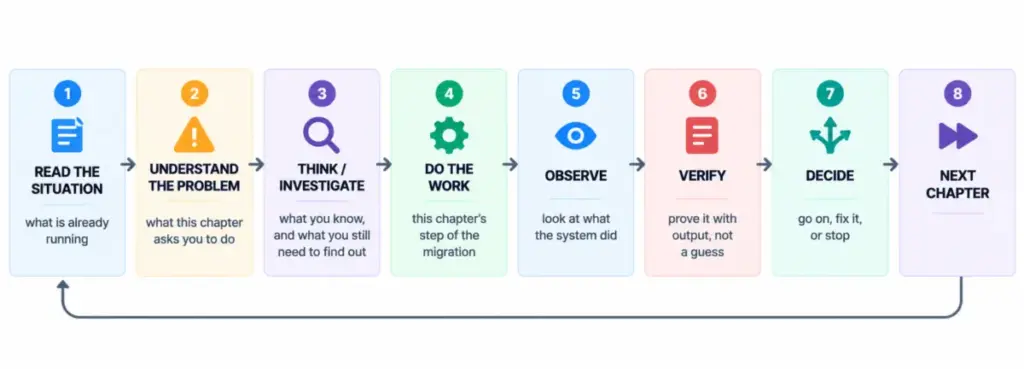
The transition process is broken down into structured developmental phases, beginning with local execution via containerization, followed by infrastructure provisioning using Terraform. The Google Cloud environment is systematically constructed across distinct modular stages, encompassing foundational application programming interfaces, isolated networking architecture, private container clusters managed via GKE Standard, secure artifact registries, and robust identity management leveraging Workload Identity Federation rather than static service account key files.
![How to Migrate an Application from AWS to GKE [Full Book]](https://cdn.hashnode.com/uploads/covers/698d563262d4ce66226a844a/b613b3b6-75c8-4b75-9cca-02750c9bab8a.png)
Security and resilience form central pillars of the migration methodology. By avoiding the storage of long-lived credential files and utilizing short-lived tokens derived from secure workload identity pools, organizations minimize potential attack surfaces. Furthermore, secret management is tightly integrated through cloud-native secret stores that synchronize sensitive configuration data, such as database connection strings and cryptographic signing secrets, directly into ephemeral container runtimes without exposing plaintext values within version-controlled repositories or local build environments.
![How to Migrate an Application from AWS to GKE [Full Book]](https://cdn.hashnode.com/uploads/covers/698d563262d4ce66226a844a/e734e16e-0bec-4f5e-b542-03b2cecc1980.png)
A critical focus of the multi-cloud architecture is database connectivity and connection pool management. Because the PostgreSQL database remains hosted on Amazon RDS within AWS throughout the migration, containerized workloads running on private GKE nodes must access the database securely across cloud boundaries. This is achieved by routing outbound traffic through a managed Cloud NAT gateway with a static public IP address, allowing the AWS database security groups to strictly whitelist the specific egress endpoint while enforcing strict Transport Layer Security encryption via required connection parameters.
![How to Migrate an Application from AWS to GKE [Full Book]](https://cdn.hashnode.com/uploads/covers/698d563262d4ce66226a844a/3dfe597d-2949-4ce8-beae-285d3a5a13f2.png)
Engineering leads heavily emphasize the importance of connection pool mathematics during dual-run phases. When both AWS and GKE environments operate concurrently to support fractional traffic routing, active API processes across both platforms simultaneously open database connections. Organizations must carefully balance maximum pod replicas, individual connection pool limits, and the underlying database server’s maximum connection ceilings to prevent connection exhaustion, request timeouts, and service degradation during peak load periods.
![How to Migrate an Application from AWS to GKE [Full Book]](https://cdn.hashnode.com/uploads/covers/698d563262d4ce66226a844a/fff6c8f3-be7d-4bb3-a525-403f424af320.png)
Automated continuous integration and continuous deployment pipelines play a vital role in ensuring artifact consistency and rigorous vulnerability screening. Container images are automatically compiled, scanned for known Common Vulnerabilities and Exposures using automated security tools, pushed to secure container registries, and deployed to isolated staging namespaces via declarative configuration management tools. Before any production promotion occurs, automated validation gates execute comprehensive functional checks—verifying application health, database connectivity, user authentication flows, and idempotency safeguards that prevent duplicate financial transactions under retry conditions.
![How to Migrate an Application from AWS to GKE [Full Book]](https://cdn.hashnode.com/uploads/covers/698d563262d4ce66226a844a/30d53ba8-7337-4be6-8b45-3d37955315b2.png)
The structured cutover phase involves methodical traffic shifting, starting at minimal fractional percentages and scaling upward incrementally while continuously monitoring telemetry data, error rates, and synthetic transaction health probes. In the event of an anomalous performance spike or infrastructure instability, pre-configured automated rollback mechanisms enable operators to instantly redirect traffic back to the stable AWS baseline while preserving clear operational visibility through distinct UI notification banners and centralized logging metrics.
![How to Migrate an Application from AWS to GKE [Full Book]](https://cdn.hashnode.com/uploads/covers/698d563262d4ce66226a844a/02de98fe-808d-4a5a-8e96-aa9b4fcb5a18.png)
Ultimately, the architectural blueprint demonstrates that large-scale cloud migrations can be achieved systematically through disciplined planning, isolated component separation, and continuous empirical validation. By establishing clear performance baselines, enforcing stringent security reviews, and utilizing weighted traffic distribution alongside robust rollback procedures, engineering teams can modernize their infrastructure stacks while safeguarding transactional integrity and maintaining continuous service availability for end users.