








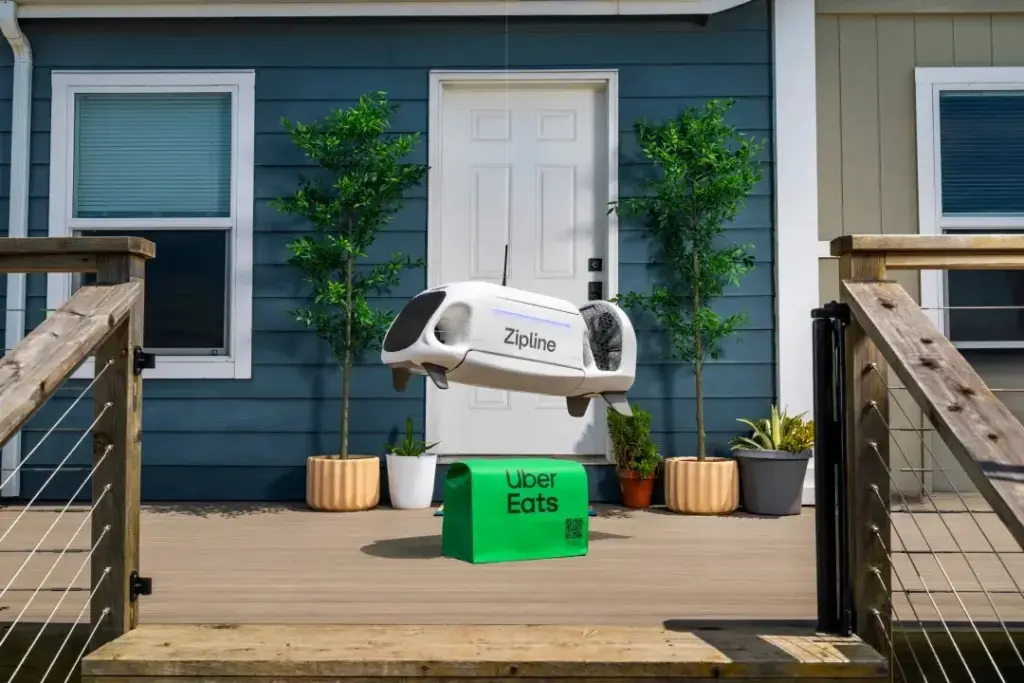
Uber Eats customers in the Houston suburb of Spring, Texas, are witnessing a transformation in logistics this week as the company officially launches its inaugural commercial drone delivery service. The initiative marks the first real-world application of a strategic partnership between the ride-hailing giant and Zipline, the California-based autonomous drone delivery startup. By leveraging advanced aerial technology, the two companies aim to redefine the speed and efficiency of local food delivery, setting the stage for a massive expansion across the United States.
While the service begins in Spring, the roadmap for the partnership is significantly more ambitious. The companies have already confirmed plans to extend drone delivery operations into Dallas, Texas, in the near future. This rollout is merely the beginning of a broader, long-term objective: Uber and Zipline have set an aggressive goal of reaching one million deliveries per day using the startup’s proprietary drone fleet by the end of 2029.
The Mechanics of Aerial Delivery
The logistics behind this operation rely on Zipline’s long-range autonomous drones, which are designed to navigate the suburban airspace with precision. These aircraft are engineered to transport food orders weighing up to eight pounds—a capacity that covers a substantial portion of typical takeout and convenience store requests.

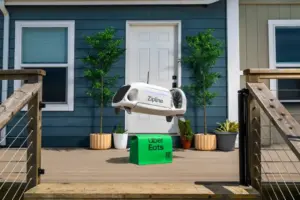
Operating at an altitude of approximately 300 feet, the drones travel at speeds reaching up to 70 miles per hour. A defining feature of the Zipline system is that the aircraft do not touch down at the delivery site. Instead, to maximize safety and efficiency, the drones hover over the designated drop-off point and lower the customer’s order, which is securely housed within a protective pod, using a specialized tether system. This approach eliminates the need for landing infrastructure at the customer’s residence or business, allowing for a seamless handover process.
To access the service, Uber Eats customers located within the active delivery zones will notice a new "drone" icon on the home page of their app. Selecting this icon filters the platform to display only the restaurants participating in the pilot program. At the launch in the Houston area, the roster of available vendors includes a mix of major national chains, such as Jersey Mike’s and Zaxby’s, alongside prominent local favorites like Urban Bird and Abu Omar Halal.
A New Standard for Consumer Expectations
Keller Cliffton, CEO and co-founder of Zipline, emphasized the strategic importance of this milestone, suggesting that the collaboration is about more than just convenience; it is about fundamentally altering consumer behavior. "In partnership with Uber Eats, we are going to create a new expectation for delivery in America," Cliffton said in a statement.
The partnership arrives at a time when the broader drone delivery sector is experiencing both rapid growth and increasing public scrutiny. The push for widespread adoption is mirrored by other major players in the space, including Alphabet’s Wing and Amazon’s Prime Air. As these companies race to scale their operations, they are encountering pushback from residents in various communities who have raised concerns regarding noise pollution, the potential disruption of local wildlife, and risks to privacy and personal safety.
In response to these concerns, industry proponents argue that drone delivery offers a net benefit to society, primarily by reducing vehicle traffic. By shifting smaller, time-sensitive deliveries from traditional passenger vehicles to the sky, proponents suggest that communities can alleviate congestion and reduce the environmental footprint associated with "last-mile" delivery. The vision, according to those leading the charge, is a future where the need to hop in a car for a minor errand—such as picking up a forgotten item or a quick takeout order—is replaced by an autonomous, efficient, and low-impact aerial alternative.

From Medical Logistics to Global Scale
While the sight of drones delivering burgers may feel like a futuristic leap, the technology has been in development for years. Zipline, founded in 2014, has spent the last decade building a comprehensive delivery ecosystem that integrates sophisticated aircraft, automated launch and landing systems, and complex logistics software.
The company’s origins were far removed from the world of food delivery. Zipline initially gained international recognition for its work in Rwanda, where it developed a vital network for the rapid, autonomous delivery of blood, vaccines, and other critical medical supplies to remote or hard-to-reach health facilities. This mission-critical experience provided the company with a robust foundation for navigating the challenges of autonomous flight in diverse environments.
In 2022, Zipline achieved a significant regulatory milestone when it was granted Part 135 air carrier certification by the Federal Aviation Administration (FAA). This certification served as a vital gatekeeper, authorizing the company to conduct long-range commercial drone deliveries within the United States. Since securing that clearance, Zipline has been scaling its operations, moving from niche medical logistics toward the high-volume, consumer-facing market.
Deepening Ties Between Uber and Zipline
The collaboration between Uber and Zipline is built on a foundation that goes deeper than a simple service agreement. Uber has emerged as a significant investor in the drone startup, signaling its long-term commitment to the future of autonomous logistics. While the specific financial terms of the investment have remained private, the scale of Zipline’s recent funding rounds underscores the massive capital being poured into the sector.
Last week, Zipline announced that it had successfully raised $1.5 billion in a funding round led by Paradigm, WCM Investment Management, and Layer Global. The round included participation from Uber, further solidifying the strategic alignment between the two firms. This influx of capital is intended to support the infrastructure expansion required to meet their ambitious 2029 delivery targets.
Despite these significant investments and technological advancements, both Uber and Zipline acknowledge that the industry is still in its infancy. Widespread adoption remains contingent on overcoming regulatory hurdles, refining flight paths to minimize community impact, and gaining the trust of the public.
As the Houston pilot program begins to generate real-world data, it will provide a testing ground for these challenges. The performance of the drones, the feedback from local residents, and the reliability of the delivery process will likely dictate the pace at which the service is introduced to other markets. For now, the sight of a Zipline drone navigating the skies of Spring serves as a tangible indicator of how the delivery landscape is poised to change. The experiment in Texas represents a critical turning point—a move from the theoretical potential of drone technology to the practical, daily reality of autonomous commerce.