









Much of a company’s most valuable analytical insight never actually makes it into its software architecture. Instead, this critical knowledge lives in fragmented spreadsheets, internal text documents, or complex mental models that employees have cultivated over years of hands-on experience. A sales team, for instance, might rely on a sophisticated, proprietary scoring model to evaluate prospective business opportunities based on specific account types, nuanced engagement patterns, and historical deal trajectories. While this model is instrumental in determining which customers deserve immediate attention and resources, applying it in daily operations still requires a tedious human workflow: collecting scattered data points, running manual calculations, and organizing the resulting metrics.
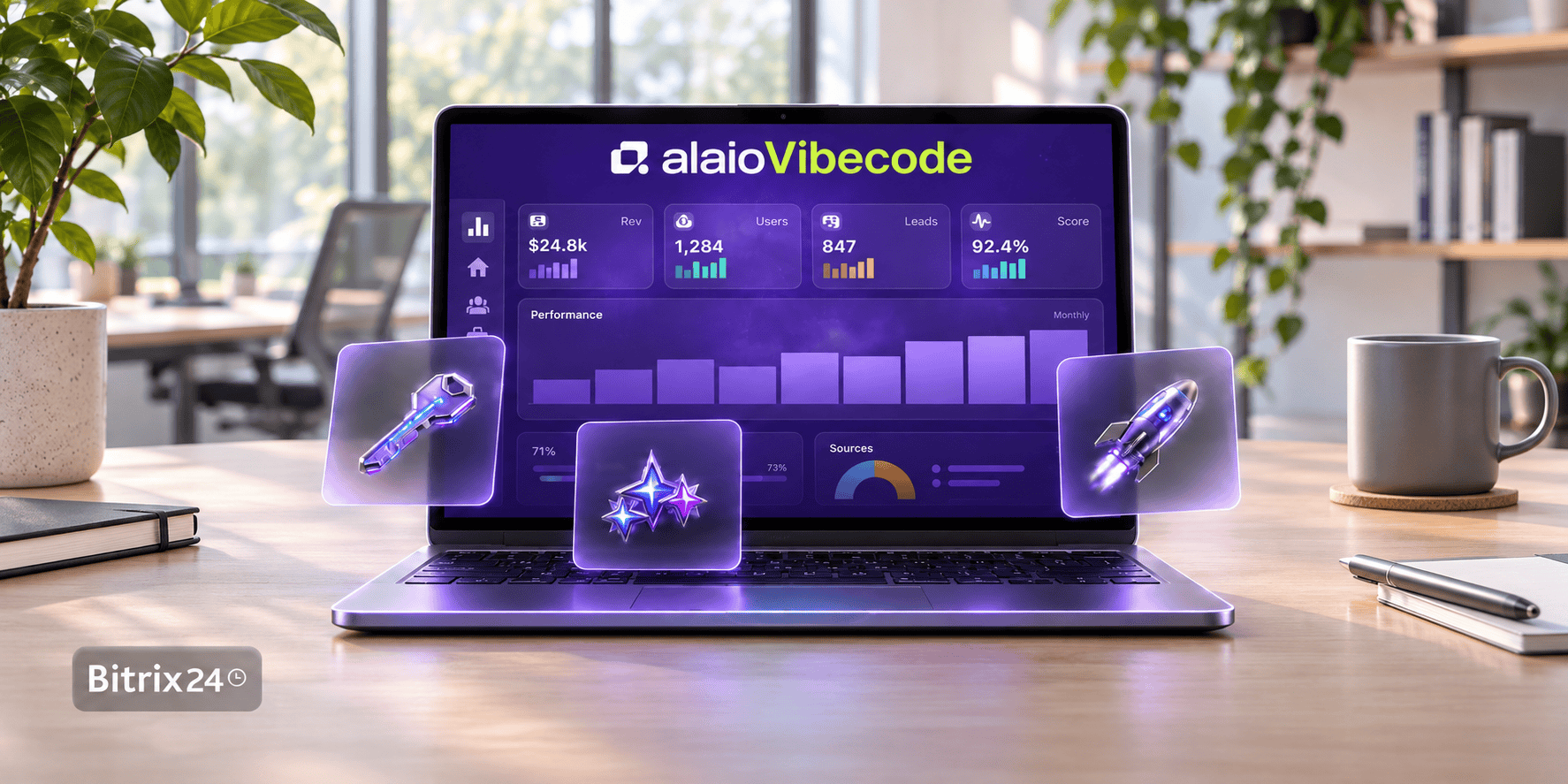
This operational friction points to a broader enterprise challenge: bridging the gap between bespoke business logic and functional software. It is precisely this kind of specialized requirement that platforms like Alaio Vibecode—an artificial intelligence application builder and vibe coding ecosystem designed for Bitrix24—aim to resolve. By leveraging natural language descriptions and AI-assisted development workflows, business teams can bypass conventional, lengthy software development cycles. Instead, they can build custom CRM analytics dashboards, tailored reporting applications, specialized lead scoring engines, intelligent chatbots, and autonomous AI agents entirely on their own terms.
Bitrix24 has long functioned as a unified environment combining customer relationship management, project tracking, task management, document handling, team communication, analytics, and workflow automation. However, the introduction of Alaio Vibecode allows organizations to extend this ecosystem significantly. Businesses can construct auxiliary applications around their proprietary calculations, unique operational processes, and distinct working methods without commissioning a traditional, resource-heavy software engineering project.

How Custom CRM Analytics Apps Evolve Through AI
The core capability of Alaio Vibecode lies in its ability to empower non-technical teams to create applications that automatically retrieve relevant records from Bitrix24, execute company-specific logic, and present the analytical results in formats precisely optimized for specific decision-making moments. Rather than settling for rigid, out-of-the-box reporting features, teams can build entirely new applications from scratch or adapt ready-made solutions to fit their workflows. Every application can be architected around a distinct mathematical calculation, a specific operational workflow, a unique combination of data sources, or a specialized business process.
The process of building a custom application begins with a straightforward, natural language description of what the user wants to achieve. Alaio Vibecode integrates seamlessly with advanced AI coding agents, including Claude Code, Cursor, and OpenAI Codex, translating plain-text instructions into fully functional applications that connect directly to the user’s Bitrix24 workspace and interact dynamically with live business data.
To visualize this in a real-world scenario, consider the aforementioned sales team utilizing its own multi-variable scoring model. An initial instruction given to the AI builder might look remarkably simple: construct a customer relationship management analytics dashboard that ranks open sales opportunities according to a custom scoring model. The prompt might specify incorporating account types, elapsed days since the last recorded activity, total deal amounts, and historical engagement patterns, while also displaying a granular score breakdown and allowing employees to open the corresponding CRM records directly from the interface.
In this workflow, the human team retains total control over defining the underlying calculation rules. For instance, the department might decide to assign 40 percent of the overall score to customer engagement, 30 percent to account fit, and the remaining 30 percent to closing potential, complete with explicit qualitative and quantitative criteria for each component. The resulting AI-built application then handles the heavy lifting, continuously calculating scores and presenting relevant deals in a clean, ranked table.
Testing and Refining AI-Built CRM Scoring Applications
Before deploying a newly minted custom scoring application across an entire department, engineering and business teams are encouraged to conduct rigorous validation checks using historical CRM data. The primary objective of this exercise goes beyond merely verifying mathematical accuracy; it ensures that the underlying scoring model actively supports better, more informed business decisions. Initial checks help identify questionable assumptions or flawed logic embedded in the prompt, allowing teams to test the model against a much larger, representative dataset before full rollout.
Following this initial testing phase, teams retain the flexibility to adjust weighting parameters, introduce new data filters, or alter how final results are visually presented to the end user. An analytical concept or hypothesis that once required submitting a formal ticket to a dedicated IT development department can now be prototyped, evaluated, and refined in a fraction of the time.
Managers across various corporate tiers frequently require vastly different perspectives on the exact same underlying business data. For example, a regional sales director might need a comprehensive interface displaying monthly recurring revenue, active pipeline value, conversion rates, and individual employee assignments all in one place. Conversely, another manager might configure an AI-driven dashboard explicitly focused on unearthing opportunities that have inexplicably stopped progressing through the sales funnel.
Applications become exponentially more valuable when they transition from passive data displays to active operational assistants. Imagine a sales representative starting their workday and looking for a concise morning briefing detailing which commercial deals are rapidly approaching their closing dates, which opportunities have gone quiet, and which fresh leads require immediate outreach. Ready-made solutions available within Alaio Vibecode include pre-built frameworks like the Daily CRM Digest, which is architected specifically to streamline this exact morning routine.
Another preconfigured application, known as the Lead Scoring Board, automatically categorizes open business deals into distinct operational tiers such as Hot, Warm, or Cold, relying on variables like pipeline progression stages, total deal values, and recent communication frequency. While defined scoring rules dictate the underlying priority, integrated artificial intelligence explicitly explains the underlying factors driving each individual result. Consequently, sales teams can easily investigate individual deals and iteratively adjust their scoring logic to better reflect their evolving customer qualification criteria.
This dynamic highlights a vital guiding principle for modern AI-driven analytics tools: allow deterministic code to calculate metrics that can be defined with mathematical precision, and reserve artificial intelligence for interpreting and explaining those results. Rather than asking a language model to estimate the number of inactive deals based on vague parameters, an effective application should count inactive deals directly from actual CRM records. Once the hard data is retrieved, AI can step in to summarize the findings and highlight specific records that warrant immediate human investigation.
This distinction becomes critically important when evaluating sales representative performance. A representative managing 80 active leads is not necessarily performing better than a colleague managing only 35. Factors such as lead sources, qualification stages, regional territories, and core responsibilities often vary wildly across a workforce. A custom analytics application built for the organization can apply nuanced, context-aware comparisons that genuinely make sense for the business.
While a general-purpose chatbot can certainly analyze an exported CRM report, that export merely captures a static snapshot frozen in time. In contrast, a custom application can fetch current records securely through an API and apply consistent, up-to-date calculations every single time it runs. Although modern language models are increasingly capable of accessing live data when equipped with appropriate toolsets, a dedicated application ensures that recurring, complex analysis remains standardized, repeatable, and easily shareable across an entire team.
Integrating External Context with Advanced Deal Intelligence
While a traditional CRM excels at recording internal interactions and historical account data, sales representatives frequently need broader contextual awareness regarding recent developments occurring outside the company walls. Vital external signals—such as a sudden product announcement, significant corporate expansion hiring, or a fresh venture capital funding round—can fundamentally alter the strategic angle of a sales conversation.
Applications designed to bridge this gap, such as the Deal Radar tool within the platform, effectively combine internal CRM records with targeted external research. The tool retrieves a specific commercial deal and its associated corporate entity directly from Bitrix24, scours external data sources for relevant signals, and compiles a comprehensive executive briefing complete with verifiable source references and an analytical explanation of why the account might be worth prioritizing at that exact moment.
While external sources naturally require human verification, and a corporate announcement does not automatically translate into an immediate sales conversion, tools like Deal Radar successfully automate the collection of external context that employees would otherwise have to research entirely by hand. This integration demonstrates how internal corporate data, external intelligence, and AI-driven interpretation can converge to support tactical business decisions.
Optimizing Task Management and Project Workflows
Analytical insights are not exclusive to sales departments. Consider a marketing department coordinating complex campaigns, content calendars, and design approvals through Bitrix24 Tasks and Projects. A marketing manager is often far less interested in reviewing every single minor assignment than in rapidly identifying which pending tasks require urgent intervention.
A task-monitoring application built through Alaio Vibecode exemplifies this targeted approach. The Stale Task Monitor application calculates a comprehensive risk score by evaluating factors such as the number of overdue days, the elapsed time since the planned start date, and the assigned task priority. It then surfaces the highest-risk assignments in a clean, ranked list, accompanied by AI-generated explanations and actionable suggestions for the next operational step.
This methodology adapts fluidly to a wide variety of organizational workflows. While marketing teams might prioritize overdue campaign approvals, operations departments can focus intensely on assignments that threaten upcoming delivery schedules. Each enterprise can define what operational urgency means within its own unique context.
For a manager facing dozens or even hundreds of simultaneous assignments, a prioritized list of five critical tasks is often infinitely more useful than an exhaustive dashboard covering every single ongoing project. The most effective analytical interface is rarely the one packed with the highest number of complex visualizations; rather, it is the one that empowers an employee to make the next correct decision with absolute clarity.
Furthermore, user placement is critical for adoption. Applications built with Alaio Vibecode can be embedded directly into Bitrix24 CRM record views, the main navigation menu, or the dedicated Tasks and Projects workspace. A task-monitoring app, for instance, can launch seamlessly from within the relevant project environment rather than forcing users to navigate away to a separate reporting module.
Embracing Conversational Analytics for Business Data
Certain analytical inquiries are inherently easier to articulate through natural conversation than to explore by navigating complex charts and filter menus. A sales manager might need a quick, verbal summary of specific high-value opportunities, while a project coordinator wants to identify overdue deliverables ahead of an upcoming team meeting.
Custom chatbots and specialized AI agents built via the platform allow employees to retrieve critical information and request executive summaries through natural-language dialogue. Preconfigured solutions like the Hermes AI agent can be tailored specifically for different internal business roles, empowering them to answer complex operational questions, draft routine reports, and assist personnel with day-to-day administrative tasks. Naturally, system administrators retain the ability to strictly limit agent permissions, ensuring that automated helpers only access the specific data sets and actions authorized for their assigned role.
In practice, a manager might rely on a traditional CRM dashboard for a high-level weekly pipeline review, and subsequently turn to a conversational AI assistant to ask targeted questions about an individual, nuanced deal. The structured dashboard excels at comparative analysis across massive records, while the conversational assistant handles focused, ad-hoc inquiries with ease.
Building and Validating Your First AI Analytics Application
Embarking on the journey of AI-assisted app development typically begins by identifying a recurring analytical question that currently demands specific data manipulation or rigid business rules—perhaps a weekly report that is painstakingly assembled by hand every Friday, or a specialized prioritization method that employees follow intuitively but have never formally automated.
Before prompting an AI coding agent to generate an application, defining a few core parameters ensures success. Vague instructions inevitably leave AI coding agents guessing about what truly matters to the business. For example, a prompt asking the system to simply "build a project dashboard" provides virtually no operational context. In contrast, an optimized description provides explicit clarity, such as instructing the system to display overdue tasks within the specific marketing department, grouped by responsible employees, complete with upcoming deadlines and a prioritized list of assignments requiring immediate attention.
Once the initial application is successfully generated, users can continuously refine its underlying rules, filtering criteria, and user interface elements through subsequent natural-language instructions. Teams can also adapt existing templates by modifying scoring logic, activity thresholds, or UI layouts to match shifting enterprise requirements.
Regardless of the starting point, validating generated results against actual business records remains paramount. Organizations must meticulously check calculations, data filters, and access permissions. Alaio Vibecode accommodates secure reporting implementations by supporting read-only API keys and granular authorization options tied directly to signed-in employees’ native Bitrix24 permissions.
Security remains a foundational pillar of the development environment. Businesses retain the ability to construct custom applications around data securely stored within Bitrix24 without ever needing to migrate sensitive CRM records into external, vulnerable third-party databases. Applications interface with Bitrix24 exclusively through strictly controlled, permission-governed access channels. For organizations requiring elevated security postures, applications can even be deployed on private infrastructure servers that remain completely inaccessible from the public internet.
Ultimately, involving the actual end users early in the deployment process is essential. Frontline employee feedback often uncovers overlooked filters, questionable analytical calculations, or simple opportunities to make the interface significantly more intuitive. While AI-assisted development drastically lowers the barrier to building software, thoughtful human testing and continuous iteration remain indispensable.
Organizations often find that their next most valuable internal software tool already exists in a fragmented spreadsheet formula, a recurring Monday morning report, or a set of informal rules passed down through teams. By identifying the necessary Bitrix24 data, articulating the desired operational outcome, and validating the output with the people who will rely on it every day, businesses can effectively transform routine analytical burdens into bespoke software applications tailored precisely to their commercial goals.