








WASHINGTON — Executives at AST SpaceMobile are standing firmly behind their aggressive timeline to field a brand-new, reusable orbital launch vehicle in just two years, despite encountering widespread industry skepticism and conflicting accounts regarding where the rocket will actually lift off from.
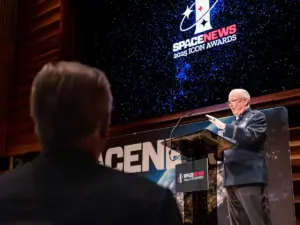
The company, which is currently building and deploying an ambitious constellation of direct-to-device cellular broadband satellites, hosted a high-profile "unveiling" event in New York City to discuss its newly announced Blacklift launch vehicle. AST SpaceMobile formally revealed the rocket project to the public just days prior, explaining that the vehicle is being developed specifically to secure reliable, dedicated access to space for its rapidly expanding BlueBird satellite constellation amid an increasingly constrained and competitive global launch market.
"We’re not doing this thing because we want to be in the launch business. We want this because we have so much demand of our satellites and, as you have seen it, we cannot get enough launches on time," Abel Avellan, chief executive officer of AST SpaceMobile, told attendees and investors during the presentation.
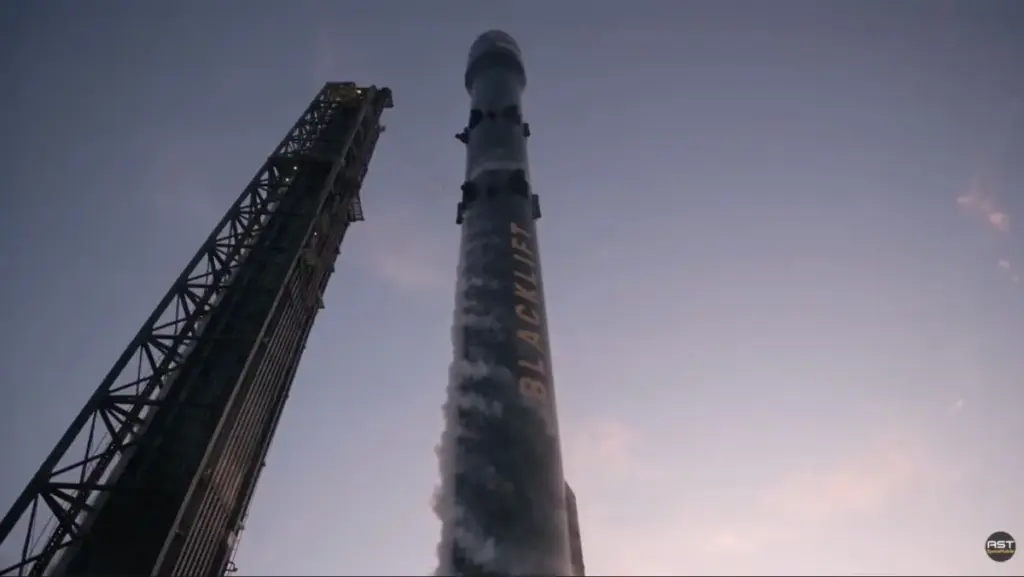
Designed as a heavy-lifter with a payload capacity of approximately 20 tons to low Earth orbit, the Blacklift vehicle is engineered to carry up to five full-scale BlueBird satellites on a single flight. According to the company’s long-term operational roadmap, the rocket will be utilized exclusively for AST SpaceMobile’s own internal payloads, with a projected flight rate of twice a month once the system matures and achieves operational status.
Despite billing the New York gathering as an unveiling event, AST SpaceMobile did not display any heavy flight-ready hardware on site. Instead, the presentation relied heavily on video footage of engines supplied by Firefly Aerospace—which AST is acquiring for the Blacklift system—alongside computer-generated animations of the rocket in flight. A substantial portion of the event was dedicated to highlighting the company’s broader manufacturing progress, including a virtual video tour of the massive production facility in Midland, Texas, where the company builds its massive spacecraft.
The company did, however, peel back the curtain on several key technical specifications governing the rocket’s design. Blacklift will feature an unconventional three-stage configuration. The first stage will be powered by seven Miranda engines developed by Firefly Aerospace, while the second stage will utilize two Firefly Vira engines, and the third stage will rely on a single Vira engine. This multi-stage architecture represents a stark departure from the current industry standard, where most modern rockets optimized for low Earth orbit payloads prefer a simpler two-stage layout.
Avellan explained during the event that this three-stage approach is directly tied to the company’s engineering plans to recover and safely reuse the first stage. "When you have three stages, the first stage will go up not that much and will come back down very easily, compared of going back very high and then trying to maneuver that back to Earth," he elaborated. This design philosophy diverges significantly from existing reusable orbital rockets, such as SpaceX’s Falcon 9 and Blue Origin’s New Glenn, as well as next-generation vehicles currently under development by competitors like Relativity Space, Rocket Lab, and Stoke Space, all of which rely on traditional two-stage designs.
Furthermore, AST SpaceMobile noted that the Blacklift vehicle will be manufactured entirely out of advanced carbon composite materials. Avellan pointed out that this choice stems directly from the company’s extensive engineering experience using composite structures on its own spacecraft, combined with Firefly’s technical background and manufacturing expertise. Utilizing composites, he argued, reduces the overall dry mass of the vehicle by an impressive 40 percent compared to conventional metallic structures.
Perhaps the most contentious and widely debated aspect of the Blacklift program is its lightning-fast schedule, which calls for the vehicle’s maiden flight to take place in late 2028. AST SpaceMobile executives argue that their strategic decision to procure proven engines directly from Firefly Aerospace, rather than embarking on a costly and time-consuming in-house engine development program, is what makes this ambitious schedule feasible.

"A typical design cycle of a rocket could be over a decade. Eighty percent of that is on the engine," Avellan noted, emphasizing the massive development hurdles traditionally faced by aerospace startups. "We’re starting this program on third base. We bypass 10 years of engineering and R&D."
In addition to acquiring the primary propulsion systems from Firefly, AST SpaceMobile outlined in its presentation that it intends to source a variety of other critical vehicle components—ranging from advanced avionics to stage separation systems—from established aerospace "heritage suppliers." Despite relying on outside suppliers for critical subsystems, Avellan asserted that the company would still maintain a "95% vertically integrated" footprint on the rocket itself. He noted that the company has already begun manufacturing composite propellant tanks at its Midland, Texas, factory utilizing existing industrial tooling, with an initial batch of 10 tanks scheduled to be completed by January for rigorous structural and qualification testing.
"What remains is integration, stage testing, and licensing: exactly what the plan is built around," a corporate presentation slide asserted.
However, industry analysts and aerospace experts have raised questions about how smoothly AST SpaceMobile’s manufacturing experience with satellite structures will translate into building high-pressure orbital rocket propellant tanks. The technical challenges associated with large-scale carbon composite structures are well documented. Rocket Lab, another prominent commercial launch provider that has championed the use of carbon composites for its medium-lift Neutron rocket, has experienced notable setbacks in this arena. A composite propellant tank built for the first stage of the Neutron vehicle was severely damaged during qualification testing in January. Later in October, Rocket Lab reported subsequent technical complications regarding the composite tanks, forcing the company to delay the inaugural launch of the Neutron rocket into 2027.
Compounding the timeline skepticism are conflicting narratives regarding where the Blacklift vehicle will actually launch from. During a financial earnings call on November 9, Avellan indicated to investors and analysts that the heavy-lift vehicle would initially launch from the historic Pad 0-A at Wallops Island, Virginia. That facility was originally constructed for Northrop Grumman’s Antares rocket and is currently undergoing infrastructure updates to support Firefly’s Alpha vehicle as well as the joint Firefly and Northrop Grumman Eclipse rocket program.
"Our first launches are going to be upgrades on existing launch, which Firefly already have prearranged for their Eclipse configuration," Avellan stated during the call. "Wallops will require an upgrade that we can fit in the timeframe that we have."
He reiterated similar sentiments during the New York unveiling event, telling the audience, "We have a launch site, a site which is Wallops. It’s the same place where Antares used to fly, and where the Eclipse from Firefly will fly, and that were upgrading that facility." A presentation slide further reinforced this claim, citing an "Antares heritage pad at Wallops, already being upgraded for Miranda engines."
However, those assertions were immediately challenged by local authorities. A spokesperson for the Virginia Spaceport Authority, the state agency that oversees commercial launch operations at the Mid-Atlantic Regional Spaceport on Wallops Island, clarified in statements to industry media that while state officials have engaged in "early, preliminary conversations" with AST SpaceMobile regarding the prospect of hosting Blacklift launches, those discussions explicitly do not involve Pad 0-A, the dedicated pad built to service the Antares program.
If AST SpaceMobile cannot secure access to Pad 0-A, the company’s remaining options at the Wallops facility would likely be limited to renovating Pad 0-B—a pad traditionally reserved for smaller solid-fueled sounding rockets—or funding the construction of an entirely new launch complex. Either alternative would prove to be significantly more expensive and time-consuming than utilizing an existing, pre-configured medium-to-heavy class pad, directly complicating the company’s aggressive two-year debut timeline.
While AST SpaceMobile has not publicly disclosed the total capital expenditure required to bring the Blacklift program to fruition, financial disclosures confirm the existence of a substantial $1.3 billion contract with Firefly Aerospace. That comprehensive agreement encompasses the acquisition of flight-ready engines for the first three Blacklift rockets, an intellectual property licensing agreement that grants AST the ability to manufacture its own engines domestically, and associated engineering support services.