









Tools like Lovable, Bolt, and v0 have fundamentally transformed how developers and non-technical users alike conceptualize software development. The capability to describe an entire application in a simple chat window and watch as a fully functional, testable product materializes feels nothing short of miraculous. For many developers, experiencing these platforms for the first time triggers a mixture of awe and existential curiosity about what is actually transpiring beneath the interface.
Behind the conversational façade, an advanced artificial intelligence model writes complex code. However, the true engineering marvel extends far beyond text generation. That newly generated code must be systematically installed, built, executed, and rendered in real time. For software architects and security-conscious developers, a profound skepticism often accompanies this magic. Because generated code typically executes without manual line-by-line human review, systemic vulnerabilities, slow performance, or malicious instructions—such as a destructive system wipe via accidental command injection—pose genuine operational risks.
Addressing these underlying security and architectural challenges has inspired developers to deconstruct the mechanics of AI-driven development. Rather than reproducing a commercial platform verbatim, engineers are exploring the core logic required to build localized, highly secure equivalents. In these architectures, users describe an application in plain English, prompting an autonomous AI agent to write code within an isolated cloud sandbox. The agent evaluates and rectifies its own compilation errors, projects a live preview, and allows iterative expansion through continued conversation, culminating in single-click publishing.

Understanding the Blueprint: System Architecture
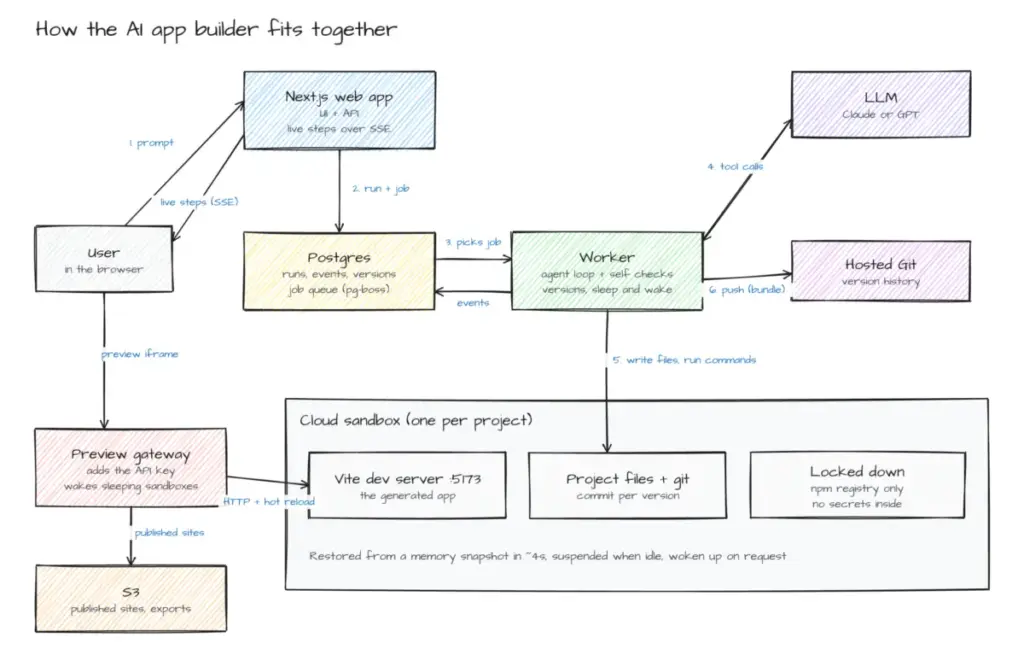
Before examining individual components, analyzing the structural blueprint of an AI app builder reveals how various infrastructure layers interact. A strict architectural rule in secure deployments is that the core web application must never execute the AI agent directly, and the agent must never execute inside the primary sandbox environment.
The operational workflow begins when a user submits a prompt. The primary web framework, typically built on Next.js, records the request, initializes a transactional run within a PostgreSQL database, queues the job asynchronously, and immediately returns a response to prevent HTTP timeout bottlenecks. Subsequently, a dedicated background worker process consumes the job. The worker ensures an active sandbox is provisioned before initiating the agent loop. As the Large Language Model makes autonomous tool calls—such as writing files, installing dependencies, or running shell commands—every action occurs safely inside the isolated container.
Concurrently, every operational step is logged as a database event, allowing the browser to render live updates through Server-Sent Events. The generated application runs its own Vite development server inside the sandbox. A specialized proxy gateway routes incoming preview subdomains directly to the containerized development server, seamlessly preserving WebSocket connections required for instant hot module reloading. Once the agent finalizes the development cycle, the worker commits the alterations as a distinct software version. When the user initiates a publish command, the application builds static production assets and uploads them to cloud object storage, ensuring persistent uptime even if the underlying sandbox is suspended to conserve resources.
Mitigating Security Risks Through Isolated Sandboxes
The fundamental premise of an AI app builder relies on executing unverified code written by an autonomous system. Package managers like npm pull in third-party dependencies whose installation scripts can execute arbitrary system commands, and development servers subsequently execute the application runtime. Running such untrusted operations directly on primary production infrastructure presents an unacceptable security exposure.
Consequently, modern implementations assign every individual project an isolated cloud sandbox, functioning effectively as lightweight virtual machines in the cloud. Essential requirements for these sandbox environments include rapid provisioning speeds, network egress controls to restrict unauthorized outbound traffic, secure memory checkpointing for fast restoration, and programmatic resource limitation. While various providers such as E2B, Daytona, Modal, or custom Firecracker microVM setups can fulfill these criteria, developers frequently leverage platforms like Tensorlake due to modular abstraction layers that isolate provider-specific code within dedicated packages.
Optimizing Performance with Memory Snapshots
Initializing a modern web application template from scratch—including dependencies like Vite, React, TypeScript, and Tailwind CSS—traditionally requires executing package installation scripts sequentially for every new project. Standard cold-path initialization routines can introduce frustrating latency, often forcing users to stare at loading spinners for more than thirty seconds while virtual CPUs compile dependencies.
To eliminate this friction, advanced architectures implement a memory snapshot strategy. The initialization routine performs the cold-path installation, dependency resolution, and initial build precisely once. It then captures a comprehensive memory checkpoint encompassing the file system state, RAM contents, and active system processes. When a user creates a new project, the system restores from this pre-warmed snapshot rather than rebuilding the environment from scratch, reducing provisioning time from over thirty seconds to mere seconds. Furthermore, strict container security policies restrict network access exclusively to trusted package registries while disabling public unauthenticated access to container ports.
Autonomous Error Correction and Verification Loops
Artificial intelligence models frequently exhibit supreme confidence, occasionally declaring that a build is fully operational while underlying compilation errors persist. To maintain high software quality, robust AI app builders do not blindly trust the agent’s self-assessment. Instead, the system subjects generated code to rigorous automated verification checks inside the sandbox before permitting the agent to finalize its task.
Verification routines execute strict TypeScript type-checking alongside production bundler builds. To catch runtime errors—such as property access exceptions on undefined objects—without relying on heavy, sluggish headless browsers, lightweight headless DOM implementations like happy-dom evaluate the application entry point within a simulated Node.js environment. If verification checks fail, comprehensive error logs are transmitted back to the agent as contextual feedback, granting the model specific iteration cycles to remediate bugs automatically.
Streaming Progress and Managing Live Previews
Because AI agents operate inside asynchronous backend workers while users interact with a browser interface, real-time progress communication is essential. Worker processes persist every operational event to a database table and broadcast notifications using database triggers. The frontend web application listens to these updates and streams them to the client interface using Server-Sent Events, ensuring that page refreshes never disrupt active execution runs.
Similarly, live preview environments require sophisticated proxy gateways to handle cross-origin isolation securely. By routing preview subdomains through a dedicated gateway service, applications can proxy HTTP traffic and WebSocket upgrade requests directly to containerized development servers while stripping away sensitive user cookies and credentials. This isolation guarantees that generated applications running inside sandboxes cannot compromise the security cookies or administrative API endpoints of the primary platform.
Version Control and Durable Publishing
To give users complete control over the development trajectory, robust AI platforms integrate native Git version control within the sandbox environment. Every successful prompt cycle commits structural changes as a new software version. Restoring a previous version does not destructive rewrite historical commits; instead, the system reverts the file tree to match the targeted historical state and commits it as a new chronological iteration, ensuring no user progress is ever permanently lost.
To protect historical data against container termination, repositories are bundled and mirrored to durable backend storage without exposing powerful repository administration tokens inside untrusted sandbox environments. Finally, when users choose to publish their applications, the system compiles optimized static assets and deploys them to cloud object storage. This decouples the live production application from the sandbox lifecycle, ensuring fast page load speeds and continuous availability even when the development container is suspended.