








Every website follows a familiar, quiet trajectory: it peaks on launch day. The final branch merges, code is deployed into production, and the platform stands briefly in a state of pristine perfection. The design system is flawlessly applied, the messaging is sharp, and every asset is accounted for. Yet, almost immediately, the digital entropy begins.
It is an unwritten law of the internet that a website will never look as good as it did the moment it shipped. This degradation does not happen because the underlying technology breaks or servers crash. The site continues to function, load, and serve traffic. Instead, the market shifts beneath it, a competitor launches a new product line, internal terminology evolves, and the carefully crafted digital footprint slowly stops matching the reality of the company it represents.
A year later, the site becomes a historical artifact—not technically broken, but quietly behind the times. Every digital product team knows this cycle of decay, and almost universally, they treat it as an inevitable law of nature.

Pierre Burgy, co-founder of the autonomous website platform Fimo, argues that it does not have to be that way. A modern web property could theoretically keep improving long after launch, sidestepping the inevitable drift from its initial perfection. Instead of stagnating, a site could continuously and quietly optimize itself while the human team behind it focuses on higher-level product development and business strategy.
Envisioning this future reveals a compelling operational workflow. While the team sleeps, an autonomous agent detects that last week’s design-system update failed to propagate across the entire pricing page, and it automatically resolves the discrepancy. Another background agent discovers a batch of high-resolution images shipped uncompressed during a rushed late-night release and optimizes them for performance. A third process flags an accessibility regression introduced by a recently added component, either implementing a corrective patch or flagging it for human review.
The promise of this technology is waking up to a web platform that is measurably superior to the one left behind the evening before, accompanied by a curated, minimal list of architectural decisions that genuinely required human intervention. Yet, as developers and product designers take this vision seriously, they quickly run into an unexpected hurdle that has virtually nothing to do with technological limitations: almost nobody actually wants a website that changes entirely on its own.
Why "Just Make It Autonomous" Is the Wrong Goal
The most intuitive trajectory for generative artificial intelligence and capable agent workflows is total delegation. Once engineers build autonomous systems capable of executing complex web operations, the immediate impulse is to hand over the keys to the entire digital property. Letting agents write, edit, optimize, and publish content without human oversight sounds like the logical endpoint of automation. It is the narrative most people picture when they hear the phrase "autonomous website."
However, it is also the exact paradigm that users hesitate to adopt once it materializes in front of them in a production environment.
Building Fimo and its dedicated autonomous agents provided a firsthand lesson in how users actually interact with self-governing software. The platform was originally conceived with the assumption that full autonomy was the primary objective. Yet, as teams began testing the software, they hesitated.
That hesitation did not stem from a deep-seated distrust of artificial intelligence or machine learning algorithms. Rather, it revealed a fundamental structural reality of modern organizations: a corporate website has no single, monolithic owner. Different sections of a web property belong to different stakeholders, and each stakeholder demands a vastly different threshold of autonomy. Consequently, the core engineering challenge was never whether humans could trust autonomous agents. The real challenge lay in determining where to draw the boundary, and for whom.
Most Website Maintenance Is a No-Brainer
Analyzing the daily workload of web management reveals that the largest share of maintenance tasks is rule-bound, repetitive, and entirely divorced from creative expression. This operational burden encompasses everything from maintaining strict accessibility compliance as dynamic pages evolve, to propagating design-system updates whenever a foundational token changes. It includes catching broken meta tags, identifying uncompressed images, and repairing internal links that rotted when directory structures shifted several development sprints ago.
None of these chores represent the domains where human talent or artistic vision thrives. Software engineers and content strategists are rarely hired for their exceptional knack for spotting missing alternative text on an image or auditing contrast ratios across thousands of deep-link pages.
This is the exact type of labor that technical teams are actively relieved to delegate. It is also the domain where autonomous agents excel, precisely because the work is governed by rigid rules rather than subjective taste. An agent that quietly maintains this foundational layer across an entire multi-language website without human intervention does not threaten anyone’s job security. Instead, it handles the tedious eighty percent of digital maintenance that routinely drains team morale and time.
Recognizing the sheer volume of work that falls into this maintenance category transforms how development teams perceive website autonomy. Handing over these routine chores does not mean surrendering creative judgment; it means offloading administrative burdens.
Some Tasks You Would Never Hand Over
At the opposite end of the operational spectrum lies a small category of work that teams would refuse to delegate at any price. This domain represents the core reason creative and strategic professionals exist within an organization.
An autonomous agent can cross-reference a newly drafted landing page against every compliance rule, style guide, and token library provided to it. It can confirm that color contrast ratios pass WCAG standards, heading hierarchies remain sequential, and terminology adheres strictly to brand documentation. What an agent cannot do is decide what the page should emotionally evoke, or evaluate whether the creative execution is fundamentally good in the subjective sense.
That nuance of taste and strategic intuition is precisely what human professionals are hired to deliver. No matter how sophisticated artificial intelligence becomes, that critical judgment remains firmly on the human desk.
This is the exact concern critics raise first when resisting the concept of website automation, and their instinct to protect that creative domain is correct. The common misconception is assuming that an entire website consists of this high-judgment work. In reality, only a tiny fraction of web management requires pure creative intuition. Yet, because that small fraction carries disproportionate weight for brand identity, automating the entire process feels deeply uncomfortable.
Autonomy Depends on Organizational Roles
Between routine chores and untouchable creative decisions lies a vast gray area. No off-the-shelf product can resolve this zone automatically because the boundary line runs through vastly different places depending on who is asked.
Consider a concrete, everyday production change: setting dark mode as the default theme when visitors land on a corporate homepage. An autonomous agent can execute this transition across the codebase in a matter of seconds. The real question is who holds the authority to decide whether that change should happen at all.
For the brand designer who safeguards the company’s visual identity, a default theme is never a trivial configuration setting. It represents an intentional statement regarding how the brand wishes to be perceived upon first impression, and the designer naturally wants direct control over that choice. For the frontend developer tasked with shipping the code update, however, it is merely a single-line configuration change with a clear technical rationale—precisely the kind of routine update they would gladly let an agent apply so they can move on to more complex architectural challenges.
The exact same change on the exact same website highlights how different stakeholders draw the line in opposing locations. This divergence occurs because the task carries differing degrees of judgment depending on the professional role. What is a strategic brand decision for one person is a routine execution chore for another.
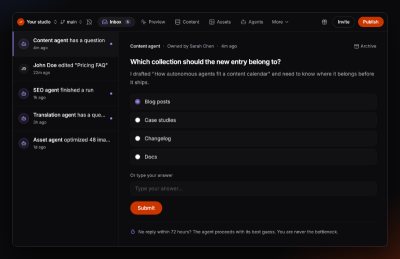
No single software default can accommodate both perspectives because the definition of the "right" boundary is a function of where professional value sits, rather than the intrinsic nature of the task itself. Consequently, digital autonomy requires per-task and per-person configuration rather than a blanket company-wide setting.
Building and Composing Individual Agents
Once organizations recognize that the boundary of autonomy is deeply personal, a simple binary toggle between manual approval and automated delegation becomes insufficient. Because the ideal threshold depends heavily on what a specific agent is designed to accomplish, the fundamental unit of control shifts to the agent itself.
Modern platforms address this by moving away from fixed menus of rigid behaviors toward composable agents. Rather than choosing a pre-packaged mode, teams define what each individual agent is permitted to touch. Administrators can build specialized agents from scratch or adapt existing templates to fit their exact comfort thresholds—such as an accessibility agent granted full autonomy to run unattended, paired alongside a content agent restricted by strict approval workflows for any brand-facing copy changes.
Furthermore, these systems do not remain static. Agents learn from the tasks they execute and the feedback they receive over time, meaning the operational boundary established last month evolves as trust is earned. Tasks requiring strict manual oversight initially can gradually transition into delegated operations, not because teams lower their standards, but because the underlying software proves its reliability. The boundary of control functions as a fluid threshold that shifts organically toward efficiency.
Starting Narrow and Widening as Trust Grows
Transitioning to autonomous web operations does not require flipping a digital switch to full automation on day one. In practical application, the adoption curve moves gradually from conservative supervision to broader delegation.
Teams can continuously audit agent performance through comprehensive execution histories, system logs, and detailed before-and-after visual comparisons of modified code and assets. Trust in automated systems does not develop merely through familiarity; it builds through verifiable transparency. When an agent quietly resolves an edge-case bug that humans would have otherwise overlooked, and the resulting logs make the exact intervention crystal clear, subsequent delegations become significantly easier to authorize.
Automated deadlines prevent human teams from becoming operational bottlenecks on tasks they have already authorized. If a stakeholder fails to review a flagged change within a designated window, the agent proceeds according to pre-set parameters, ensuring that the broader web platform never stalls waiting for administrative sign-off.
The Real Risk of the Frozen Site
The initial anxiety surrounding web autonomy often focuses on the fear that an automated agent might alter a live page without direct supervision. Shifting perspective reveals a more systemic vulnerability: the genuine risk is a corporate website that never changes at all.
A frozen, static web property does not remain secure or relevant. It simply falls behind the curve in subtle ways that often go unnoticed until the digital footprint no longer reflects the active enterprise behind it. The ultimate objective of introducing autonomy into web management was never to remove human oversight from digital infrastructure. Rather, the goal is to eliminate digital decay, allowing professional teams to invest their critical judgment into the small fraction of work that truly demands human creativity while letting automated systems handle the rest.