








The lineage of knowledge transfer stretches far back into human history. Long before writing emerged in ancient Mesopotamia, laws, history, myths, and songs were passed down orally through instruction and storytelling. Across civilizations, the teacher-student dynamic has served as the bedrock of progress. History records that Socrates taught Plato, who subsequently established an academy in Athens where he mentored Aristotle for twenty years, ultimately laying the foundation for modern science, logic, and politics.
In the twenty-first century, this lineage of mentorship finds a modern parallel within deep learning artificial intelligence. During the period known as the AI winter, when neural networks were widely dismissed as a scientific dead end, a tight-knit lineage of researchers kept the discipline alive. Geoffrey Hinton, widely regarded as a foundational figure in modern AI, operated a laboratory where he mentored pioneers such as Yann LeCun and Ilya Sutskever. LeCun went on to invent the convolutional neural network, while Sutskever co-founded OpenAI before later establishing Safe Superintelligence Inc.
While human-to-human knowledge transfer is universally understood, the artificial intelligence community has increasingly turned its focus toward a parallel phenomenon: machine-to-machine knowledge transfer, known broadly as model distillation. This technique has emerged as a vital strategy for addressing the immense computational and financial burdens associated with deploying state-of-the-art artificial intelligence models in practical environments.

The Necessity of Model Distillation in Modern AI
Model distillation, frequently referred to as knowledge distillation, is a compression technique designed to transfer the learned behaviors and predictive capabilities of a large, highly accurate model to a smaller, computationally efficient model tailored for practical deployment. In this dynamic, the larger model acts as the teacher, while the smaller model functions as the student. The primary objective is for the student model to approximate the performance of the teacher while operating with a significantly reduced parameter count and lower computational overhead.
At present, both closed-source and open-source frontier models are routinely trained on trillions of parameters. These internal configuration variables, automatically learned from vast training datasets, allow models to exhibit sophisticated reasoning and pattern recognition. However, this massive scale creates substantial operational hurdles. Running these frontier models demands significant financial investment, heavy energy consumption, and specialized, expensive hardware infrastructure.
Model distillation offers a practical solution to this challenge. By capturing the underlying insights of these massive systems and transferring them into leaner architectures, developers can create models that are vastly cheaper and easier to integrate into everyday applications without sacrificing catastrophic amounts of accuracy.
Techniques in Knowledge Distillation
The specific approach utilized in model distillation often depends on the nature of the information being transferred from the teacher to the student. Different methodologies focus on final predictions, internal representations, attention mechanisms, or comprehensive behavioral patterns.
Response-based distillation represents the classic teacher-to-student paradigm, originally formalized by Geoffrey Hinton and his colleagues. To understand this method, developers must distinguish between hard labels and soft labels. Hard labels deal strictly with fixed categorical targets. For instance, when an image of a dog is processed by a classification model, a hard label identifies it definitively as a dog while assigning zero probability to other categories like cats or horses.
Conversely, soft labels incorporate probabilities. When the same image is evaluated using soft labels, the model might assign an 85 percent probability that the subject is a dog, a ten percent probability that it resembles a cat, and a fractional probability of resembling a horse. In response-based distillation, the student model learns from these soft targets generated by the teacher. This additional probability distribution contains valuable contextual insights, often described as dark knowledge, which enables the smaller model to mimic the nuanced behavior of its larger counterpart. While response-based distillation is stable and straightforward to implement, it remains limited by its focus solely on the output layer, essentially treating the teacher network as a black box that hides its internal reasoning steps.
To address these limitations, feature-based distillation transfers the internal feature representations of the larger model rather than restricting the process to final outputs. In this framework, the student model is trained to produce hidden layer activations that closely match those of the teacher. This is typically achieved using metrics like mean squared error, meaning the student is penalized if its internal operations diverge from the structural patterns established by the teacher. Although highly effective in computer vision tasks involving convolutional networks and vision transformers, feature-based distillation demands substantial memory and processing power because the student must constantly track the internal feature maps of the teacher during training iterations.
Another advanced approach, attention distillation, focuses on where transformer models concentrate their computational focus. Rather than copying every neuron, the student model observes the attention maps of the larger network, which highlight the specific input tokens or regions deemed most important for making a prediction. By replicating these attention distributions, the student learns how to properly prioritize information. However, this method introduces significant computational overhead due to the necessity of calculating complex divergence metrics across massive attention tensors.
Self-distillation provides an alternative path where a model trains itself through knowledge transfer between earlier and later versions or across different internal layers. This allows a network to enhance its own performance organically without requiring an even larger separate model to act as a teacher.
Practical Implementation and Evaluation
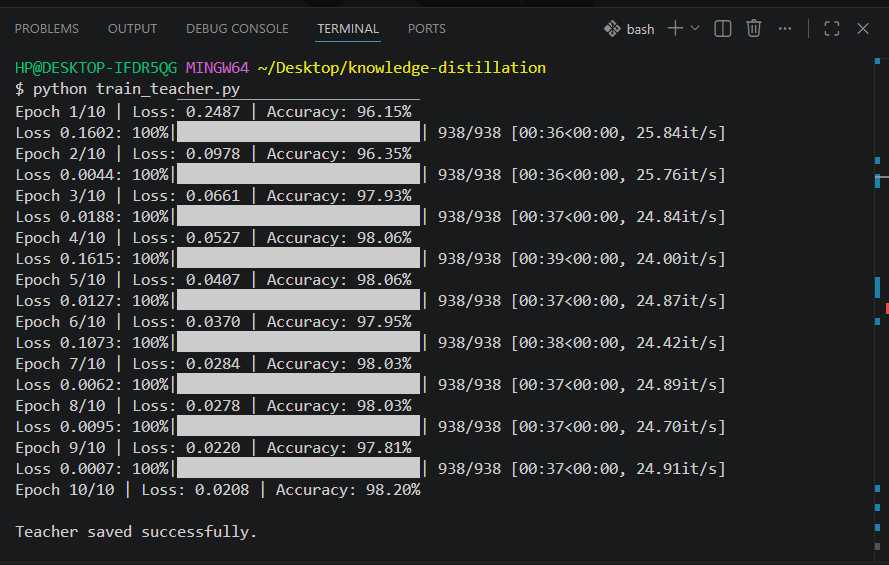
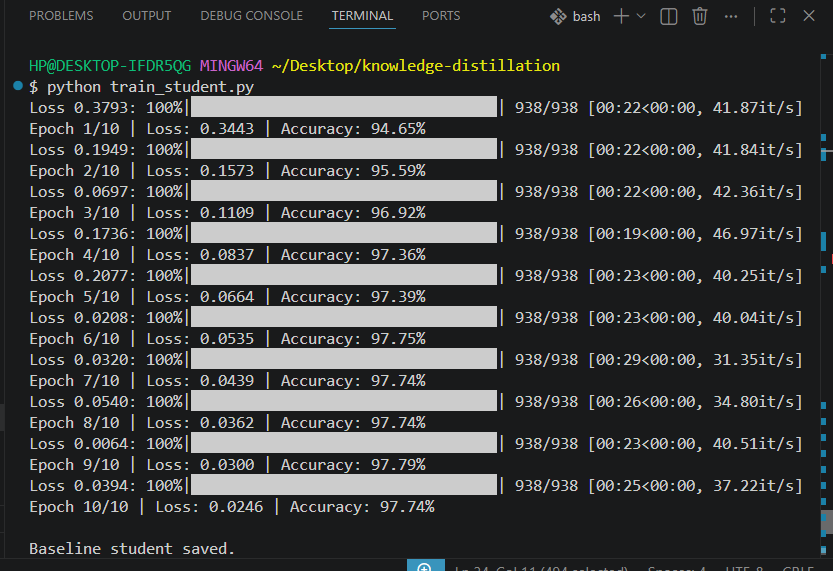
To demonstrate model distillation in practice, researchers frequently turn to standard classification benchmarks such as the MNIST dataset, which comprises 70,000 grayscale images of handwritten digits. In a typical experimental setup, a large multi-layered neural network is trained as the teacher model on the dataset until it achieves high classification accuracy. Once trained, the teacher model’s weights are frozen.
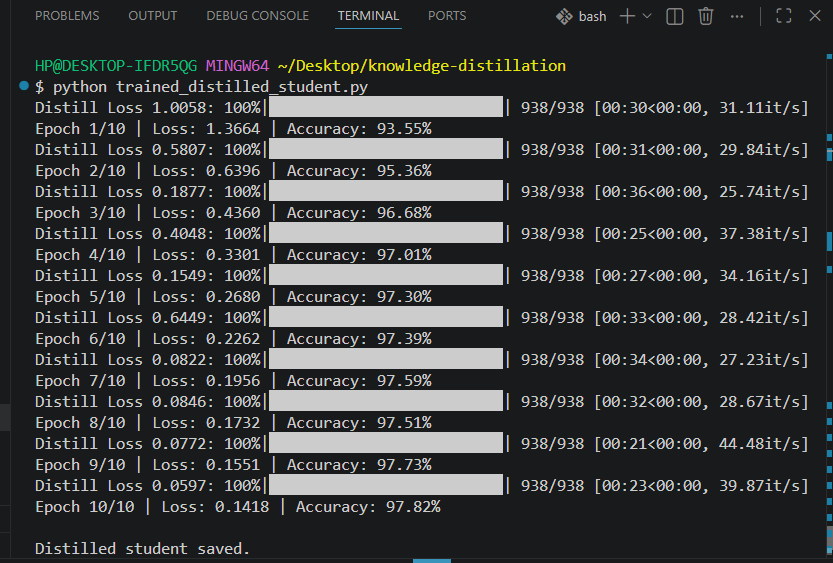
Following this, a baseline student network—featuring a significantly reduced parameter structure—is trained independently using standard cross-entropy loss against the ground-truth labels. This establishes a baseline performance metric for the smaller network operating without guidance. Subsequently, a distilled student model with the exact same compact architecture is trained using a combination of hard labels and soft targets generated by the frozen teacher model, incorporating a temperature scaling parameter to soften probability distributions alongside an alpha weighting factor.
Empirical evaluations of this workflow typically reveal clear performance distinctions. A large teacher network often achieves high accuracy levels, such as 98.20 percent on benchmark classification tasks after completing standard training cycles. A baseline student network, constrained by its smaller size, may achieve slightly lower performance. However, when the same compact student network undergoes knowledge distillation under the guidance of the teacher, its accuracy frequently improves, allowing the smaller model to punch above its weight class by absorbing the rich probability distributions provided by the larger network.
Alternative Approaches to Model Size Reduction
Beyond knowledge distillation, the artificial intelligence community utilizes several other architectural optimization techniques to reduce the memory footprint, latency, and computational costs associated with large models.
Quantization achieves efficiency by reducing the bit-width of the numerical data types used to store model weights and activations. Rather than altering the underlying network architecture, quantization targets memory bandwidth bottlenecks by converting high-precision numbers into lower-bit representations, effectively shrinking file sizes dramatically with minimal loss in fidelity.
Pruning operates on the premise that many large-scale neural networks contain redundant parameters that contribute marginally to overall performance. By systematically identifying and removing these low-impact connections, developers can streamline network structures to execute faster and consume fewer resources.
Low-rank factorization applies linear algebra principles to simplify the complex matrix multiplications that dominate deep learning architectures, effectively re-engineering heavy computational layers into streamlined mathematical equivalents.
While quantization primarily addresses memory constraints, techniques like pruning and model distillation are specifically engineered to reduce computation time and enhance inference speed. Together, these methodologies provide a comprehensive toolkit for deploying sophisticated artificial intelligence capabilities across resource-constrained environments, ranging from edge devices and mobile phones to consumer-grade hardware.