








Large language models have fundamentally reshaped the landscape of modern software development, serving as remarkable text generators capable of synthesizing code, drafting prose, and analyzing complex data. Yet, they continue to grapple with a well-documented and stubborn vulnerability: hallucinations. When operating in isolation without access to verified, up-to-date information, these models routinely produce plausible-sounding answers that are factually incorrect. To combat this limitation, Retrieval-Augmented Generation, commonly known as RAG, emerged as the gold standard for enterprise artificial intelligence applications. By grounding model outputs in external knowledge sources, RAG dramatically reduced instances of fabrication and allowed organizations to build reliable knowledge retrieval systems.
However, as businesses push these generative architectures into increasingly complex operational workflows, a new class of engineering bottlenecks has surfaced. Standard RAG pipelines are fundamentally linear, executing a rigid sequence where the system retrieves information once, passes those results to the model, and generates a final answer. While this linear approach functions adequately when handling simple queries within a well-structured knowledge base, it quickly begins to break down under pressure. Modern enterprise use cases frequently require multi-step reasoning, cross-referencing disparate data sources, and synthesizing information that is fragmented across multiple standalone documents.
To overcome these structural limitations, the artificial intelligence community is rapidly pivoting toward Agentic RAG. Rather than treating information retrieval as a single, fixed preliminary step, this advanced architecture endows the system with the capability to reason about how to search, evaluate the quality of what it finds, and iterate dynamically until it arrives at a genuinely satisfying and accurate answer. Industry researchers and practitioners are now evaluating how these two architectural paradigms compare, where linear pipelines ultimately hit their functional limits, and what specific technical capabilities make agentic systems better suited for complex organizational tasks.
The Baseline: Understanding Naive RAG and Its Foundations
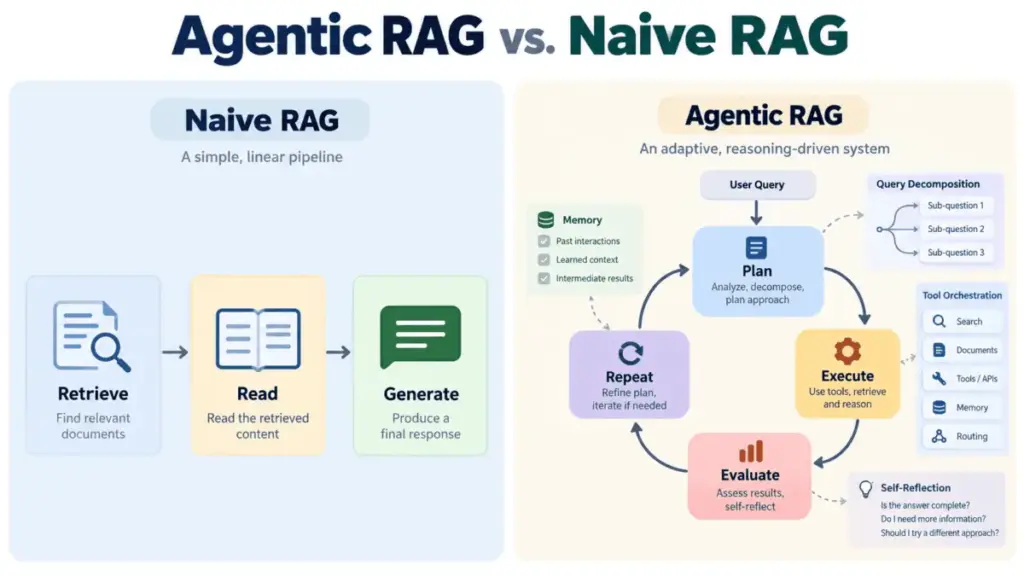
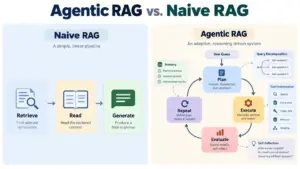
To understand the trajectory of modern retrieval systems, it is necessary to examine the architecture where the technology originated. Naive RAG, frequently referred to as standard or baseline RAG, follows a rigid, three-stage pipeline consisting of retrieval, reading, and generation. In this traditional setup, a user submits an informational query, which the system converts into a vector embedding. It then executes a mathematical similarity search against an underlying vector database, retrieves the top-k most relevant document chunks based on spatial proximity, and injects those specific chunks directly into the large language model as context. The model then synthesizes a response constrained primarily by the provided text.
This mechanism can be conceptualized as a student preparing for a comprehensive examination within a massive library. Naive RAG mirrors the behavior of a student who types a single keyword into the central catalog, grabs the first three books pulled from the shelf, and attempts to write an entire essay based exclusively on those immediate texts, without pausing to verify whether those sources actually answer the core questions posed by the prompt.
Beneath the software interface, a sophisticated chain of events occurs during ingestion and inference. When documents are initially loaded into the ecosystem, they are partitioned into smaller fragments or chunks, which are subsequently converted into dense vector representations by a specialized embedding model. These vectors are housed in a database specifically engineered for approximate nearest-neighbor searches. During inference, the user’s incoming query undergoes the same embedding transformation, allowing the database to return the document chunks residing closest in high-dimensional vector space. Those retrieved fragments are then appended to the large language model’s context window as reference material.
This development represented a genuine architectural breakthrough for enterprise technology. Naive RAG enabled developers to construct reliable internal question-and-answering systems, corporate knowledge assistants, and automated document summarizers that remained anchored to verified organizational sources. For numerous straightforward applications involving uniform documents, this traditional baseline remains an exceptionally efficient and cost-effective choice.
The Bottleneck: Where Linear Retrieval Pipelines Break Down
Despite its widespread adoption, the core weakness of traditional RAG lies entirely in its linearity. A single retrieval pass either successfully captures the necessary context, or it fails completely. If the initial user query is poorly formulated, if the critical piece of information is scattered across multiple unrelated files, or if the correct answer demands multi-hop reasoning over several logical stages, the standard pipeline possesses no internal mechanism to recover from the oversight.
The single-pass limitation represents a critical vulnerability in production environments. Naive RAG is granted only one opportunity to retrieve relevant data. If the vector representation of the query fails to surface the correct document segments, the underlying language model is forced to generate a response derived from incomplete, tangential, or entirely irrelevant context. The system lacks the awareness to recognize that its initial retrieval operation failed, and it cannot dynamically pivot to a different search strategy.
This structural rigidity becomes even more pronounced during multi-hop reasoning tasks. Consider an intricate query such as inquiring about the regulatory policies followed in the European Union by the parent company that acquired WhatsApp. Answering this question correctly requires at least two distinct logical steps. The system must first identify the specific corporate entity that acquired WhatsApp, and subsequently retrieve the regulatory framework governing that specific parent organization within the European Union.
A single vector search targeting WhatsApp European regulatory policies will almost certainly fail to bridge the logical connection, particularly if those two critical pieces of information reside in entirely separate corporate documents. Naive RAG possesses no native capability to automatically decompose the prompt into sequential sub-questions, execute an initial retrieval to find the intermediate answer, and subsequently feed that newly acquired insight into a secondary, more targeted search.
Furthermore, naive pipelines remain exceptionally susceptible to the dangers of bad retrieval. When the top-k retrieved results are fundamentally irrelevant to the original query, the large language model is placed in an untenable position. It is forced to choose between generating a response that completely ignores its grounding context—which inevitably triggers hallucinations—or outputting a safe but unhelpful statement indicating that it lacks sufficient information to respond. In high-stakes enterprise settings where factual accuracy is paramount, neither outcome is acceptable for deployment.
Agentic RAG: Transforming Retrieval into an Autonomous Reasoning Loop
Agentic RAG reframes the entire information retrieval problem by altering the role of the language model within the architecture. Instead of treating the model as a passive text generator that simply receives static context and produces an output, agentic systems treat the model as an autonomous reasoning engine that actively plans, executes, and orchestrates the entire retrieval lifecycle.
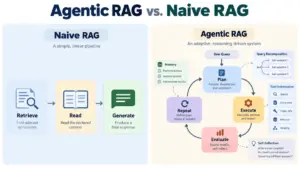
While Naive RAG operates as a static pipeline, Agentic RAG functions as an adaptive loop defined by planning, execution, evaluation, and iteration. Returning to the library analogy, a dedicated professional research assistant does not simply grab the first three books encountered on a shelf and immediately begin writing. Instead, the researcher reads the initial sources, recognizes that a crucial piece of evidence is missing, opens a completely different database, cross-references two conflicting claims, and only begins drafting once absolute confidence in the sufficiency of the sources has been established. Agentic RAG embeds this sophisticated behavioral pattern directly into the software architecture of the retrieval system.
Under this paradigm, the language model transitions from being a mere consumer of retrieved context into the central orchestrator of the information-gathering process. It actively decides what information needs to be retrieved, determines the optimal repository to search, evaluates whether the retrieved results meet quality standards, and establishes corrective courses of action if the initial attempts fall short. This transforms retrieval from a fixed pre-processing step into a dynamic, self-correcting cognitive loop.
The fundamental shift between the two methodologies is stark. In a naive setup, the model observes the retrieved context exactly once without recourse. In an agentic configuration, the model continuously reasons about the retrieval operation itself, exercising autonomous judgment regarding when to search, what specific terms or parameters to search for, and when it has accumulated sufficient data to generate a reliable, factually grounded response.
The Core Mechanisms Driving Agentic Architectures
The operational distinction between a naive retrieval pipeline and an agentic system is not defined by a single design modification, but rather by the integration of four distinct functional mechanisms. Each mechanism addresses a specific failure mode that linear retrieval architectures cannot handle independently.
Query routing represents the first major enhancement. Not all enterprise questions belong to the same data source or require the same search methodology. A financial query concerning quarterly earnings is best answered by querying a structured SQL database. Conversely, a human resources policy question calls for semantic search across unstructured document repositories, while a request regarding recent market shifts might necessitate a live web search. Query routing empowers the system to determine the optimal location to search before executing the query. The language model examines the incoming prompt and selects the appropriate tool or data source from a predefined registry, avoiding the common failure mode of forcing every query through a single semantic vector search regardless of structural fit.
Query decomposition tackles the challenge of complex, multi-faceted prompts. Because intricate questions frequently contain multiple sub-questions, an agentic system breaks the original user prompt down into smaller, independently addressable components prior to executing any retrieval operations. Returning to the WhatsApp corporate example, the system avoids searching for the entire phrase as a single vector. Instead, it first determines the acquiring corporation, retrieves that intermediate answer, and subsequently uses that newly verified entity to construct a precise secondary query regarding regulatory compliance. Each successive answer informs the next search, building toward a comprehensive final response through a targeted chain of retrievals.
Self-reflection and critique serve as the most consequential capabilities within the agentic toolkit. Following a retrieval pass, the system deliberately pauses before forwarding information to the generation phase. It evaluates whether the retrieved document chunks actually answer the underlying question, checking for semantic relevance and filtering out noise. If the model determines that the retrieved context is insufficient, contradictory, or off-target, it automatically rewrites the query and initiates a new retrieval pass. This evaluation and retry loop continues iteratively until the system reaches a satisfactory confidence threshold or hits a predefined iteration limit, preventing runaway loops from inflating computational costs and latency.
Tool use and function calling further expand the boundaries of what retrieval systems can accomplish. Agentic RAG architectures are no longer restricted to querying text databases. Through programmatic function calling, the language model can invoke external computational tools mid-reasoning, such as calculators for arithmetic validation, live web search application programming interfaces for real-time information, structured SQL executors, or proprietary internal enterprise APIs. The model dynamically evaluates which tool is best suited for each individual sub-task and invokes it as part of a coherent reasoning loop, bridging unstructured text retrieval with deterministic computation.
Evaluating the Trade-Offs and Strategic Choices
The decision to implement either Naive RAG or Agentic RAG ultimately boils down to an engineering trade-off between operational cost, system latency, and analytical capability. Naive RAG involves a single embedding operation and a single language model invocation, resulting in low latency, predictable operational costs, and simplified debugging processes. In contrast, Agentic RAG relies on multiple reasoning steps, each introducing additional latency and token consumption. A complex query requiring multiple retrieval iterations and tool invocations will naturally demand significantly more computing resources than a single-pass search.
Industry practitioners generally recommend choosing naive retrieval architectures when application requirements involve straightforward informational lookups against uniform, well-structured documents, where query complexity is consistently low, and where system latency and operational budgets are primary constraints. Conversely, organizations are advised to deploy agentic RAG frameworks when handling complex multi-step reasoning tasks, heterogeneous data sources spanning structured and unstructured formats, high-stakes environments where factual accuracy is non-negotiable, and domains requiring dynamic interaction with external computational tools.
To balance these operational factors, many production environments now favor hybrid architectures. These systems route simple, high-volume queries through a fast, cost-effective naive pipeline, while selectively reserving the heavier agentic loop for complex queries flagged as high-stakes or ambiguous. As frameworks for building autonomous AI systems continue to mature and become more accessible, understanding the precise nature of the organizational problem remains the most critical step in determining the appropriate architectural path forward.