











As artificial intelligence deployment shifts increasingly toward edge devices and local hardware, engineering teams are finding that raw model capability is only half the battle. Efficient execution matters just as much, particularly when deploying small language models (SLMs) for narrow, high-frequency automation tasks. In the final installment of a technical series examining performance optimization for SLMs, developers are turning their attention away from individual inference passes and toward smart batching strategies. Previous explorations in the series tackled constraining output spaces to simplify classification tasks and reusing prompt prefixes via key-value caches. Now, engineers are tackling the single largest source of pipeline waste: processing data item by item.
Benchmarks throughout this series have relied on the Qwen2.5-0.5B-Instruct model running in float16 via Hugging Face Transformers. Tested on standard consumer hardware—specifically an M2 MacBook Air equipped with 24GB of RAM and a 16-core Neural Engine—the experiments reveal critical bottlenecks that affect how language models operate in real-world production environments. When an application processes a single support ticket per forward pass, a small model is almost entirely memory-bandwidth bound rather than compute-bound.
At a batch size of one, hardware must repeatedly stream every model weight out of memory to serve a single sequence, before immediately flushing and repeating the process for the next item. Arithmetic units sit largely idle in the intervening moments. This inefficiency plagues both graphical processing units and central processing units, with the latter serving as the most common environment for sub-billion parameter models in practical automation workloads.

The standard remedy for memory-bandwidth constraints is batching, which amortizes weight reads across multiple sequences simultaneously. However, naive batching introduces its own form of waste because sequences within a batch must be padded to a uniform length. Real-world text distributions frequently exhibit a long tail. In a typical customer support dataset, the longest incoming ticket might span several hundred tokens, while the median length remains well under a hundred. If an application pads every batch to match the global maximum length of the entire dataset, the hardware spends a massive percentage of its compute cycles processing empty padding tokens rather than actual semantic data.
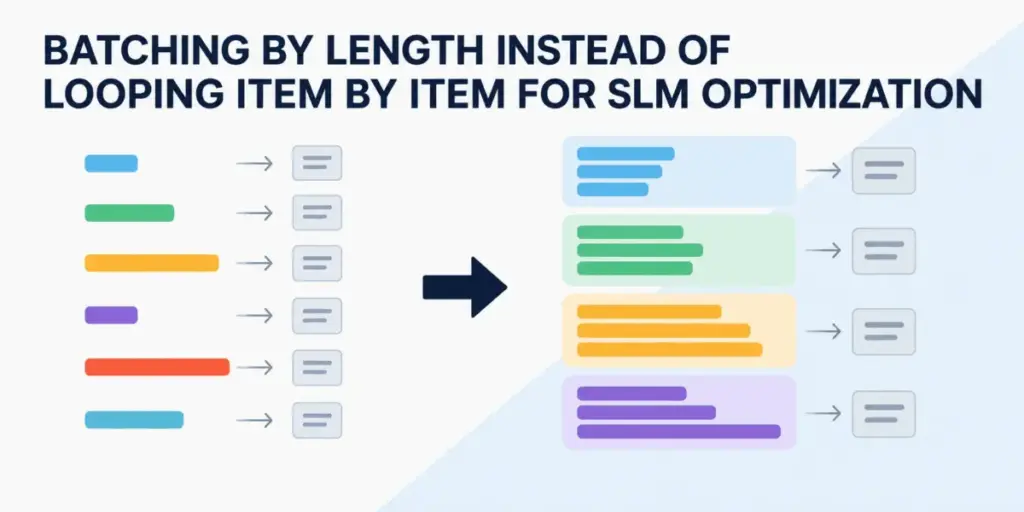
To resolve this tension, engineers implement length-bucketed batching. By sorting incoming text sequences by token length prior to forming batches, each batch contains items of comparable sizes and only needs to pad up to its own local maximum. This approach preserves the throughput advantages of batching while drastically reducing computational overhead.
Examining the performance baseline under a realistic length distribution illustrates the severity of the unbatched bottleneck. Simulating a support ticket triage pipeline where tasks are categorized into billing, technical, or account inquiries reveals a wide range of input sizes. Utilizing constrained scoring mechanisms to ensure each classification check costs precisely one forward pass, processing items sequentially exposes the true cost of unbatched execution.
With prompt lengths ranging from a minimum of 48 tokens to a maximum of 449 tokens, with a median of 94 tokens, naive global padding would force the system to process nearly four times the necessary token volume. When running these 600 tickets one at a time through the model on CPU, the sequential loop takes well over two minutes to complete, translating to a modest throughput of roughly four items per second.
Introducing length-bucketed batching fundamentally alters these performance metrics. When running the same dataset through the model using batches of 32 items sorted by token length, the processing time drops precipitously. While an unorganized batching approach would still suffer from inefficient length discrepancies, sorting the indices beforehand ensures that padding overhead is kept to a minimum.
In empirical tests, length-bucketed batching reduces the padding overhead to a single-digit percentage of total processed tokens, meaning the vast majority of computational effort goes toward actual text analysis rather than empty filler. Consequently, the total time required to process the 600 support tickets drops by nearly half, raising overall throughput significantly on identical hardware and model weights. Critically, these performance gains are achieved without sacrificing output fidelity. Verification checks comparing batched predictions against unbatched reference runs confirm 100 percent agreement across distributed length probes, proving that the speedup is a product of superior workload scheduling rather than compromised accuracy.
Developers must still exercise caution when combining these optimization techniques in production systems. For instance, pairing prompt prefix caching with batching requires careful tensor manipulation. Because typical caching mechanisms assume a batch dimension of one, reusing a cached prefix across a multi-item batch requires expanding every key and value tensor along that dimension and cropping them back correctly afterward. While worthwhile for long system prompts, such implementations demand rigorous verification to ensure predictions match unbatched baselines.
Ultimately, this optimization strategy highlights a fundamental truth of modern AI deployment: architectural speedups must never come at the expense of model reliability. Techniques like length-bucketed batching do not make a language model inherently more intelligent; rather, they remove structural inefficiencies that impede hardware performance. By systematically addressing output constraints, memory caching, and batch scheduling, engineering teams can unlock the full potential of small language models for rapid, cost-effective automation.