Large language models have fundamentally transformed how organizations interact with data, serving as remarkable text generators capable of drafting emails, summarizing reports, and writing code in seconds. Yet, they continue to grapple with a heavily documented and persistent vulnerability: the tendency to hallucinate. When operating without direct access to verified, up-to-date information, these models routinely manufacture plausible-sounding answers that are factually incorrect. To combat this limitation, Retrieval-Augmented Generation, commonly known as RAG, emerged as the industry standard. By grounding model outputs in external knowledge sources, RAG dramatically reduced hallucinations and unlocked reliable enterprise applications across various sectors.
However, as organizations push these artificial intelligence systems into increasingly complex workflows, a new architectural problem has surfaced. Standard RAG pipelines are inherently linear, executing a single retrieval operation, passing the resulting text chunks to the model, and generating a final answer. While this straightforward approach functions adequately for simple queries and well-structured knowledge bases, it begins to crack when tasks demand multi-step reasoning, cross-referencing across multiple distinct sources, or the synthesis of fragmented information that does not exist within a single document.
To overcome these barriers, the artificial intelligence community has increasingly turned toward a more dynamic paradigm known as Agentic RAG. Rather than treating information retrieval as a single, fixed step at the beginning of a workflow, agentic systems grant the underlying architecture the ability to reason about how to search, evaluate the quality of what it finds, and iterate continuously until it reaches a genuinely satisfying and accurate answer.
Understanding this evolution requires examining how traditional retrieval systems operate, where they inevitably hit their limits, and the specific capabilities that make agentic frameworks uniquely suited for complex enterprise tasks. Industry experts, including AI educator and technical mentor Vinod Chugani, have emphasized the necessity of choosing the right framework based on the actual problem an organization is trying to solve, balancing the trade-offs between computational cost, system latency, and reasoning capability.
The Baseline: Understanding Naive RAG
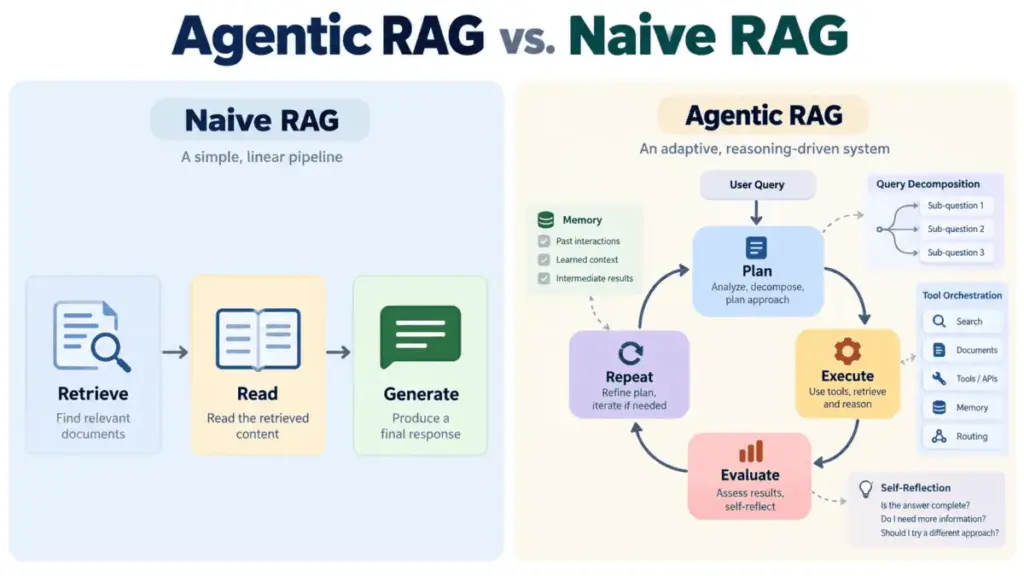
Before evaluating where modern retrieval systems are heading, industry practitioners must be precise about where they started. Naive RAG, frequently referred to as standard RAG, follows a rigid, three-stage pipeline consisting of retrieval, reading, and generation. In this traditional workflow, a user submits a query, and the system converts that text into a vector embedding. It then runs a similarity search against a specialized vector database, retrieves a predetermined number of the most relevant document chunks, and passes those chunks directly to the large language model as context. The model subsequently formulates a response based strictly on the provided material.
This process can be likened to a student preparing for an examination in a massive, unfamiliar library. Naive RAG is analogous to a student who types a single keyword into the catalog, grabs the first three books pulled from the shelf, and attempts to write a comprehensive essay using only the open pages directly in front of them, without ever pausing to verify whether those sources actually answer the prompt.
Under the hood, the technical mechanics are straightforward. When documents are initially ingested into the system, they are segmented into smaller chunks and converted into dense vector representations using an embedding model. These vectors are subsequently stored in a database optimized for approximate nearest-neighbor search. At inference time, the incoming user query is embedded using the exact same model, and the database returns the specific chunks whose high-dimensional vectors sit closest in spatial proximity. Those chunks are injected into the model’s active context window as reference material.
This architecture was a genuine breakthrough for enterprise technology. Naive RAG made it feasible to build dependable customer support question-and-answer systems, internal knowledge assistants, and automated document summarizers that remained strictly grounded in verified enterprise sources. For many straightforward applications, it remains an exceptionally efficient and cost-effective choice.
The Bottleneck: Where Naive RAG Breaks Down
Despite its widespread adoption, the core weakness of standard RAG lies in its absolute linearity. A single retrieval pass either successfully surfaces the correct information or it fails entirely. If the initial user query is poorly formulated, if the relevant pieces of information are scattered across multiple disparate documents, or if the correct answer requires drawing conclusions across several logical steps, the pipeline possesses no built-in mechanism to recover.
The architecture suffers acutely from a single-pass limitation. Naive RAG gets precisely one chance at retrieval. If the embedding of the query fails to return the right document chunks, the language model is left generating a response from incomplete, noisy, or entirely irrelevant context. The system cannot recognize that its retrieval attempt failed, nor can it dynamically alter its strategy to try a different approach.
This limitation becomes especially glaring during multi-step reasoning tasks. Consider a complex query regarding corporate acquisitions and regulatory oversight, such as inquiring about the specific regulatory policies followed within the European Union by the parent company that acquired WhatsApp. Answering this accurately requires at least two distinct logical steps: identifying the acquiring corporate entity, and subsequently locating the regulatory frameworks governing that specific entity within the European jurisdiction. A single vector search targeting broad keywords related to WhatsApp and European regulatory policies will frequently fail to bridge that connection, particularly if those two crucial pieces of data reside in entirely separate corporate documents. Standard RAG pipelines lack the structural capacity to decompose such a prompt into sequential sub-questions, execute an initial retrieval to find the intermediate answer, and use that result to inform a secondary, targeted search.
Furthermore, naive pipelines remain highly susceptible to bad retrieval results. When the top search results are completely irrelevant to the prompt, the language model faces an impossible operational dilemma. It must either generate a response that completely ignores its grounding context—which inevitably triggers hallucinations—or output an honest but unhelpful statement indicating a lack of sufficient information. In high-stakes corporate and financial environments, neither outcome is acceptable for production deployment.
Agentic RAG: Giving the System a Brain
Agentic RAG fundamentally reframes the information retrieval problem by altering the role of the large language model. Instead of treating the model as a passive text generator that merely consumes provided context and produces output, agentic frameworks treat the language model as an autonomous reasoning engine that actively orchestrates the entire retrieval process from start to finish.
Where naive RAG operates as a static pipeline, agentic RAG functions as a continuous, adaptive loop characterized by planning, execution, evaluation, and repetition. Returning to the library analogy, a dedicated professional research assistant does not simply grab the first three books off the nearest shelf and begin writing. Instead, the researcher reads the initial sources, realizes a critical piece of evidence is missing, accesses a different database, cross-references conflicting claims, and only sits down to write once absolute confidence in the sufficiency of the sources has been established. Agentic RAG builds that exact iterative behavior directly into the retrieval system itself.
In this advanced setup, the language model is no longer a downstream consumer of retrieved context; it acts as the central orchestrator. It decides what information needs to be retrieved, determines where to retrieve it from, evaluates whether the retrieved results are actually good enough to answer the prompt, and dictates what corrective actions to take if they fall short. This transformation elevates retrieval from a fixed preprocessing step into a dynamic, self-correcting operation.
Key Mechanisms Driving Agentic Frameworks
The functional gap between a naive pipeline and an agentic system is defined by the integration of several distinct operational mechanisms, each engineered to address specific failure modes that linear retrieval cannot resolve independently.
Query routing allows the system to determine the most appropriate data source before executing a search. Because not all organizational questions belong in the same repository, a financial analysis query may require structured SQL databases, while internal policy questions demand semantic search across unstructured text documents, and current events require live web searches. By examining the incoming prompt, the language model selects the correct tool or data source from a predefined registry, preventing the common failure of forcing every query through a single retrieval mechanism regardless of fit.
Query decomposition enables the system to dismantle complex, multi-faceted questions into smaller, independently answerable sub-components before launching any retrieval operations. By addressing these components sequentially and using intermediate answers to inform subsequent searches, the system builds toward a complete response through targeted actions rather than a single broad sweep.
Self-reflection and critique serve as perhaps the most consequential capabilities in the agentic toolkit. Following a retrieval pass, the system pauses to evaluate whether the retrieved chunks actually answer the question or merely introduce noise. If the model determines that the context is insufficient or contradictory, it rewrites the query and initiates a new retrieval pass, repeating the evaluation loop until a confidence threshold is met or a safety iteration limit is reached.
Finally, tool use and function calling expand the boundaries of retrieval systems entirely. Through function calling, language models can invoke external tools mid-reasoning, such as calculators for arithmetic, APIs for live web data, or custom enterprise software interfaces. The model determines which tool is required for each sub-task and invokes it within the same reasoning loop, transforming the retrieval system into a general-purpose reasoning engine capable of combining retrieved text with live computation and structured data.
Making the Strategic Choice
For organizations navigating the transition from experimental prototypes to robust production environments, the decision between deploying naive RAG and investing in agentic RAG ultimately boils down to a fundamental trade-off between operational cost, system latency, and functional capability.
Naive RAG involves a single embedding operation and one language model call, resulting in low latency, predictable costs, and straightforward debugging. Conversely, agentic RAG requires multiple reasoning steps, with each iteration adding latency and token consumption. Organizations handling high-volume, routine queries with well-structured data find naive architectures sufficient and cost-effective. However, workflows demanding multi-step reasoning, heterogeneous data integration, and strict accuracy standards benefit immensely from the adaptability of agentic loops. Many production systems now leverage hybrid architectures, routing simple queries through fast naive pipelines while reserving agentic workflows for complex or high-stakes inquiries.